
by Ervin Mulaj. Translation Petrit Latifi
Abstract
This text examines the origin, leadership, and historical legacy of the Bajraktars of Has, a prominent Albanian clan rooted in the Voksh (Thac) tribe, as documented by Mehmet Vokshi (1931). It traces the evolution of the Bajrak of Has as a major political and military authority spanning Kosovo and Northern Albania, highlighting key figures such as Ali Sahiti, Rexhe Bajraktari, and especially Mehmet Ali Bajraktari. The narrative details Mehmet Ali Bajraktari’s armed resistance against Serbian forces, his political alignments during the interwar period, and personal losses during World War II. It further documents his persecution under the communist regime, forced exile, and the disappearance of his sons at the hands of Yugoslav security forces. The abstract underscores his enduring symbolic importance in Albanian nationalist memory.
Origin and family
According to Mehmet Vokshi in the book “Fisi Vokshi” (1931), the family of the Bajraktari of Has in Wallachia belongs to the Voksh (Thac) tribe, who settled in this region during the migration. In his time, the Bajrak of Has was among the most powerful in Kosovo and Northern Albania, including 31 villages under his leadership.
The Bajraktars of Has
Ali Sahiti – The first Bajraktari of Has. He was poisoned in Prizren. He collaborated closely with Ymer Prizren, Hoxha Korenica and Sulejman Vokshi in the framework of the “Action of Gjakova” against Maxharr Pasha, after the Congress of Berlin.
Rexhe Bajraktari – Led the flag until 1914.
Mehmet Ali Bajraktari – Took over the flag after Rexhe and became one of the most well-known figures of the resistance in Has.
Military and patriotic activities
Mehmet Ali Bajraktari distinguished himself for his continuous battles against Serbian forces in Vaspas, Qafë të Qytetit and Breg të Goska, where according to historical evidence he killed 11 officers and 1 Serbian colonel.
In 1918, he was surrounded by the Serbian army in Has, but managed to escape. His bravery was immortalized in a folk song:
“Kërcet pushka te dollia,
a je çu Mehmet Alia,
unë jam çu e s’kam ku shkoj,
me Serbi unë po luftoj.”
In 1924, he supported Bajram Curri against Ahmet Zog. A year later he reconciled with Zog and was promoted to major in the Albanian army. During World War II, he lost his brother Sahit Ali, who was killed in a clash with the German command in Gjakova.
Persecution by the communist regime
After the establishment of the communist regime in Albania, Mehmet Ali Bajraktari faced continuous political persecution. In a 1945 circular from Kukës, he was described as an “ardent Zogist” and an opponent of popular power and communist reforms. He was arrested several times and on July 3, 1948, he was forced to flee to Kosovo with his sons Rexhe, Sadri and Shaban. There they were killed and disappeared by the Yugoslav UDB, without leaving a trace.
Legacy
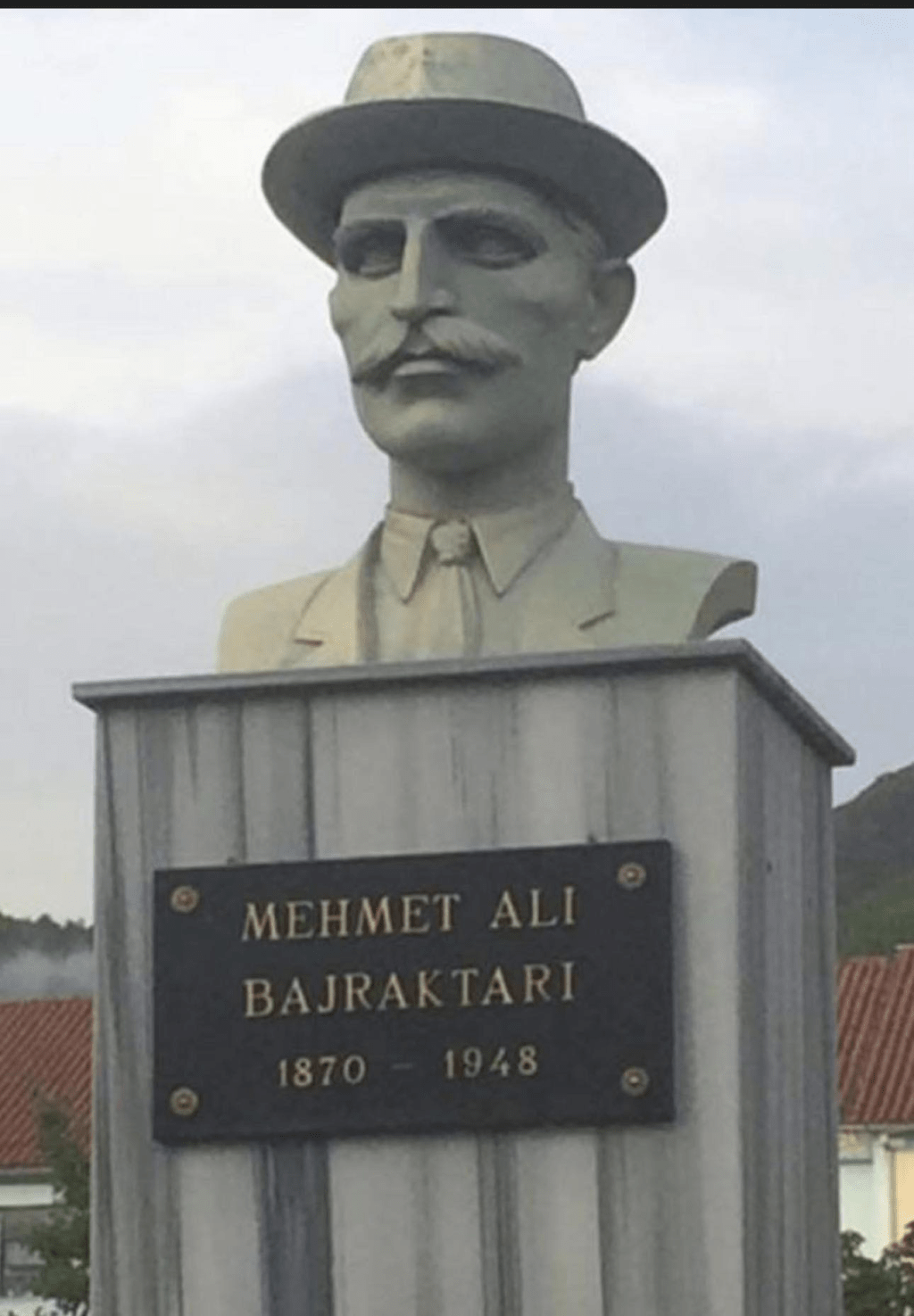
Mehmet Ali Bajraktari of Has remains an important figure of Albanian nationalism, a symbol of resistance and Hasjan pride. Today, his bust stands in Kruma, while in Vlaha the “Rexhë Bajraktari” school operates, named in honor of his predecessor.
Credits: Ervin Mulaj

 Balkan Academia