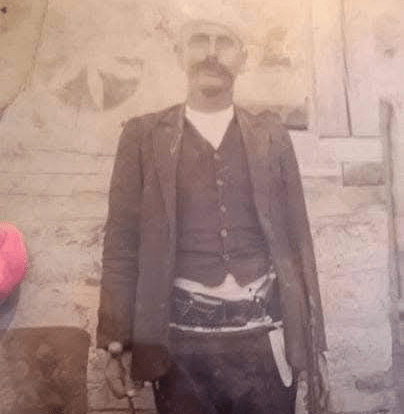

Banush Hoxha (Sedllari) was born in 1880 in the village of Shala in Drenica, in the Municipality of Lipjan — a sacred place for patriots and the cradle of great men who have given much to Kosovo and the national cause. From his youth, Banush demonstrated his fighting spirit, rare courage and unconditional love for the homeland. He did not belong only to the Hoxha family, nor only to Shala — he belonged to all of Kosovo.
In 1910, when the fire of the liberation uprisings swept the Albanian lands, Banush took up arms against the Ottoman Empire in the areas of Carraleva and Kaçanik. He was among the first to go to the front line. His heart beat for the freedom of his people, for the blood of his ancestors, and for a united Albanian future.
After the dissolution of the Ottoman Empire, the threat did not disappear — it took on a new face: the Serbian and then Bulgarian invasion. In defense of the border in Merdar, Banushi fought alongside his brother, Ramadan, who was martyred in that bloody battle. The loss of his brother did not break Banushi — on the contrary, it strengthened his determination to never bow down to the occupiers.
He was at the heart of every struggle for freedom. He was connected to all the Kazakh groups fighting for the liberation of Kosovo and its unification with Albania. He became the right-hand man of major figures such as Shaban Polluzha, Mehmet Gradica, Ahmet Shtimja, Ramë Bllaca, Aziz Zhilivoda, and many others. Throughout his life, he was never separated from his rifle and his ideal.
The people of Shala trusted him with leadership and elected him mayor, a position that Banushi held for more than 20 years with honesty, wisdom and dedication. Under his leadership, it became an invincible fortress against the dark plans of Serbia, which wanted to expel the Albanians from Kosovo to Turkey and replace them with Serbo-Montenegrin settlers. In Upper Drenica, where he had the word and honor, no Serbian settlers were allowed to settle. Not as long as Banushi lived.
But he did not fight only with rifles — he also worked to prepare the new generation. In collaboration with other patriots, he organized the sending of young people to Albania to be educated at military academies, such as Ibrahim Hoxha (his son), Shefqet Bylykbashi, Rifat Berisha and others. He saw the future in the light of knowledge, in the organization of a national liberation army.
His activities shook the foundations of Serbian power. Serbia organized numerous assassinations against these steely men, killing some of them, such as Ahmet Štimja and Ramë Bllaca. Banushi was declared an enemy of the Yugoslav state and an arrest warrant was issued for him. To escape prosecution, he was forced to emigrate to Albania.
But his love for his homeland never faded. After the capitulation of Yugoslavia in World War II, Banushi returned to Shala — to his beloved land. But the communist regime that Serbia installed after the war never forgave him for his resistance and patriotism. He was arrested along with his six sons by the OZNA. After a rigged trial, he was sentenced to death. In 1948, Banushi closed his eyes in the dark prison cells of Niš, in Serbia, far from his family, far from the land that gave birth to him and for which he lived.
His body was not allowed to return to Kosovo. But his name never died.
Banush Hoxha and his son, Ibrahim Hoxha, today rest in the hearts of everyone. In their birthplace, in Shala, a joint tombstone has been erected in their honor — as an eternal memory, as a stone of testimony for future generations, that freedom did not come to us as a gift, but was ground with the blood and labor of men like Banush.
As a sign of gratitude and respect for his glorious life and sublime sacrifice, Banush Hoxha’s name has been placed on several streets in Kosovo, making his name part of the daily life and historical memory of our nation. Those streets are not just names — they are stories of pride that walk with the pace of history.
Banush was and remains one of the most powerful pillars of national resistance. He was the unspoken word of the people in captivity, the rifle that never went out, the pride that did not bend. In every whisper of the wind in Drenica, in every palm of Shala’s land, the footsteps and honor of Banush Hoxha are traced — the eternal pride of the Albanian nation.

 Balkan Academia