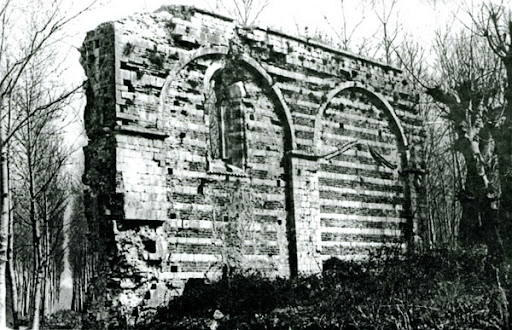

Photo from Robert Elsies articles.
According to a testimony by the Archbishop of Tivat, Marin Bicit, during his visit to Ana i Mali, he encountered an emissary of the Orthodox Patriarch of Peja who had come to Ana i Mali (Anamalit) to collect taxes from the residents of Anamala according to a privilege obtained from the sultan.
Text in translation:
“… A little later we received news that the Sanjakbey of Shkodra, Cascapan, would arrive in Selita that night on his way to his residence in Shkodra. Then we received another message saying that an emissary of the schismatic (Orthodox) Patriarch of Peja had arrived with a group of Turks at the above-mentioned church (in the village of Gorica) across the river with the intention, as usual, of extorting taxes from the priests of the Latin villages.
These taxes, which according to an old tradition approved by the sultans, belonged to the Archbishop of Tivar. These duties consisted of two aspra per family each year, twelve for each marriage, twenty-two for the marriage of a widower and forty-eight for the marriage of a widow, as well as one ‘zecchino’ (medieval gold coin) each year for each church. These emissaries appeared two or three times a year, sometimes, as mentioned, with the patriarch himself.
With the help of the Turks he had with him, he also extorted taxes from the Latins, although the latter are under the sole authority of the archbishops of Tivar.
Reis Sinan, who, as mentioned above, was voivode of Ulcinj and qadi of the surrounding villages, sent some of his men to bring the emissary before us in order to find out by what authority he was extorting taxes from the Latins that did not belong to him, and to take back everything he had taken, and with it to reward Sinam Rais.
When the emissary was brought before him, he produced some imperial patents, by the authority of which he claimed that he had the right to demand taxes since the sultan had authorized his patriarch to do so. When Sinan read the document, he turned to the emissary and asked if he had no higher authority.
When the emissary replied that the patents he had were quite sufficient, Sinam lost his temper and said: “With this patent alone, you have gone about extorting by force before the Latins who have nothing to do with your patriarch, because they are under the authority of the Archbishop of Tivar and not his!”
He then ordered the emissary to be bound and placed under arrest until the Sanjakbey arrived. While the guards were busy carrying out the order and were bringing ropes to tie him up, I said that, since the matter was in my interest, I would be quite pleased if the emissary, unbound, were sent before the Sanjakbey so that the matter could be settled fairly. He should go before the Sanjakbey and show him the patents, explaining his reasons, and I would explain mine.
Sinam and the knight, Musli Bey, accompanied by my nephew, then took the emissary with them and set out for Selita. The few Turks who were still with the emissary abandoned him because they feared that the Sanjakbey might be angry with them. The emissary gave the guards ten thalers, promising to appear in Shkodra the following Sunday to settle the matter in the presence of Isuf Bey.
But he did not appear. Some of my priests, for their part, had gone there to protest that they were being forced to pay such taxes two or three times a year, although they owed nothing to the schismatics, but only to their superior, the Archbishop of Tivar. And although Isuf Bey ordered the emissary to be summoned once more, he did not appear, but tried even more persistently, with the help of his Turks, to collect what he had not yet managed to collect.
This forced me not to demand taxes from anyone because they were already forced to pay them elsewhere. I only took what people gave me voluntarily. I could not do this without accepting it because I was in a difficult financial situation due to of the theft and the many excessive gifts that I was forced to give to the Turks.”…
Source
Report of a Visit to Parts of Turkey, Montenegro, Albania and Serbia (1610). Marino Bizzi.

 Balkan Academia