

These sections are extracted from Grace Harriet Macurdy’s publication from 1915 about the Dardanian war skills.
Abstract
This study analyzes Homeric language and later classical sources to reassess the origins of the Trojan Dardanians and their connection to Europe, particularly the Danubian and Illyrian–Thracian world. It argues that Homer’s limited references to European Dardanians reflect poetic focus rather than ignorance, while linguistic and military epithets in the Iliad preserve implicit evidence of their foreign origin. Special attention is given to the epithet anchimachetai (“close fighters”), applied almost exclusively to Dardanians and Danubian Mysians, and later attested as a characteristic of Central European and Illyrian warfare. Roman historians such as Livy corroborate this tactical tradition. Philological analysis further links the Dardanian epithet to the name Anchises, father of Aeneas, reinforcing the martial identity of the Dardanians. Combined with archaeological and linguistic research, the evidence supports sustained migration from the Danube valley into Asia Minor, the Peloponnese, and Italy, positioning the Dardanians as key mediators between Balkan and Mediterranean worlds.
Dardanian War Skills by Grace Harriet Macurdy in 1915
Cited:
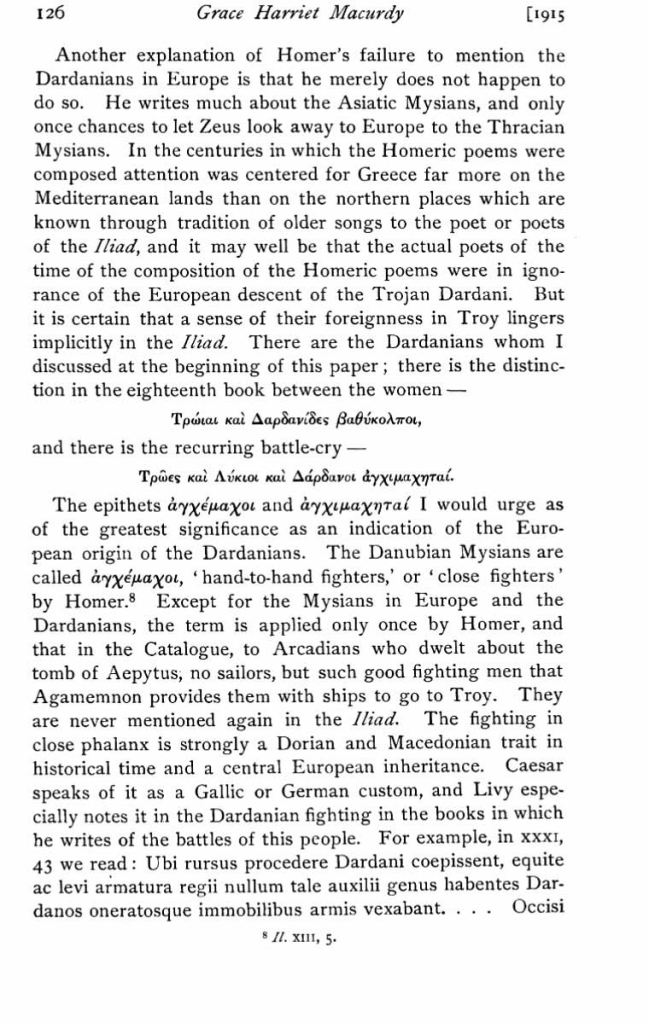
“Another explanation of Homer’s failure to mention the Dardanians in Europe is that he merely does not happen to do so. He writes much about the Asiatic Mysians, and only once chances to let Zeus look away to Europe to the Thracian Mysians.
In the centuries in which the Homeric poems were composed attention was centered for Greece far more on the Mediterranean lands than on the northern places which are known through tradition of older songs to the poet or poets of the Iliad, and it may well be that the actual poets of the time of the composition of the Homeric poems were in igno-rance of the European descent of the Trojan Dardani.
But it is certain that a sense of their foreignness in Troy lingers implicitly in the Iliad. There are the Dardanians whom I discussed at the beginning of this paper; there is the distinc-tion in the eighteenth book between the women:
Trojan and Dardanian deep bays (“Τρώιαι καὶ Δαρδανίδες βαθύκολποι”)
And there is the recurring battle-cry:
Trojans and Lycians and Dardanians, fierce fighters (“Τρῶες καὶ Λύκιοι καὶ Δάρδανοι ἀγχιμαχηταί”)
The epithets ἀγχέμαχοι and ἀγχιμαχηταί I would urge as of the greatest significance as an indication of the Euro-pean origin of the Dardanians. The Danubian Mysians are called ἀγχέμαχοι, ‘hand-to-hand fighters,’ or ‘close fighters’ by Homer. Except for the Mysians in Europe and the Dardanians, the term is applied only once by Homer, and that in the Catalogue, to Arcadians who dwelt about the tomb of Aepytus, no sailors, but such good fighting men that Agamemnon provides them with ships to go to Troy.
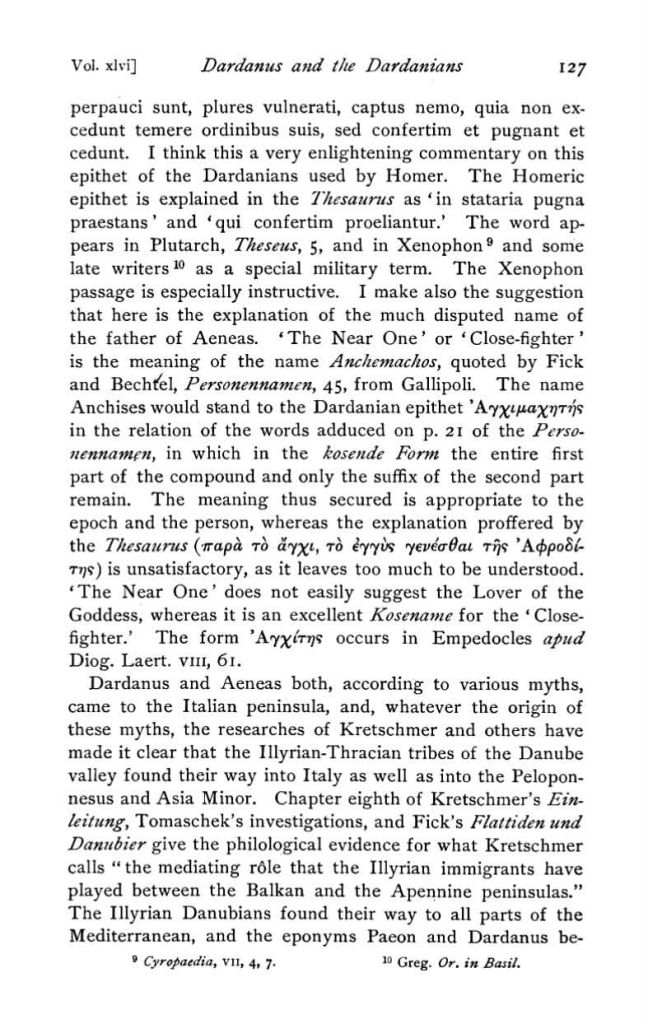
They are never mentioned again in the Iliad. The fighting in close phalanx is strongly a Dorian and Macedonian trait in historical time and a central European inheritance. Caesar speaks of it as a Gallic or German custom, and Livy espe-cially notes it in the Dardanian fighting in the books in which he writes of the battles of this people. For example, in xxXI, 43 we read: Ubi rursus procedere Dardani coepissent, equite ac levi armatura regii nullum tale auxilii genus habentes Dar-danos oneratosque immobilibus armis vexabant. Occisi
Vol. xlvi]
Dardanus and the Dardanians
127
perpauci sunt, plures vulnerati, captus nemo, quia non ex-cedunt temere ordinibus suis, sed confertim et pugnant et cedunt. I think this a very enlightening commentary on this epithet of the Dardanians used by Homer. The Homeric epithet is explained in the Thesaurus as ‘in stataria pugna praestans’ and ‘qui confertim proeliantur.’ The word ap-pears in Plutarch, Theseus, 5, and in Xenophon and some late writers 10 as a special military term. The Xenophon passage is especially instructive. I make also the suggestion that here is the explanation of the much disputed name of the father of Aeneas. ‘The Near One’ or ‘Close-fighter’ is the meaning of the name Anchemachos, quoted by Fick and Bechtel, Personennamen, 45, from Gallipoli. The name Anchises would stand to the Dardanian epithet ᾿Αγχιμαχητής in the relation of the words adduced on p. 21 of the Perso-nennamen, in which in the kosende Form the entire first part of the compound and only the suffix of the second part remain. The meaning thus secured is appropriate to the epoch and the person, whereas the explanation proffered by the Thesaurus (παρὰ τὸ ἄγχι, τὸ ἐγγὺς γενέσθαι τῆς ᾿Αφροδί της) is unsatisfactory, as it leaves too much to be understood. ‘The Near One’ does not easily suggest the Lover of the Goddess, whereas it is an excellent Kosename for the ‘Close-fighter.’ The form ᾿Αγχίτης occurs in Empedocles apud Diog. Laert. VIII, 61.
Dardanus and Aeneas both, according to various myths, came to the Italian peninsula, and, whatever the origin of these myths, the researches of Kretschmer and others have made it clear that the Illyrian-Thracian tribes of the Danube valley found their way into Italy as well as into the Pelopon-nesus and Asia Minor. Chapter eighth of Kretschmer’s Ein-leitung, Tomaschek’s investigations, and Fick’s Flattiden und Danubier give the philological evidence for what Kretschmer calls “the mediating rôle that the Illyrian immigrants have played between the Balkan and the Apennine peninsulas.” The Illyrian Danubians found their way to all parts of the Mediterranean, and the eponyms Paeon and Dardanus …[…]”
Footnotes:
(6) Cohen, Trajan, 338; Hadrian, 1166.
Dec. 29, 1915.
(8) 11. XIII, 5.
(9) Cyropaedia, VII, 4, 7.
(10) Greg. Or. in Basil.
Source
Dardanus and the Dardanians. IX. The Wanderings of Dardanus and the Dardani BY PROFESSOR GRACE HARRIET MACURDY. VASSAR COLLEGE. pp. 126-127.

 Balkan Academia