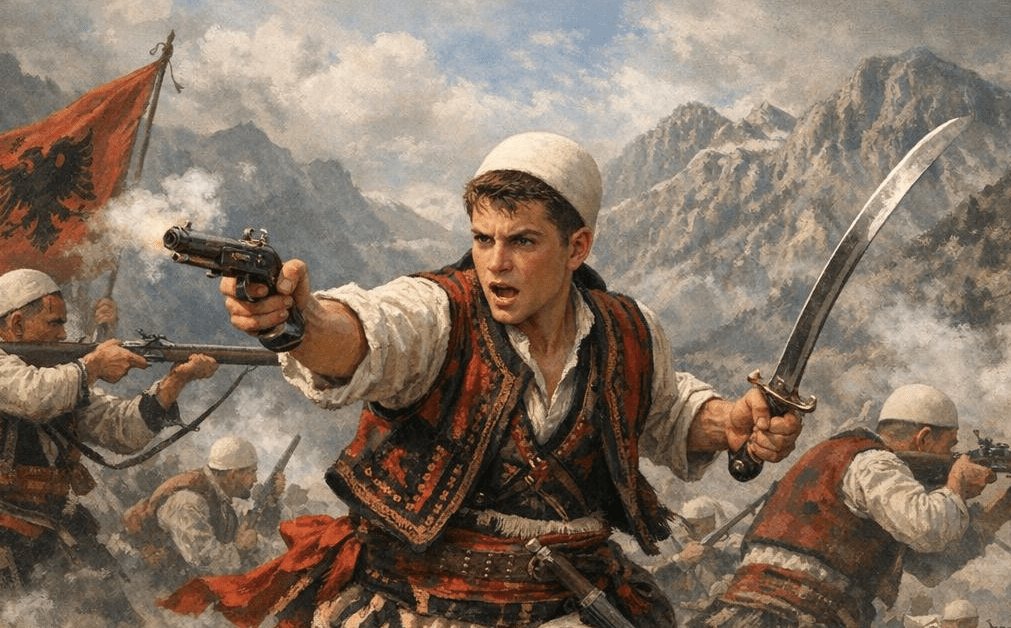

Rexhë Avdia (or Rexh Avdija) was an Albanian patriot from village of Shkrel of Rugova who defended his homeland from Montenegrin invaders at the Battle of Nokshiq in 1879.
According to Albanian folklore, Rexhë Avdia was the grandson of Dem Isufi and is said to have been a fiercely brave man, “having his body gradually become scarred from being cut with the scimitar by the enemies”.
In Shkrel, Rugova, there is a Memorial Center of the Rexhaj family
In Shkrel, Rugova, on Friday, the 133rd anniversary of the Albanian League of Prizren and the 132nd anniversary of the Battle of Nokshiq were marked.
Deeds and heroism
The history of Rugova, although not very long, was full of many great and heroic events. Being located on the border of Montenegro and Kosovo, it was active in every important event. Thus, in the war of Nokshiq in 1879, near Plav, where the great battle against the Montenegrins for Albanian territories took place, the Rugovas participated en masse. Among them, the Rexhë Avdiu of Shkrel and Dem Isufi stood out.
Battle of Nokshiq
According to the Albanian song “Sali Jaha”, dedicated to the fighter Sali Jaha, Rexhë Avdia was killed at the Battle of Nokshiq, and according Albanian folklore, only his blood was visible at the battle field.
Excerpt from Albanian folklore
“Kadri Bajri and Salih Jana, resistance leaders from Koshutani, Istref Mujani and Hajdar Feka from Pepiq, Çel Shabani, Sokol Çela, Istref Salihi from Stankaj, Demë Isufi and Rexhë Avdija from Shkreli, Balë Alija from Haxhaj and many others, most of whom defended the territory and risked the wind in the Congress of Berlin, were sacrificed in the fields and behaved like examples worthy of the Chancellor.”
References
https://www.botasot.info/kosova/122968/kryeministri-thaci-rugova-eshte-emer-i-krenarise-shqiptare/2
Folklor kosovar Volym 1 Av Qemal Haxhihasani, Agron Xhagolli, Instituti i Kulturës Popullore (Akademia e Shkencave e RPS të Shqipërisë). 1985.
Stili dhe figuracioni i poezisë popullore shqiptare. Rrustem Berisha · 1986.
Studime filologjike Volume 34. Edition 3–4. 1980

 Balkan Academia