
Discovery by Artur Vrekaj. Translation Petrit Latifi. Original author: Professor Grace Harriet Macurdy at the Vassar College.
Abstract
This article examines the Danubian river peoples and their role in the prehistoric connections between the Balkans and the Troad, with particular emphasis on the Dardanians. Focusing on religion, metallurgy-based trade routes, and military organization, it explores the movement of Dardanian groups from Europe into Asia Minor, contrary to earlier assumptions of east-to-west migration. Ancient literary sources, including Herodotus, Strabo, Pausanias, and Dionysius, are reassessed alongside modern linguistic and archaeological research. The mythical figure of Dardanus is interpreted as a symbolic projection of collective Dardanian identity, comparable to other culture heroes in the ancient world. Archaeological evidence linking Troy with the middle Danube valley, together with the identification of key nodes such as Naissos (Nish) and the Vardar corridor, supports the existence of a major prehistoric trade route from the Balkans to the Hellespont. The study highlights the cultural and economic unity of the Dardanian world across Europe and the Troad.
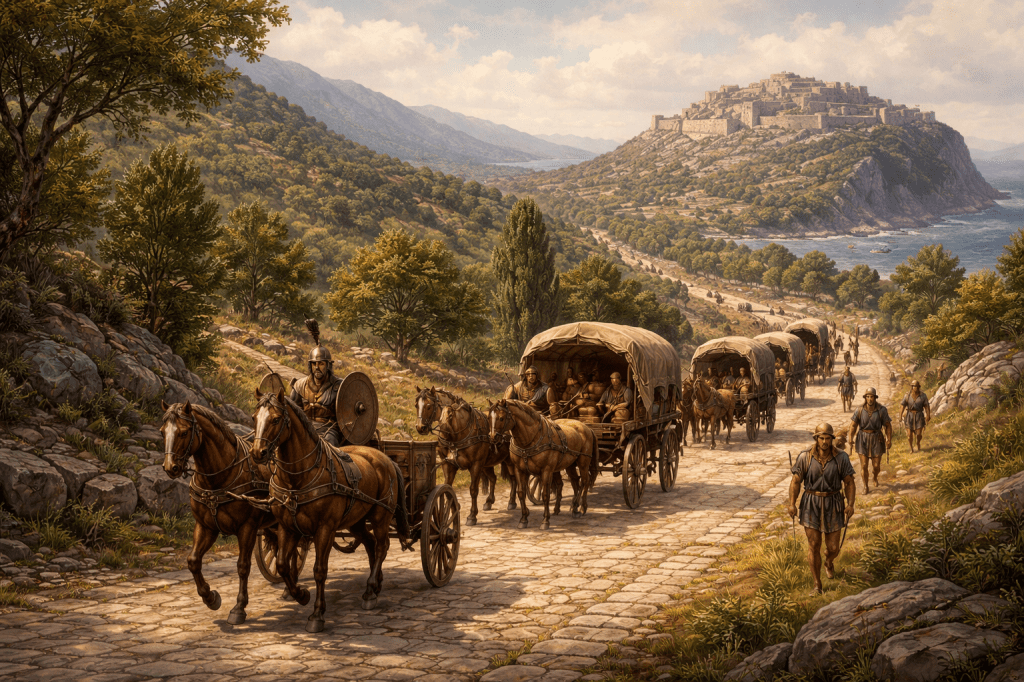
The first horse-drawn highway was between Nish and Troja
Cited:
“In this article I shall discuss only that part of my subject which deals with the Danubian river-folk, the prehistoric trade-route from Servia to Troy, and the Dardanians in the Troad, omitting for the present the Arcadian, Cretan, and Mediterranean traditions. I suggest some points regarding the Dardani in Europe and in the Troad which, I believe, have not yet been brought out in linking the two divisions of this people.
The points which I desire to make in this connection are concerned first with religion, second with the trade-route of the metal-using Balkan peoples, and third with a point of military tactics. I hope to show that the mythical Dardanus was as truly a projection of the community emotion and activities of his people as Orpheus and Dionysus were of Thrace, Achilles and Athena of the Achaeans, and Paeon of the Paeonians.
The tribal movements of the Danubian peoples are men-tioned by Herodotus in several places, and, in particular, in the seventh book ¹ he states that before the Trojan war there was an invasion of Europe by the Mysians and Teucrians, who penetrated as far as the Adriatic after vanquishing all the Thracians. It is recognized by scholars of the present day who have studied the problems of the Danubian connec-tions with Asia Minor, that the movement of the tribes in question was from the opposite direction from that assumed by Herodotus.
The drift from Europe into the Asiatic penin-sula has been established by scholars who treat the subject from the various sides of language, ethnography, and archae-ology. The present mode of stating the matter may be quoted from Dr. Walter Leaf’s Troy, 16 f., or in his recent book on Homer and History. I quote the latter, 72 f.: “The Dardanians who founded the Troy of the Mycenaean age were Protesilaus, the first victim of the war. I do not know whether or not there is any religious significance in this.
The founder of the race of Dardanians in the Troad, according to the account given in the twentieth book, was a son of Zeus who founded Dardania before holy Ilion had been surrounded with walls in the plain. According to the legend preserved in Dionysius, VIII, 461 and Diodorus, v, 48 and elsewhere, he was the son of Zeus and the Atlantid Elec-tra.
It is related that Dardanus was the first to cross the sea by means of boats, and that he was the founder of the city Dardanus on the strait; further, that he learned the mys-teries which already existed on the Holy Island and was the first to initiate strangers and to make the rite famous.
Pausanias (VII, 4, 3) states that the original name of the island known to Homer as Thracian Samos was Dardania. He also tells us in another place (ib. 19, 6) that Dardanus received from Zeus an image of Dionysus in a chest. Strabo and Dionysius both relate that the brothers Dardanus and Iasion, or Iason, came to Samothrace, and that in conse-quence of his sin against Demeter Iasion was consumed by a thunderbolt, after which episode Dardanus left the holy island, and going to the Troad taught the mysteries to those on the mainland.
The connection of Dardanus with Samo-thrace is regarded by Bloch, Thraemer, and others as a relatively late invention without historical foundation. On the philological evidence Fick maintains that the appearance of the name in connection with Samothrace indicates that in the time of the great migrations Dardanians coming from Europe reached the Troad from this island. This view gains substantial support from the archaeological remains, which show such a strong connection between Troy and the middle Danube valley.
“It is probable that the main trade-route left the middle Danube and followed more or less the Roman road from Nish to the Hellespont.” 4 Nish is, of course, the Dardanian Naissos. The Dardanians and their neighbors, the Paeonians, possessed the Vardar river from its head-waters down to the plain at its mouth where Saloniki now stands.
At this moment there is no need to comment on the strategic and commercial importance of this river and its mouth. The words of Homer in praise of the Axios, which have sometimes caused wonder, are intelligible to-day when the nations of Europe have its banks for their battle ground. If, as the pottery, celts, and other prehistoric objects already excavated indicate, there existed an old caravan route, run-ning as far as Aenos and starting from the country of the metal-using Dardanians, it is reasonable to argue that these early immigrants settled in the Thracian islands, which lie on the way to the Troad.
The fact that these islands were so productive of metal would have been the important con-sideration with these men from the north, whose prehistoric working of the mines of Servia can be traced back to neo-lithic times. The importance of the mining industry in old Servia under the Romans is attested by coins of Trajan and Hadrian inscribed Dardanici, and by the procuratores metal-lorum inter Macedoniam, Daciam Mediterraneam, Moesiam seu Dardaniam.
The shining armor of the young prince from the Vardar is described with ardor by Achilles, who stripped it from his body when he slew him. In the twenty-second book, 569 ff., Achilles says, “I will give a breastplate which I stripped from off Asteropaeus of bronze it is, and around its edge a casting of molten tin is rolled.” And again, “I will give a sword silver-studded, a fair thing, made in Thrace, which I took from off Asteropaeus.” Diomed wins this prize and carries away the mighty sword, together with its scabbard and well-wrought baldric.
The fact that the Dardanians in Europe were possessed of the art of metallurgy is of great significance in connection with the religion of Samothrace, Lemnos, Imbros, and Tha-sos, in which islands we find the worship of the Kabeiroi and the mysteries. “Among primitive people metallurgy is an uncanny craft and the smith is half medicine man.” I quote from Miss Harrison in Themis, p. 26. The part that Darda-nus, representative of a people whose contribution to the cul-ture of the new lands to which they had come was, above all … […]”
Footnotes:
(4) Wace and Thompson, Prehistoric Thessaly, 258.
(1) Hdt, VII, 20.
(6) Cohen, Trajan, 338; Hadrian, 1166.
Reference
Dardanus and the Dardanians. IX. The Wanderings of Dardanus and the Dardani BY PROFESSOR GRACE HARRIET MACURDY. VASSAR COLLEGE. pp. 119-122.

 Balkan Academia