
Translation Petrit Latifi
Abstract
This study examines the forced displacement of the Albanian population from Kosovo—particularly the Gjilan (Gnjilane) region—following the Serbian occupation during and after the Balkan Wars of 1912–1913. Drawing on archival documents from the former Federal Secretariat of Foreign Affairs in Belgrade and Albanian historiography, it analyzes state-sponsored violence, colonization policies, and systematic discrimination aimed at altering the region’s ethnic structure. The paper documents large-scale expulsions of Albanians toward Turkey and neighboring territories, the organized settlement of Serbian and Montenegrin colonists, and the unequal legal, economic, and social treatment imposed on the indigenous population. Special attention is given to land confiscations, excessive taxation, religious coercion, and administrative repression as mechanisms of forced migration. The findings demonstrate that these practices constituted a coordinated strategy of demographic engineering, resulting in mass emigration, social devastation, and long-term transformation of Kosovo’s ethnic and agrarian landscape.
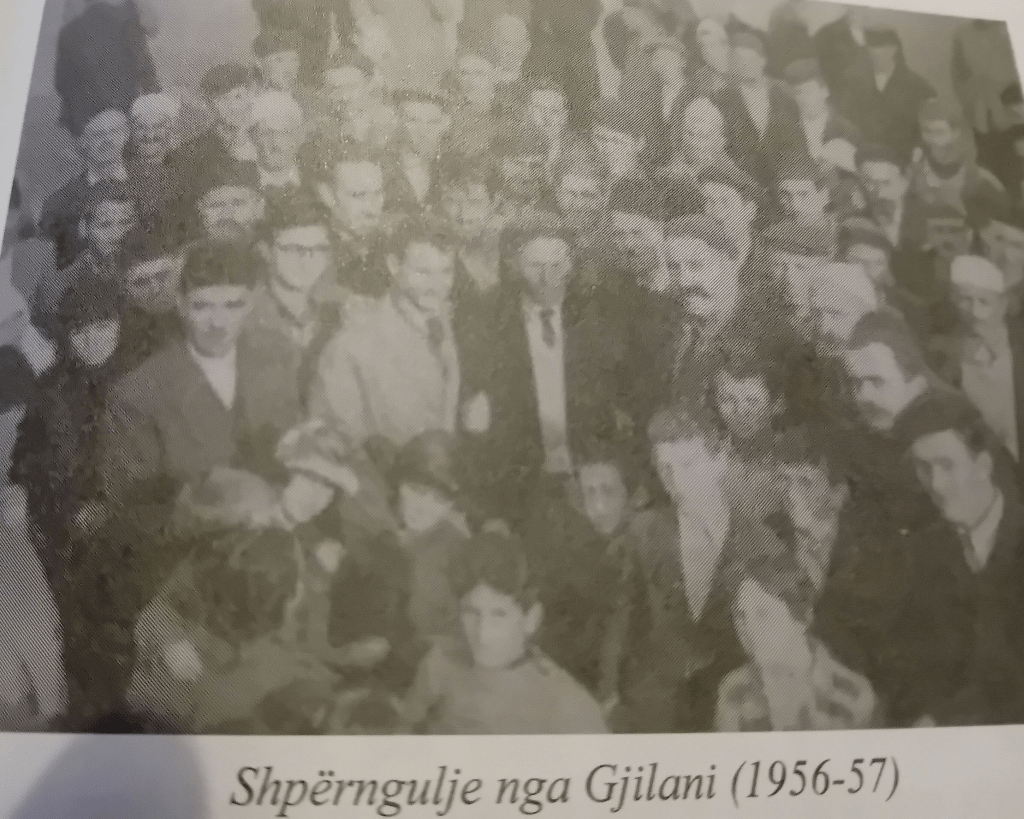
The photo shows Albanians being expelled from Gjilan to Turkey in 1956-57 during Aleksandar Rankovics era of terror.
Enver Sadiku writes:
“The Serbian government, from the first days of their entry into the territories inhabited by Albanians, began violence and terror against the Albanian population, with the ultimate goal of changing the ethnic structure, which would be to the detriment of the Albanians. The violence and cruel killings caused large crowds of the Albanian population to retreat towards Turkey, Macedonia and Albania. The occupation of Kosovo and other Albanian territories was accompanied by numerous displacements of the Albanian population from their native lands.
According to documents found in the former Archive of the Federal Secretariat of Foreign Affairs in Belgrade, in the “Political Department” Fund, number 1246 dated 12.06.1914 from the Consulate General, data is provided on the displacement of Albanians through Thessaloniki to Turkey.
According to this document, 239,807 people were displaced to Turkey alone. This figure does not include children under the age of 6. It is also noted in these documents that 4,000 Muslim families passed through Kavala, but also by land. All of these people are said to have been transported to Turkey by 395 European ships,[1] while according to Albanian historiography, during the First Balkan War alone, around 150,000 Albanians were displaced from various parts of the Kosovo vilayet.[2]
To fill this number of displaced persons, the Serbian governors, after the “liberation” from the Ottomans in 1912, brought many Serbian families from Vraja, Vlasotince, Prokuplje and other cities in Serbia to Gjilan and its surroundings, and many colonist families also came from Lika and Herzegovina, settling mainly in the villages of Upper Morava, and some even settled in the city.
The settlers enjoyed many benefits from the Serbian regime, most of these colonist families received land from the agrarian reform, while another part of them, on their own initiative, from the passive regions of Serbia, came to the fertile plains of Upper and Lower Morava. During the settlement of the settlers, the existential interests of the Albanian villagers were not taken into account at all, and there were cases when the Albanians had everything around their homes taken away, while to enter their homes they had to pass through the property of the settlers.[3]
After the Serbian occupation, in Gjilan, at the end of 1913, the settlement of Serbian and Montenegrin colonist families in the city and its districts began. In Upper Morava, the arrival of Serbs began in 1912.[4]
The Albanian population, which was in the majority, and the Turkish population, which was in the minority, were forced by the arrival of the colonists to move to Turkey and other countries. Gjilan and its surroundings, which had very good quality land for agriculture, was one of the cities in Kosovo in which, since the Serbian occupation in 1912, the process of emigration of Albanians to Turkey has been very pronounced.[5]
There were waves of emigration to Turkey from Gjilan and its surroundings, especially after the Balkan Wars of 1912-1913, and from this time on, an intensive, uninterrupted and often very massive process of emigration motivated by discriminatory Serbian policies began.[6] Gjilan and its surroundings were the part with the largest number of those forcibly displaced from their ethnic lands, as a result of anti-Albanian policies, violence and genocide against the indigenous Albanian people with the aim of Serbizing these lands.
The intensity of this process, during this period, will change depending on the evolution of the political circumstances of the time.[7] According to the data of the Ministry of Internal Affairs of the Serbian Kingdom (1912-1915), in Kosovo it was planned to colonize 20 thousand Serbs in the area occupied by the Serbs and 5 thousand Montenegrins in the area of Kosovo occupied by the Montenegrins.[8]
Migration of Albanians to Turkey
From Upper and Lower Morava immediately in 1912, 54 houses of emigrants migrated to Turkey, while 107 families with 265 members remained in each clan.[9]
The district of Gjilan and especially Upper Morava, due to its fertile soil, but also due to the proximity of the border with Serbia, was attractive to Serbian immigrants. With the arrival of Serbian settlers, who came from different parts of Serbia, the first conflicts began between local Albanians and Serbian and Montenegrin colonists. The installed Serbian government always blamed the Albanians for these conflicts, and used violence against them, which led to the displacement of the local population.
The Serbian government also gave the colonists as much land and mountains as they wanted and wherever they wanted, especially the colonists who settled in Gjilan and its surroundings, who were from Serbian regions, such as Niš, Vrajë, Pqinje, Crna Trava, Pirot, etc.[10]
The Serbian colonists were not only more privileged than the Albanians in every respect, they were also more privileged than the local Serbs. The installed Serbian government, in addition to giving the colonists free land, allowed them to receive assistance through agricultural services, and this money had to be spent only for the construction of houses, auxiliary buildings, for the purchase of livestock, tools and seeds. The settlers also had many rights that the Albanians and the autochthonous Serbs did not enjoy, they had the right to cut down working wood in the mountain of the commune and in the state mountains, for the construction of houses and auxiliary buildings.
These rights of the settlers, the autochthonous Albanians did not enjoy in any field, but on the contrary the Albanians paid taxes on lands, forests, mountains, etc. at triple prices, while the settlers were exempt from taxes on land, on animals for three years and from all municipal and state taxes.[11]
Slavic settlers settled in the following settlements of the municipality of Gjilan: Bresalc, Bukovik, Capar, Gjilan, Livoç i Epërm, Livoç i Poshtëm, Llashticë, Malishevë, Pogragjë, Përlepnicë, Ponesh, Stublinë, Velekincë, Vërbice e Kmetoc, Vrapçiq, Kufcë e Poshtme, Nasalë. Partesh, Dobërçan, Zhegër and other villages.[12]
Under such conditions of open discrimination, life for Albanians had become unbearable and unaffordable, therefore all these actions taken by the Serbian state apparatus and by the settlers caused the migration of residents from various villages of Gjilan and the surrounding area to begin to Turkey. The Serbian government, in order to encourage the largest possible migration of Albanians, used various forms of pressure. In addition to physical violence and persecution, he also used political pressure, not excluding economic pressure and especially that of high land taxes.
Pressure was exerted especially on Albanians who were richer and had a larger amount of arable land, burdening them with unbearable taxes. Using this method of pressure, the Serbian government sought to relocate the richest and most influential people, so that it would later make it easier for those who were poorer. There have been cases when citizens who moved to Turkey were forced to sign documents before leaving that they would give all their land to the “state”, because their relatives had not taken over their land either, due to the inability to pay the taxes that were too high.
Such a practice has been used whenever it has been necessary to relocate Albanians. Given the poor yield of the land, the amount of tax that was unbearable and was collected by force, the population was dissatisfied and their life had become unbearable, so the population sought salvation in moving from their lands.[13]
Another type of pressure on the Albanians was that of changing religion – the forced conversion of Albanian Muslims and Catholics to the Orthodox religion. This was a special form of state terror and genocide, with the ultimate goal of denationalizing the Albanian population and assimilating this population in the occupied territories, as well as moving that population that did not accept the change of religion. Such an attempt was made in the villages of Karadak.
The Serbian invaders had also assigned Slavic names to the Albanian inhabitants, bringing certificates from Belgrade and trying to impose the belief that the Albanians had willingly changed their religion.[14] The Serbian army killed Albanians who insisted on preserving their religion, such as Salih Ajvaz from Terzijaj, who before being killed had told the Serbs: “Salih I have left and Salih I want to go”. The local Serbs also expelled the Albanians who were known as the Muhajirs of Pasjan.[15]
Almost all the villages of Gjilan/Gnjilane emigrated to Turkey. Thus, from Llashtica, the families that emigrated to Turkey in 1913 and later were: the Bektesh family, whose houses were on the outskirts of the village and the Serbian colonists settled in their houses. The same year, the families of Sela and Zenel Murseli also emigrated after they had come into conflict with the Serbs of Budrika. The family of Kadri Murseli was forced to sell three hectares of land and their house and decided to move to Turkey, but temporarily settling in Skopje and with the outbreak of World War I, they returned to Llashtica, now without any property, settling in the house where they had lived before, in which Serbian colonists lived on the second floor. The family of Shaip Shaban Shaqiri suffered the same fate, who sold their property, but did not manage to cross to Turkey. The Dalipi and Shabani families also moved to Turkey.[16]
The plundering of property and land, the violence that was exercised against the population and the impossibility of working the land, made the winter of 1912/1913 very difficult for Gjilan. These areas had been gripped by famine and the population lived a difficult life. Reports from the police inspectorate and other leaders of the Ministry of the Interior, dated January and February 1913, stated that there was a shortage of grain in the Gjilan and Llapi Districts and that corn urgently needed to be sent to alleviate the hunger.[17]
Many people were forced to flee to the mountains, pursued by the authorities, who often took revenge on the population, while mass burnings were justified by the armed resistance that was offered from their homes during the pursuit of the fugitives.[18]
Thus, the horror of the massacres and deaths was increased by the separation and flight to Turkey, as well as the difficult social situation, namely extreme poverty. Albanians, despite all the pressure that was put on them, did not want to be part of the Second Balkan War, although many of them from Gjilan and the surrounding areas were forced to join the war, which was not for the freedom of their people, and many Albanians, to avoid this war and the terror of the Serbian invaders, fled to the mountains, never surrendering and waiting for more favorable days for a new uprising.”
References
(Taken from the book “Gjilan and the surrounding area during the Balkan Wars 1912 – 1913” by the author Enver Sadiku)
[1] Архив Секретарята инистраних Дела у Београду, Фонд Политичко Одељенье, докуменат брой 1246, састављен 12 априла 1914. годе.
[2] History of the Albanian People II…, p. 508.
[3] Obradović, M. 1981. Agrarna reforma i kolonizacija na Kosovo 1918 – 1941. Priština: Institut za Istoriju Kosova, s. 118.
[4] Урошевић, A. 1935. Горја Морава и Изморник, СКА, Насеља и порекло становниства, књ. 28. Belgrade, p. 76-77.
[5] Selmani, A. 2008. The migration of Albanians from Gjilan and its surroundings to Turkey (according to archival documents). Prishtina: Trend, p. 9.
[6] Selmani, A., Migration…, p. 7.
[7] Ibid., p. 9.
[8] “Documents on the Foreign Policy of the Kingdom of Serbia”, K. VII Sv.1 Belgrade 1980, p. 617-618.
[9] Урошевић, A., op. cit., p. 76-77.
[10] Ibishi A. R. and Murseli R. S. 2010. Llashtica through time (monograph). Gjilan: I-Bimi, p. 75 – 76.
[11] Obradović, M., op. cit., p. 27 – 28.
[12] Osmani, J., Venbanimet…, p. 25.
[13] Selmani, A., Shpërngulja…, p. 26.
[14] ASHK, Fondi i Sadullah Brestovci, nr. i inv. 29. (Expedita e Karadakut).
[15] Rrustemi, S., art. i përm., p. 319.
[16] Ibishi A. R. and Murseli, R. S., vep. e përm., p. 70 – 71.
[17] Rushiti, L., Rrethanat…, p. 97.
[18] AIH, Vj. 23 – 30 – 3054, nr. 2316, nr. 80, recte 122, p. 746.
Other sources
Shpërngulja e shqiptarëve nga Gjilani e rrethina në Turqi, Prishtinë, 2008;

 Balkan Academia