
by Artur Vrekaj. Translation Petrit Latfi
Abstract
This study explores the ethnic and cultural origins of Pelops and his descendants through ancient literary testimonies, emphasizing Anatolian, Phrygian (Brygian/Brigian), and Dardanian connections. Classical authors such as Herodotus, Strabo, Apollodorus, and Thucydides consistently associate Pelops and his father Tantalus with Phrygia in Asia Minor, particularly the region around Mount Sipylus. These sources portray Pelops as an Asiatic figure who brought wealth and power to the Peloponnese, giving the region its name and establishing a ruling dynasty. The paper further examines how Pelops’ lineage shaped the royal houses of Mycenae and Sparta through Atreus, Agamemnon, and Menelaus, whose power extended over much of the Greek mainland. The settlement of Dardanian captives from Tenedos at Tenea and intermarriage between Dardanians and Phrygians underline close kinship ties between the protagonists of the Trojan War. This evidence challenges simplified notions of a purely “Greek” Peloponnesus and reframes the Trojan conflict as a struggle among closely related Anatolian and Balkan elites.
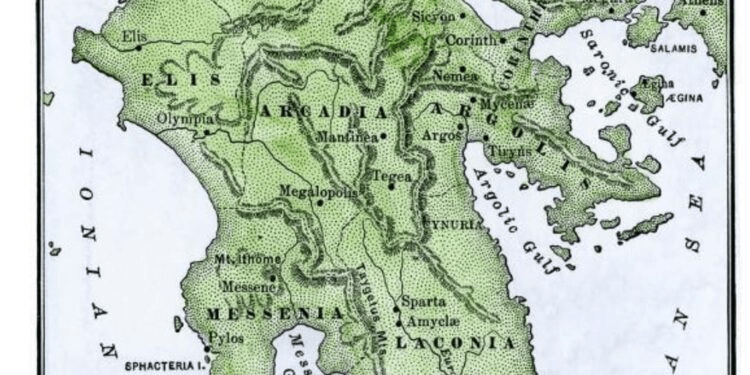
Why the Peloponnese does not have a Greek name
The story begins with Tantalus, the father of Pelops, who is said to have owned a gold mine on Mount Sypulus, in Anatolia, in present-day Turkey. To which tribe, people did Pelops belong according to some ancient authors?
In a testimony according to Herodotus: Xerxes gives this answer to Artabanus when they were discussing how to defeat their opponents:
“If I lead an army against these men, men like Pelops, the Phrygian, (Brigje), who was a slave of my ancestors…” according to Herodotus, book 7, chapter 11.(1)
The other testimony comes from Strabo:
“The boundaries of these territories have been so confused with each other that I have often said that it is uncertain whether the territory around Mount Sypulus, which the ancients call Phrygia, was part of Greater or Lesser Phrygia where the Phrygians, (Brigje) Tantalus, Pelops and Niobe lived.”, according to Strabo, Geography, book twelfth, chapter 4. (2).
“While Pelops is said to have been exiled to the Peloponnesus, it is admitted that Tantalus, although driven from Paphlagonia by Ilus, Phrygian, remained on the eastern side of the Aegean.” a fact which, based on Hittite writings, Mary Elizabeth Cooper brings in the work “Uhha-ziti, king of Arzawa; Tantalus, king of Lydia”.
Apollodorus writes that: “When Pelops reached the ocean, having been driven by Hephaestus, he returned to Pisa, to Elis, and succeeded in taking the kingdom of Oenamus, but not until he had subdued what was called Apia and Pelasgium, which he (Pelopus) called Peloponnesus after his own name.” according to Apollodorus, Library Epitome, translated by J.G.Frazer. (3).
According to Thucydides, “Those Peloponnesians who keep accurate traditions say originally that Pelops increased his power from the great wealth which he brought with him from Asia to a poor country where he was able, although a stranger, to give his name to the Peloponnesus and this great fortune was enjoyed by his descendants after the death of Eurystheus, king of Mycenae who was killed in Attica by the Heracleids.
Atreus, (the son of Pelops) had been banished by his father on account of the murder of Chrysippus.
Eurystheus never returned and the Mycenaeans who were afraid of the Heracleids were ready to receive Atreus, who was considered a powerful man.
Thus, he succeeded in taking the throne of Mycenae and the other possessions of Eurystheus.
The house of Pelops triumphed over that of Perseus. This was, for I believe, because Agamemnon inherited this power although he was able to unite an expedition and the other princes followed him not for good, but out of fear. ” According to Thucydides, History of the Peloponnesian War, book 1, chapter 9, translated by Benjamin Jovett. (4).
Thus, the Peloponnesus has no Greek name.
Atreus and Aerope had children Agamemnon, Menelaus, and Anaxibia.
Menelaus first became king of Sparta with the help of Agamemnon and took Helen as his wife, who was later abducted by the Dardanian princes Paris and Alexander.
Also, in the Peloponnesus were settled the Dardanians, exiled from the war on the island of Tenedos opposite Troy, whom Agamemnon brought as captives to Mycenae. These Dardanians called their new settlement Tenea, who later exiled to Italy.
Mycenae and Sparta were two powerful kingdoms of half-Phrygian blood, whose kings at the time of the Trojan War were descendants of the Dardanian kingdom of Tros and Ilos.
The Dardanian king Priam had for his wife Hecuba from the Phrygian tribe, the Brygians.
The two great tribes in Anatolia, the Dardanians and the Phrygians, the Brygians lived side by side in Illyricum as well.
This evidence of the origin of Pelops and of both the kingdoms of Mycenae and Sparta makes it clearer who fought whom at Troy and what blood ties the opponents of the Dardanians of Troy had with Mycenae and Sparta.
Reference
https://dardaniapress.net/histori/pse-peloponez-nuk-ka-emer-grek/

 Balkan Academia