
Discovered by Armand Alushaj. Translation Petrit Latifi
Summary
Pavle Rovinski emphasizes that the concept of “tribe” does not fit these populations, as the names are territorial rather than genealogical. For example, the Rovci (Upper and Lower) are linked to the Morača valley but consist of small brotherhoods from different regions and periods, totaling 1,800 people compared to Morača’s 5,700. Some old families, called Macure derogatorily, were early settlers in Morača, like the Danilovići, Sjenovići, and Prgomelići. Later migrations included Albanian tribes such as Kuči, Hoti, and Vasojevići. Key brotherhoods in Morača include Radović, Medenice, Dulovići, Rakočević, Dobričani, Peković, and Jeknić, with smaller groups from Nikšić and Ozrinići.
Cited from Pavle Rovinskis work:
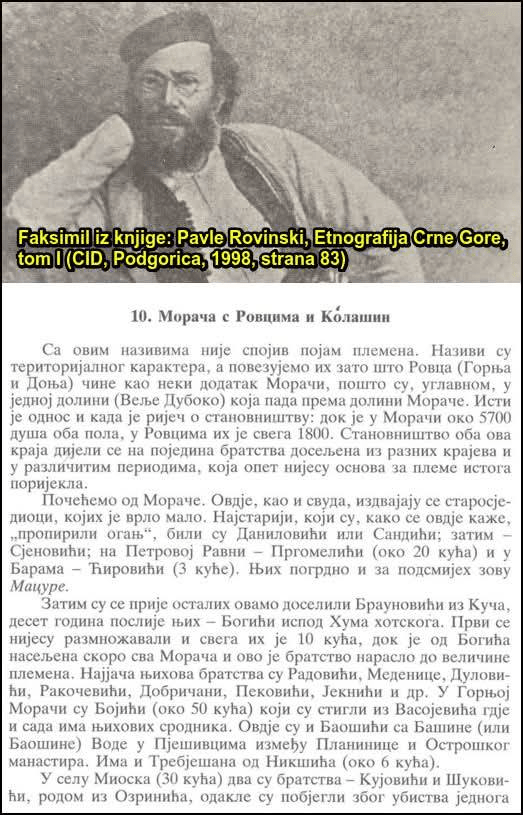
“The concept of tribe is not compatible with these names. The names are territorial in nature, and we connect them because Rovci (Upper and Lower) form a kind of addition to Morača, since they are mostly in one valley (Velje Duboko) that falls towards the Morača valley. The same relationship applies when it comes to population: while Morača has about 5700 souls of both sexes, Rovci has only 1800. The population of both these regions is divided into individual brotherhoods that migrated from different regions and in different periods, which again do not form the basis for a tribe of the same origin.”
The Albanian toponym “Macure” is used to denote the Moraca
“We will start with Morača. Here, as everywhere, the old settlers stand out, and there are very few of them. The oldest, who, as they say here, “stoked the fire”, were the Danilovići or Sandići; then the Sjenovići; on Petrova Ravna the Prgomelići (about 20 houses) and in Bare Ćirovići (3 houses). They are called Macure derogatorily and for fun.”
Albanian tribes of Kuci, Hoti and Vasojevic
“Then, before the others, the Braunovićs from Kuči moved here, ten years after them the Bogićs below Hum Hotski. The first ones did not multiply and there are only 10 houses, while the Bogićs inhabited almost all of Morača and this brotherhood grew to the size of a tribe.”
Their strongest brotherhoods are the Radovićs, Medenices, Dulovi-ći, Rakočevići, Dobričani, Pekovići, Jeknići and others. In Gornja Morača there are the Bojićs (about 50 houses) who arrived from Vasojevići where there are still their relatives. Here are also the Baošićs from Bašina (or Baošina) Voda in Pješivci between Planinica and Ostrog monasteries.
Tribes from Nikshiq
“There are also Trebješani from Nikšić (about 6 houses). In the village of Mioska (30 houses) there are two brotherhoods, Kujovići and Šukovići, originally from Ozrinići, from where they fled because of the murder of one of their brothers.”
Source
Facsimile from the book: Pavle Rovinski, Ethnography of Montenegro, volume I (CID, Podgorica, 1998, page 83)

 Balkan Academia