
Summary
George Finlay explains that modern Greek national dress—particularly the fustanella (kilt)—was adopted under strong Albanian influence. Albanian warriors were admired for their military reputation, bravery, and distinctive attire, which gradually became associated with heroism and resistance. As the prestige of Albanian groups such as the Souliots grew, Greeks adopted their clothing both for practical military reasons and as a symbol of national identity. Over time, this Albanian-derived dress came to be seen as a Greek national costume, representing freedom, resistance to Ottoman rule, and classical aesthetic ideals.
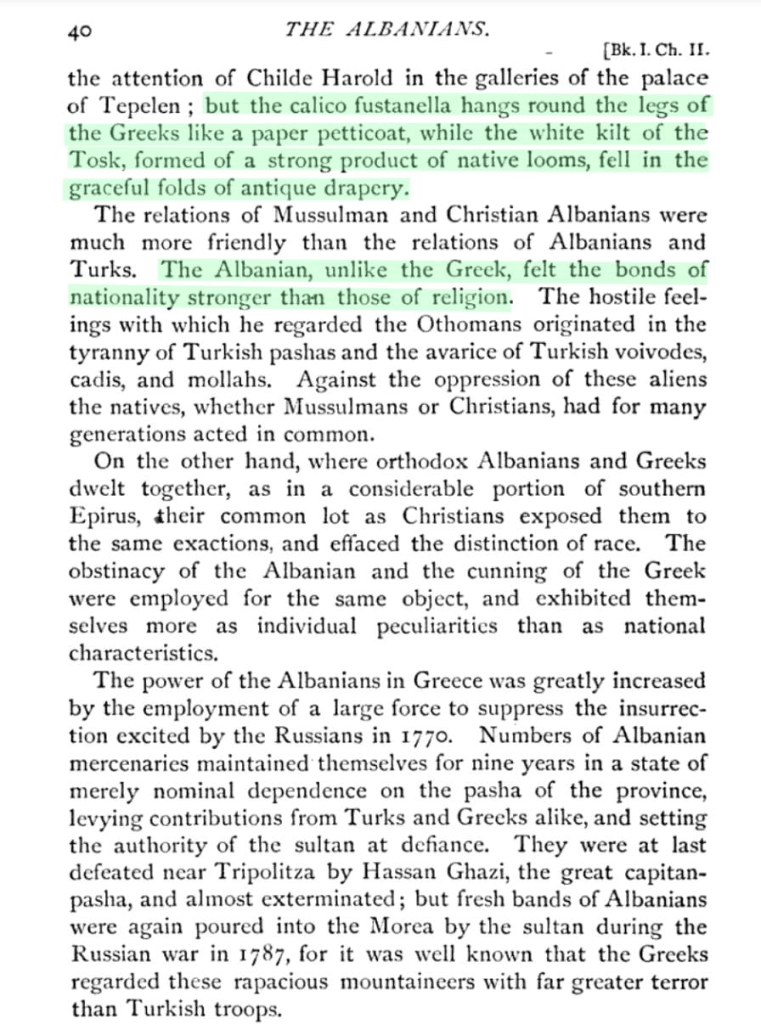
The fame of the Albanians led modern Greeks to adopt the Albanian kilt as a national costume.
The calico garment, hanging around the legs like a paper petticoat, is a kilt made from strong fabric produced on native looms, arranged in graceful folds reminiscent of antique drapery.
It is no longer difficult for me to see my fatherland, both in the West and the East, proudly wearing the Ottoman tunic or the white kilt of the Ottomans. It was, above all, a beautiful and practical military outfit. Greek and Christian soldiers employed as police officers, both in war and in the field, always wore this armor.
However, it was the Greeks—after the military reputation of the Armatols declined and that of the Souliots rose—who led modern Greeks to adopt this tunic and kilt as their national costume.
All in all, it is a beautiful appearance. Note the Childe Harold depiction in the gallery of the King’s palace.
The Greeks, who were among the first to take up arms in the country, formed armed bands that fled Ottoman tyranny, the oppression of Turkish pashas, and the greed of Turkish voivodes.
Source:
The Greek Revolution, Part I, 1821–1827, George Finlay, Clarendon Press, 1877.


 Balkan Academia