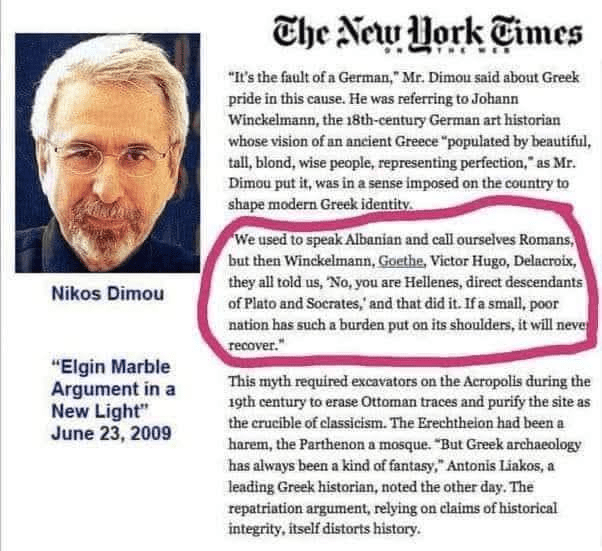

In the article “Elgin Marble Argument in a New Light” from June 23, 2009, Greek writer Nikos Dimou says:
“It’s the fault of a German,” Mr. Dimou said about Greek pride in this cause. He was referring to Johann Winckelmann, the 18th-century German art historian whose vision of an ancient Greece “populated by beautiful, tall, blond, wise people, representing perfection,” as Mr. Dimou put it, was in a sense imposed on the country to shape modern Greek identity.
We used to speak Albanian and call ourselves Romans, but then Winckelmann, Goethe, Victor Hugo, Delacroix, they all told us, ‘No, you are Hellenes, direct descendants of Plato and Socrates,’ and that did it. If a small, poor nation has such a burden put on its shoulders, it will never recover.
This myth required excavators on the Acropolis during the 19th century to erase Ottoman traces and purify the site as the crucible of classicism. The Erechtheion had been a harem, the Parthenon a mosque. “But Greek archaeology has always been a kind of fantasy,” Antonis Liakos, a leading Greek historian, noted the other day. The repatriation argument, relying on claims of historical integrity, itself distorts history.”
Source
“Elgin Marble Argument in a New Light” June 23, 2009. https://www.nytimes.com/2009/06/24/arts/design/24abroad.html

 Balkan Academia