
Author: Erlet Shaqe. Translation Petrit Latifi
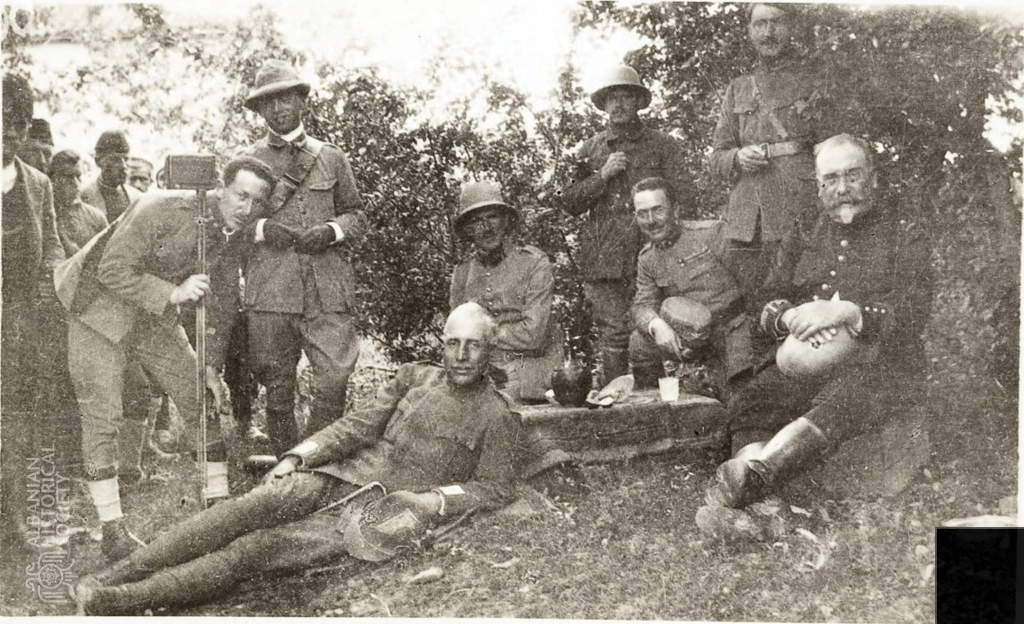
Photo: Border Commission 1922–1926)
Abstract
This study examines the formation of Albania’s borders between 1878 and 1926 as a product of imperial diplomacy rather than organic nation-building. While the Great Powers publicly promoted the principle of ethnolinguistic self-determination, border-making in the Balkans was primarily driven by strategic interests and power politics. From the Congress of Berlin to the final boundary commissions after World War I, international commissions claimed ethnographic neutrality but consistently subordinated linguistic and national realities to geopolitical compromise. Albania emerged not as a fully self-determined nation-state, but as a buffer entity shaped by European rivalries. The Albanian case demonstrates how ethnography and cartography were instrumentalized to legitimize imperial objectives, revealing the limitations of the nation-state model in Southeast Europe.
Introduction
In the late 19th and early 20th centuries, Albania emerged at the intersection of linguistic nationalism and imperialist politics. The formation of Albanian borders was not a product of organic nation-building, but the result of diplomatic engineering by the Great Powers. From the Congress of Berlin (1878) to the final border commission (1926), the demarcation of Albanian borders was managed by five international commissions that claimed ethnographic neutrality but essentially served the opposing interests of European empires.
Albania in the broader context of the transformations of Southeast Europe, highlighting how the rhetoric of “nation-states” based on linguistic identity was constantly subjugated to the politics of great power balance. The Albanian case is a significant example of how European powers used ethnography and cartography as tools for political purposes, while presenting their action as an implementation of the principle of self-determination.
The Albanian Question and the Congress of Berlin
The “Albanian Question” first became an object of international discussion at the Congress of Berlin (1878), when the Great Powers redistributed the territories of the Ottoman Empire. The delegates to this congress denied the existence of an “Albanian nation”, presenting the Albanians as a heterogeneous population divided according to religion, dialects and tribal traditions.
The congress awarded territories with Albanian majorities to Montenegro and Greece, while creating two border commissions to implement these decisions on the ground.These early commissions set a precedent: the demarcation of borders was not guided by ethnolinguistic realities, but by geopolitical trade-offs against Albanian interests.
When Albanian resistance prevented the surrender of some territories (such as Plava and Gucia), the Powers compensated Montenegro with the port of Ulcinj, Antivar, etc. Thus began a tradition where the borders of Albania were formed through diplomatic bargaining, not through linguistic or national criteria.
Ethnography and Diplomacy: The Commissions of 1913–1914
After the declaration of independence in 1912, the Great Powers gathered at the London Conference to determine the borders of the new state. They declared the principle of creating “linguistic borders”, but this principle remained largely declarative.
3.1 Southern Border Commission
The Southern Commission (1913), chaired by British Colonel Charles Doughty-Wylie, was tasked with determining the border between Albania and Greece. Although officially supposed to be based on language as a criterion of nationality, the commission quickly faced the impossibility of applying this principle in a region where the population was bilingual, religiously mixed and with overlapping identities.
Field investigations showed that many communities used mainly Albanian but a smaller part also Greek, Turkish for administration, and that religious affiliation often influenced self-identification. As a result, the commission abandoned the pure linguistic criterion and included economic, geographical and strategic factors.
This was concretized in the Florence Protocol (December 1913), which gave Albania the main cities of Korça and Gjirokastër, while Greece received several Aegean islands as compensation. An attempt was made to make a balanced geopolitical compromise, which ensured British and Italian interests in the Eastern Mediterranean.
3.2 Northern Border Commission
Meanwhile, the Northern Commission (1913–1914), which was supposed to determine the borders with Serbia and Montenegro, failed to reach an agreement due to conflicting interests. Austria-Hungary and Italy defended Albania to prevent the Slavs from reaching the Adriatic, while Russia and France supported Serbian demands.
Before the work began, the borders had been politically predetermined: Serbia kept Kosovo and Novi Pazar, while Albania took Shkodra. The commission turned into a formal process that ratified the existing situation. In the absence of applicable linguistic criteria, the members applied a system of “compensations” – each territorial gain for Albania was accompanied by another for Serbia or Montenegro. World War I finally interrupted the work, leaving the northern border undefined.
The Boundary Commission 1922–1926: Postwar Continuities
After World War I, the principle of self-determination—popularized by Woodrow Wilson—revived the language of ethnographic justice. However, the 1922–1926 commission, tasked with finalizing Albania’s borders, reaffirmed the pre-war lines rather than revising them. The Great Powers—now Britain, France, and Italy—continued to see Albania as a buffer state between Yugoslavia and Greece, not as a nation entitled to territorial unity.
The commission’s linguistic mandate was again overridden by political priorities. Despite formal equality, Italy exerted unequal influence, securing territories in southern Albania as a counterweight to Greek expansion.
The assassination of the Italian delegate, General Enrico Tellini, during fieldwork near the Greek border, and the ensuing Corfu Incident of 1923, illustrated the continuing instability of the Albanian border. When the commission concluded in 1926, Albania’s borders were essentially those drawn in 1913–1914—a testament to the durability of the imperial compromise.
Consequences of Border Decisions
The economic, social, and political consequences of these decisions, which produced long-term consequences:
- Economic fragmentation: The disruption of trade routes between Albanian lands in Epirus by Greece and southern Albania, or Debar and Kosovo, destroyed traditional trade, cultural, ethnographic, and linguistic ties.
- Tribal and nomadic concerns: Tribes and herders lost access to seasonal pastures, separated by new borders.
- Ethnolinguistic divisions: Hundreds of thousands of Albanians remained outside state borders – in Kosovo, Montenegro, Greece and Macedonia – creating tensions that would recur in later decades.
Albania’s Position
Albania during this time presents itself not as a self-determining nation, but as a geopolitical construct—an entity whose existence reflects the intersection of imperialist interests, rather than the culmination of a national awakening. While Albanian leaders sought recognition, the decisive forces remained external. Border commissions acted as instruments of control, translating power politics into cartography under the guise of ethnographic objectivity.
By placing Albania at the nexus of Europe’s competing empires, the moral and methodological failure of the ethno-linguistic nation-state model is revealed. Albania’s borders were justified through the language of science and justice, but in reality they were the result of negotiation, coercion, and diplomatic balancing. This discrepancy between principle and practice makes Albania a paradigmatic case of the limitations of national self-determination in the post-Ottoman Balkans.
Conclusion
The Albanian border commissions showed that the formation of Albania’s borders between 1878 and 1926 was more a product of diplomatic engineering than ethnolinguistic nationalism. The ideals of linguistic and ethnographic justice were constantly subjected to the strategic pressures of the Great Powers. The border commissions served as tools for managing international rivalries, not as instruments of Albanian self-determination.
Thus, the Albanian state was created as an unstable compromise, with incomplete borders and a dependent economy. The decisions of the Great Powers to divide Albanian territories into several states transformed the nation into a fragmented entity, the consequences of which still affect the dynamics of the Balkans. Issues such as that of Kosovo prove that the legacy of the borders of 1913–1926 remains a source of tension and uncertainty.
In conclusion, the Albanian case proves that the political map of nations is not a natural result of language or identity, but a reflection of power, compromise and strategic interest. Albania, in this context, remains a historical symbol of the way in which the ideal of the nation was subjected to European politics with a negative impact on the Albanian people.
References
1. British Documents on the Origins of the War, 1898–1914, 11 vols., ed. G.P. Gooch and H.M.V. Temperley, London, 1926–1938.
2. The National Archives (UK), Foreign Office series: FO 371, FO 421, FO 881, FO 93/1/36 — correspondence, reports, and minutes of the Albanian Boundary Commissions, 1878–1926.
3. U.S. Department of State, Papers Relating to the Foreign Relations of the United States: The Paris Peace Conference, 1919, 13 vols., Washington, D.C., 1942–1947.
4. Ministero degli Affari Esteri (Italy), I Documenti Diplomatici Italiani, Series 7, Vol. II, Rome, 1953–1990.
5. Documents Diplomatiques Français, Troisième Série (1911–1914), Paris, 1929.
6. S. Skendi, “Albanian Political Thought and Revolutionary Activity, 1881–1912,” Südost-Forschungen, 13 (1954): 159–199.
7. S. Skendi, The Albanian National Awakening, 1878–1912, Princeton: Princeton University Press, 1967.
8. G.W. Gawrych, The Crescent and the Eagle: Ottoman Rule, Islam and the Albanians, 1874–1913, London & New York: I.B. Tauris, 2006.
I. Blumi, “Contesting the Edges of the Ottoman Empire: Rethinking Ethnic and Sectarian Boundaries in the Malesore, 1878–1912,” Middle East Studies, 35 (2003): 237–256.
9. W.N. Medlicott, The Congress of Berlin and After: A Diplomatic History of the Near East Settlement, 1878–1880, London: Methuen, 1938.
10. W.L. Langer, European Alliances and Alignments, 1871–1890, 2nd ed., New York: Knopf, 1960.
11. E.C. Helmreich, The Diplomacy of the Balkan Wars, 1912–1913, Cambridge, MA: Harvard University Press, 1938.
12. B. Jelavich and C. Jelavich, The Establishment of the Balkan National States, 1804–1920, Seattle & London: University of Washington Press, 1977.
13. R.J. Crampton, The Hollow Détente: Anglo-German Relations in the Balkans, 1911–1914, London: Athlone Press, 1979.
14. R.J.B. Bosworth, Italy, the Least of the Great Powers: Italian Foreign Policy before the First World War, Cambridge: Cambridge University Press, 1979.
15. A.F. Pribram, Austrian Foreign Policy, 1908–1918, London: Oxford University Press, 1923.
16. A.F. Pribram, Austria–Hungary and Great Britain, 1908–1914, London: Oxford University Press, 1951.
17. Z. Zeman, A Diplomatic History of the First World War, London: Weidenfeld and Nicolson, 1971.
18. H.N. Brailsford, Macedonia: Its Races and Their Future, London: Methuen, 1906.
19. H. Wilkinson, Maps and Politics: A Review of the Ethnographic Cartography of Macedonia, Liverpool: Liverpool University Press, 1951.
20. M. Vickers, Between Serb and Albanian: A History of Kosovo, New York: Columbia University Press, 1998.
21. J. Swire, Albania: The Rise of a Kingdom, London: Williams & Norgate, 1929.

 Balkan Academia