
by Genc Llakaj. Translation Petrit Latifi
Summary
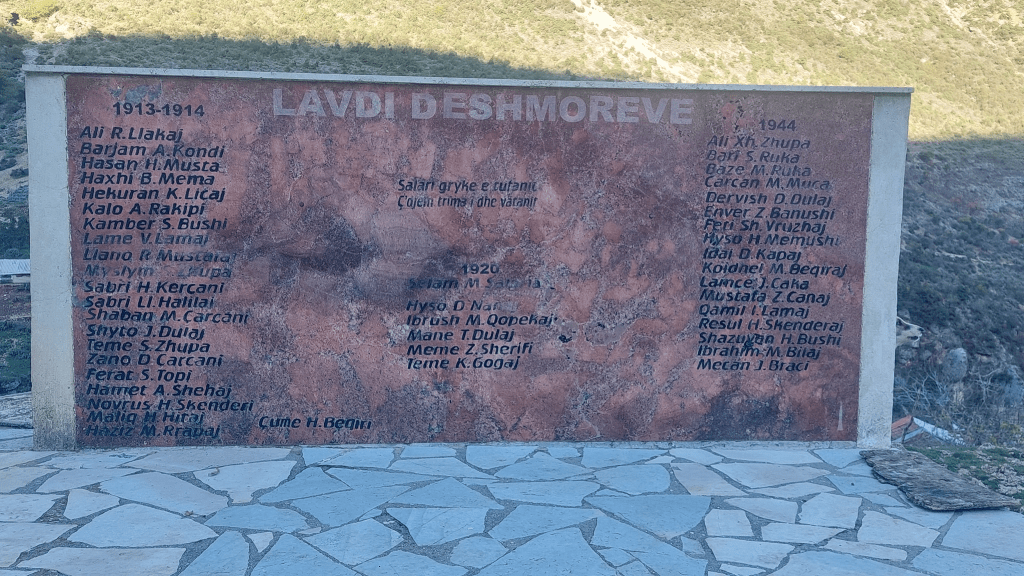
Salaria, a village in Labëria at the foot of Mount Këndrevicë, has a long historical legacy. First mentioned in Ottoman records in 1507 as Istraixh, it later became known as Salari. The village played an active role in regional defense during the early 20th century, including the struggle against Greek Andarts and participation in the Battle of Vlora in 1920 under Selam Musa Salaria. During World War II, Salaria served as a base for partisan detachments, producing 48 martyrs and one recognized national hero. The village also contributed to education and state-building, with figures such as Mustafa Llakaj and Niazi Islam shaping its intellectual and political legacy.
Salaria, located at the foot of Mount Këndrevicë (2,121 m) in the region of Tepelena, is a village with a long history and notable contributions to Albanian social and political life.
I. Origins and early history
Ottoman records mention a settlement called Istraixh in 1507, known for resisting central authority. Later it became known as Salari, and in 1937 it was officially renamed Shpati, though the original name remained in common use. The village has maintained a strong local identity and traditions over centuries.
II. Early 20th-century conflicts
During the period following Albanian independence (1913–1914), Salaria was involved in defending local territory from incursions by Greek Andarts. Local inhabitants participated in the broader regional resistance, including providing shelter to fighters of the Çerçiz Topulli Brigade.
III. The Battle of Vlora (1920)
In June 1920, Salaria contributed fighters to the defense of Vlora, including Selam Musa Salaria, who became recognized for his leadership. Roughly half of his 370 fighters came from Salaria, reflecting the village’s active participation in national defense at the time.
IV. World War II and the National Liberation Movement
During World War II, Salaria served as a refuge and base for partisan detachments in the region. The village lost 48 inhabitants and produced one recognized national hero, reflecting its involvement in anti-fascist efforts.
V. Education and intellectual contributions
Salaria has a tradition of education dating back to the 19th century. Villagers attended schools such as the Zosimea Gymnasium in Ioannina, contributing to the spread of literacy and the Albanian language. Mustafa Llakaj played a central role in establishing the first school in the Albanian language in the village.
VI. Political and civic contributions
In the post-war period, Salaria contributed to Albanian state-building. Notable figures include Niazi Islam, the first Minister of Transport and Telecommunications, and Neki Llakaj, who led local cooperatives and development initiatives. Other politicians from Salaria have continued to represent the village in the Albanian parliament.
VII. Salaria today
Salaria remains a village with preserved traditions, local culture, and historical memory. Residents maintain awareness of the village’s historical contributions, while balancing modern development with cultural heritage.


 Balkan Academia