
Translated and edited by Petrit Latifi
This paper is based on the original study by [Milazim Krasniqi, 2025], which has been translated and edited for clarity. Additional commentary, analysis, and interpretive nuances have been added by the translator/editor to contextualize the findings and highlight their implications in a broader historical perspective.
Abstract
This study aims to present a historically nuanced view of the late 14th-century Balkans, focusing on the Battle of Kosovo and its aftermath. It avoids nationalist myths by acknowledging the complex political and social dynamics of the period: the fragmentation of Serbian power, the limited role of Albanian actors in the battle itself, and the long-standing cultural and religious pressures on Albanian populations under Serbian rule. The analysis does not seek to glorify or diminish any group, but rather to provide a factual, evidence-based perspective that highlights the interplay of power, religion, and identity in a turbulent historical context.
Background: Albanian communities in the late medieval Balkans experienced cultural and political pressure under Serbian rule, including religious and administrative integration. The Ottoman expansion (14th-15th centuries) interrupted these processes and reshaped the region.
Method: This study examines chronicles, archival documents, and previous scholarship from Serbian, Albanian, and Ottoman sources.
Analysis: The Ottoman arrival ended ongoing Slavicization efforts, introducing administrative flexibility and religious tolerance, allowing Albanians to preserve their identity. Political rivalries among Serbian lords limited local resistance.
Myths in the discussion of the Battle of Kosovo
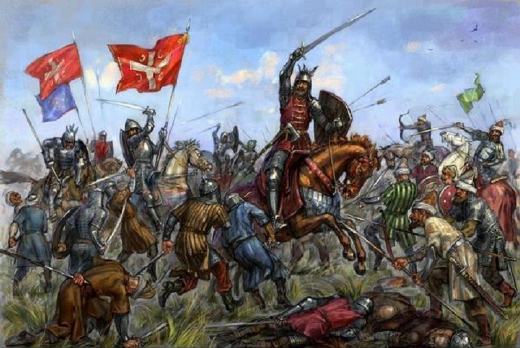
In the context of this bitter reality of relations between Albanians and Serbs in the 11th-14th centuries, even as regards the culminating event, the Battle of Kosovo in 1389, as an event that begins the fall of Serbian rule and begins the installation of Ottoman rule, it is not possible to understand how Albanians and Serbs can have the same approach.
According to Serbian mythology, the blood of Tsar Lazar, who “sanctified the Serbian land of Kosovo”, is blood that symbolizes the Serbness of Kosovo and the permanent presence of Serbia in Kosovo. They say that Tsar Lazarus lost earthly power, but gained heavenly power. This mythology is a product of the Serbian Orthodox Church and Serbian Orthodox nationalism.
From the Albanian point of view, that battle or its role should be viewed critically. Therefore, when Albanians talk about the arrival of the Ottomans in the Balkans, in this case they should talk about their arrival in the territories that were ruled by the Serbs.
More precisely, these territories had been conquered by Lazar Hrebellanović (the eastern part of Kosovo with Novo Brdo as its center), by Vuk Branković (with Prishtina as its center) and by Toma Prelubović (the latter in Epirus). They were rulers of the remnants of the Serbian dynasty, which began to fragment after the death of Uroš in the Battle of Maritsa (1371), which ended the Nemanjic legacy.
It is important to note that when the Ottomans entered the Balkans, there was no unified Albanian state or kingdom. Various Albanian communities and feudal lords maintained local autonomy, although some regions had come under the political influence of Serbian rulers. These communities were subject to Orthodox Church administration and political pressures, but largely retained their language, culture, and distinct identity. Ottoman rule subsequently reshaped the political and religious landscape, providing new opportunities for local Albanian elites while halting the expansion of Serbian influence in the region.
So what is the truth about the Battle of Kosovo?
The coalition for the Battle of Kosovo was reached between Lazar Hrebelanović and the King of Bosnia, Tvrtko, who had previously reached an agreement on the division of Dušan’s state, which had begun to crumble. That negotiated division of Dušan’s inheritance into two large units kept them bound by their interests in protecting their rule and eliminating other claimants to the Serbian imperial throne. Another claimant to Dušan’s inheritance was Kraljević Marku, the son of King Vukašin, who ruled in Prilep and who in the Battle of Kosovo was on the side of the Ottoman army.
Kraljević Marku’s alignment on the side of the Ottomans has serious implications for the character of that battle. First, it shows that it was not a battle between a Christian coalition and a Muslim one, since Kraljević Marku’s alignment on the side of the Ottoman forces refutes this claim.
The Serbian lords were trying to seize territories
So, the rivalry was also among the Serbs themselves, who were competing and trying to seize as much territory and power as possible on the ruins of Dušan’s former state. King Vukašin, for his part, and his son, Kraljević Marku, claimed to be the legitimate heirs of the Serbian imperial state.
During the reign of Tsar Dušan, Vukašin was appointed by him as secretary of state and by will was appointed advisor to Uroš, Dušan’s son. (Giuseppe Gelcich, Zeta and the Ballšaj Dynasty, Publishing House 55, Tirana, 2009, p. 84) The death of King Vukašin and King Uroš at the Battle of Maritsa in 1371 represents the most tragic event of the Serbs, and if any event from that period should be remembered, it is precisely the Battle of Maritsa, which paved the way for the Ottoman march.
After the defeat at Maritsa, most Serbian rulers accepted vassalage to Ottoman rule, among them King Vukašin’s son, Kraljević Marku. As a vassal, he also participated in the Battle of Kosovo on the side of the Ottomans, although his reasons may have been deeper than the obligation imposed by vassalage. Kraljevic Marku may have had the idea that after the defeat of Lazar and Tvrtko, he would extend his rule over their territories and return the territories that the Ballshaj had taken from him, just a few years earlier.
If this could be documented with documentary data, then it would result that the Battle of Kosovo also had elements of civil war among the Serbs themselves. Serbian epic songs emphasize the element of betrayal, of Vuk Branković, (who was Lazar’s son-in-law), which in a way creates the idea of an intra-Serbian conspiracy. Right, a few years before the Battle of Kosovo, King Vukašin marched against Lazar and his son-in-law, Vuk Branković, taking part of the territories. (Gelqiq: 84)
In fact, the divisions and conflicts between Vukashin, Lazar and Vuk Brakovic, supplemented by the actions of Nicolo D’ Altomano, Vojnov’s successor, facilitated the Ottoman advance. Therefore, rather than being a unified coalition, they have the epithet of divided rivals who played tricks on each other.
Even the fact that immediately after the Battle, the heirs of Lazar’s rule accepted vassalage to the Ottomans and made a quick alliance with them, giving Sultan Bayezid’s daughter Mileva as his wife, is an indication of that passion for maintaining power at all costs.
An important element related to the Battle of Kosovo is the abstention of the two most powerful Albanian rulers of that time, Karl Topia and Gjergj Balsha I. Their non-participation in the coalition has within itself two motives, the ethnic and the religious motive. The ethnic motive has to do with their efforts to consolidate and strengthen themselves, after the beginning of the collapse of Dushan’s Serbian empire, which had taken the breath away from the Albanians.
Gjergj Ballsha I’s victory against Kralević Marku and his capture of Prizren, had also caused ethnic friction in the territories involved in that conflict. On the other hand, “The Ballshajs had embraced the Catholic religion in 1369” (Gelqiq:105) which had its own implications, at least psychological in relation to Serbian Orthodoxy. Also, Karl Topia was Catholic and had special ties to Venice, which also had its implications in the attitude towards the Serbian coalition.
Of even greater importance in this context is the abstention from the coalition between Tvrtko and Lazar and their allies, who held the two most powerful Catholic states of that time, Hungary and Venice. Neither one nor the other helped the coalition. This attitude also makes it clear that there can be no question of a conflict between religions and civilizations, because the non-participation of the Catholic states of the time excludes the religious motivation of that battle.
The Battle of Kosovo was not a Christian alliance
The Serbian state or Serbian states at that time were weakened and were not leaders of the Christian world. On the contrary, Hungary and Venice had the primacy of the leading states of Christianity, therefore without their participation in a coalition, it has no possibility of being called a Christian coalition. Ragusa, also an important entity of the Catholic province, did not participate in the coalition, nor did Kotor or any other coastal municipality.
The presence of the Ragusans was visible in the cities of the Balkan peninsula at that time, but they were reserved from any implication on the side of the Serbian coalition. In fact, a very significant gesture of theirs from a religious aspect is recorded: when Gjergj Balsha I defeated and took Prizren from Kralević Marko, the Ragusans who lived in that city welcomed him with valuable gifts.
Few catholics fought alongside the Serbs in the Battle of Kosovo
Meanwhile, on the day of the Battle of Kosovo, the ruler of Zeta, Gjergj Strazimir Ballsha II, “on the fateful day of the Battle of Kosovo, was precisely in Ulqin”. (Gelcich:170) The entire Catholic world of that time abstained from that battle, leaving the Orthodox Serbs and their vassals to fend for themselves in confrontation not only with the Ottomans but also with their own renegades, such as the work of Kraljevic Mark. The absence of Catholic states and entities of that time inevitably makes that battle less important for the peoples of the region and even for Europe.
Finally, the non-participation of the two dynasties with Albanian elements, the Ballshajs and the Topiajs in that coalition, shows the de facto non-participation of the Albanians. The participation of the Albanians in the ranks of Vuk Branković’s army was the participation of the subjugated, who were forced to fight under the command of their imposed ruler.
Some other participants, such as Dhimitër Jonima, were small feudal lords without any element of state subjectivity, which at that time, as far as it existed, was under the authority of the Ballshajs and the Topiajs.
If we look at the consequences after the Battle of Kosovo, the picture seems even more surprising: Lazar’s daughter, Mileva became the wife of Sultan Bayezid, Lazar’s daughter, Mara was the wife of Vuk Branković, while Helena, also a daughter of Lazar, was the wife of Gjergji II of the Ballshajs.
This marriage bond between them and the sultan, excludes national and religious pride from the behavior of the Serbs, who, having secured vassalage from the Ottomans, showed themselves to be very enthusiastic and loyal to Sultan Bayezid. Lazar’s two sons, Stefan and Velko, fought loyally on the side of Sultan Bayezid, until he was defeated in the Battle of Ankara on July 28, 1402.
The consequences of the Battle of Kosovo for Albanians who had been under Serbian rule
After the dismantling of Serbian rule, which began in 1389, the process of Slavization of Albanians was interrupted and a large part of them began to convert to Islam. “What must be understood well from this cursory outline of Muslim-Ottoman law is that Ottoman law was not centralized for the entire territory, but was in practice, a separate territorial law, since the religion, profession, place of residence, social status and sex of each individual determined the law to which they were subject.” (Sugar:19)
The early conversion of Albanians to Islam was primarily motivated as an escape from the violent authority of the Serbian and Greek Orthodox Churches. Since the Serbian Church had gained autonomy in 1219, its authority also included the Orthodox Albanians who had been under Serbian rule since at least 1196.
Otherwise, Ottoman rule did not provoke any pressure on the Serbian Orthodox Church, much less on the Greek Orthodox Church, which would force their believers to convert to Islam. On the contrary, tolerance towards the Orthodox Church was very great. “The new powers granted to the Orthodox Church by Mehmed II made it a state within a state.
Over time, the hierarchs began to consider themselves the de facto rulers and protectors of Christians and at the same time the only body to confront the central government. The Church performed these tasks with great skill. The life of the Christian peoples of the Balkans depended as much on the efficiency of the ecclesiastical authorities as on the Ottoman ones.
This explains the fact that the various differences between them, such as that with the metropolitans of Ohrid and Peja, developed on a large scale within the church. (Sugar:57) Although the Orthodox Church was practically a state within a state, the Albanians in large numbers abandoned it. The reason was simple: since they had not managed to have a church of their own, they largely accepted Islam, in their efforts to preserve their ethnic affiliation, avoiding ethnic assimilation into Serbs, which was imposed through conversion in Orthodoxy.
“Thus the “nation” or Greek millet would now be represented and governed by the Patriarchate of Istanbul. Disputes among the Greeks would be resolved by Orthodox courts. Finally, the free exercise of religious activity was allowed. In fact, this status corresponded to the situation that Christian communities usually had in Muslim countries, but the establishment of this situation at the state level and the recognition of the importance of the Patriarchate constituted a significant event.” (Mantrani: 93)
It is clear that the great authority of the Greek church and later of the Serbian church, remained with a devouring power over the Albanians, therefore their conversion to Islam was more an escape from that devouring policy than a consequence of any conversion policy of the Ottomans. If the Ottomans had coherent policies of religious conversion of the ruled, they would have been directed at other peoples and not only Albanians.
The truth is that those Albanians who remained under the umbrella of the Serbian Orthodox Church, over time, were assimilated into Serbs.
On the other hand, through ethnic compaction motivated by the clear separation of Serbs and Greeks, the growth of the Albanian population during the period of Ottoman rule is evident, as is the territorial expansion, which managed to encompass all of coastal Albania, northern Greece, present-day Macedonia and present-day Kosovo, as well as present-day Serbia, up to the vicinity of Belgrade.
This was in in fact a demographic expansion of the Albanians, the first and only in their history, after the tragic contraction of the Illyrians. If the Albanians had not been deprived of their territories in which they lived during the period of Ottoman rule by the Great European Powers at the Congress of Berlin and if the occupation of Albanian territories by neighboring states after the Balkan Wars and after World War I had not been justified, which provoked the tragic exodus of Albanians towards Turkey, the Albanian national state could have been territorially several times larger than and how much is Albania today and the Albanian nation itself would be numerically several times larger than it is today.
Finally, we can conclude that the Albanians entered the 14th century under the Ottoman Empire as a conquered people, defactored, in a process of ethnic and religious assimilation by the Serbs, while at the beginning of the 20th century, when they emerged from the Ottoman Empire, they were a consolidated nation, capable of fighting for their national state, in a very hostile Balkan and European encirclement.
Sources and references
La Zedda e la dinastia dei Balšidi; studi storici documentati — Giuseppe Gelcich. (1899)
Tom Papademetriou, Render Unto the Sultan: Power, Authority, and the Greek Orthodox Church in the Early Ottoman Centuries (Oxford University Press)
History of the Eastern Orthodox Church under the Ottoman Empire (Britannica)
Peter F. Sugar – Southeastern Europe under Ottoman Rule, 1354-1804
Robert Mantran (red.) – Histoire de l’Empire ottoman
Render unto the Sultan: Power, Authority, and the Greek Orthodox Church in the Early Ottoman Centuries – Tom Papademetriou


 Balkan Academia