
by Qelë Qelaj. Translation Petrit Latifi.
Summary
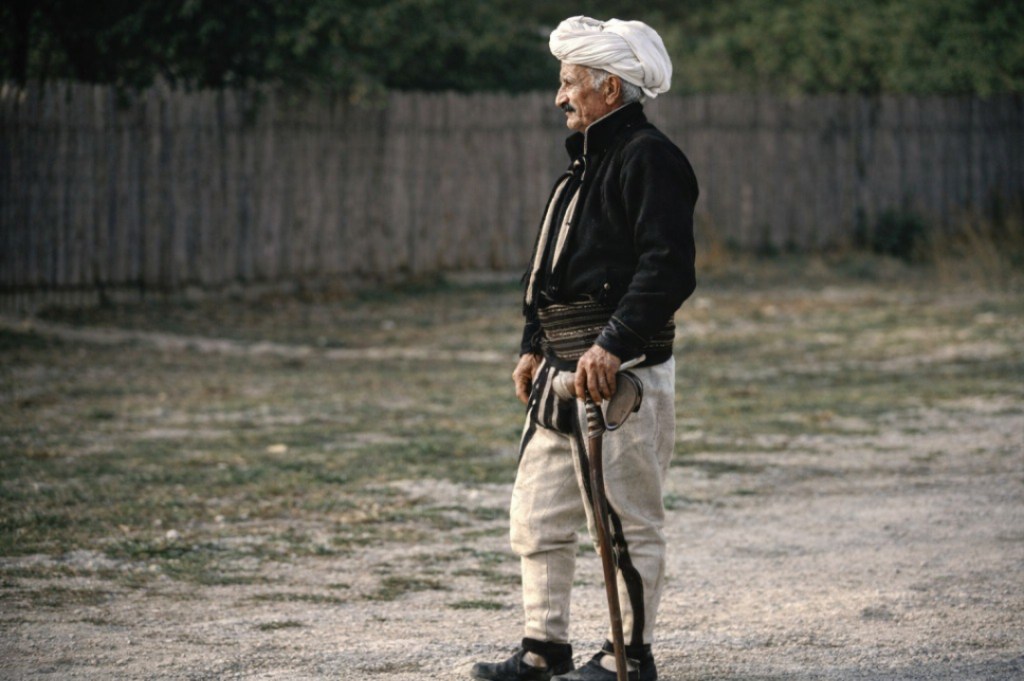
Zhukë Haxhia (1885–1947) was a prominent Albanian fighter from Rugova who dedicated his life to national resistance. Descended from a renowned patriotic family active since the Albanian League of Prizren (1878), he distinguished himself through bravery and leadership in battles against Montenegrin forces in Luma, Berane, and Mokna. Widely respected, he served as mayor of Rugova from 1930 to 1935. After World War I, he remained a key insurgent leader until communist rule tightened repression. In 1947, to save Rugova’s population, he surrendered, was imprisoned, sentenced harshly, and had all his property confiscated.
Zhukë Haxhia
Zhukë Haxhia was a fighter from the first hours in all stages of our national resistance. He was a distinguished fighter and a worthy descendant of his family, known in the villages of Rugova, since the Albanian League of Prizren in 1878. Since his youth, he was distinguished for his wisdom and bravery, qualities inherited from his father Haxhi Çela and his uncle Sokol Çela, as well as from his grandfather Çelë Shabani. His grandfather – Çelë Shabani was a participant in the League of Prizren, while his father Haxhi Çela was one of the leaders of the National Resistance of his time in Rugova.
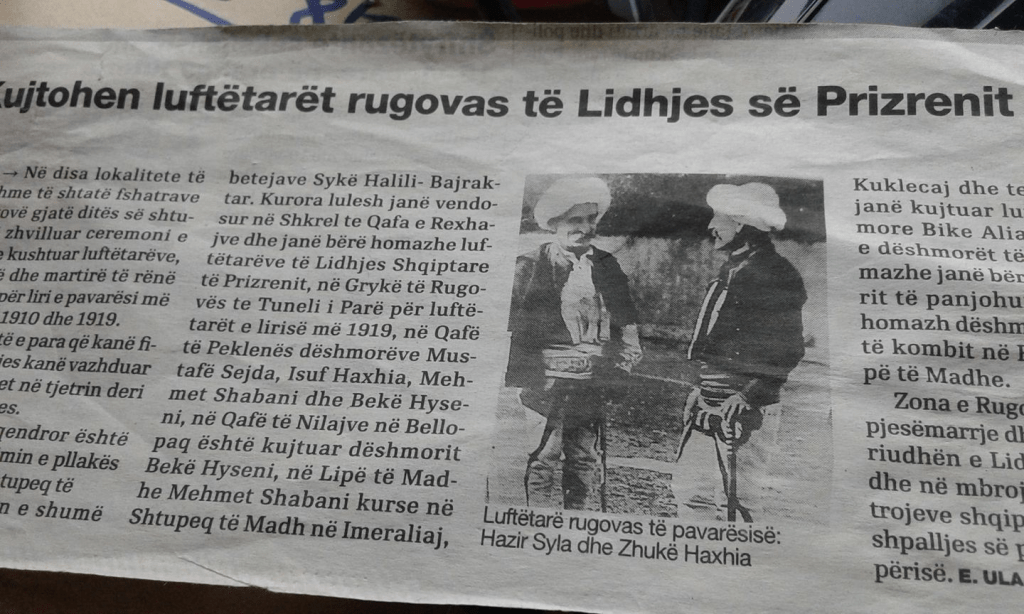
Hazir Syla (left) and Zhukë Haxhia in an Albanian newspaper.
Zhuka was born in the village of Stakaj in Rugova in 1885. Imbued with national ideas by his ancestors, who left an indelible mark on the history of the defense of Rugova and other Albanian lands since 1907. Zhukë Haxhia distinguished himself and became known for his political and military activity, becoming one of the most authentic figures of Kosovo and the Dukagjini plain.
He participated in the wars that took place in Maje i Luma against the Montenegrins, in which war he was wounded, as well as in other wars that took place against the Montenegrins in Berane in 1910 and in the war of Mokna.
Zhukë Haxhia was among the most distinguished fighters not only in Rugova, but also beyond. Due to the great authority he enjoyed in these parts, in 1930 the people of Rugova elected him their mayor in Rugova, a position he held for 5 years. The path of his grandfather, Çelë Shabani, was followed by his sons Sokol and Haxhi Çela, as well as their successor Zhukë Haxhia.
His grandfather Çelë Shabani was a renowned warrior and leader, a participant in the Albanian League of Prizren, 1878, who in the war of Nokşiç, where he was also a commander together with Jakup Feri, fell heroically on the field of honor. His grandson Zhukë Haxhia also followed this path.
In 1911 Zhuka participated in the War of Berani. In 1912 he participated in the War of Mokna. From 1918-1924 he was among the most distinguished warriors of Rugova. After the evacuation of the inhabitants of Rugova, Zhukë Haxhia also stayed in Junik (since it was neutral), in Albania and other areas.
Zhukë Haxhia and other fighters of Rugova during his passage to Albania were prepared a trap in the mountains of Tropoja, which led to an exchange of fire between the nationalist forces and those of Albania.
The establishment of the Slavic communist order in Kosovo narrowed the circle of action of the fighters of ethnic Albania.
Now they were pursued more and on 25.01.1947, after the place of refuge of the insurgents group of Zhukë Haxhia and Sali Rama, who were in Prevarë e Malajve, was discovered, realizing that the regime in power would massacre all the inhabitants of Rugova, since such preparations had been made by the Slavic communists, Zhukë Haxhia and his fighters surrendered to save the people of Rugova.
Even though they knew that they would be killed or imprisoned, this group, which consisted of Zhukë Haxhia, Sali Rama, Bekë Rexhepi and many other brave men, surrendered to the Serbian-Montenegrin regime.
After the arrest, Zhukë was sent to the prison in Pristina and was sentenced to death and then 20 years in prison. The presiding judge was a Serb named Stanković, while the prosecutor was the well-known Albanian traitor Ali Shukriu. He served his sentence in the notorious prisons of Goli Otok and Niš.
Zhukë Haxhia was sentenced together with the well-known fighters of our ethnic guards, with Ukë Sadiku, Ajet Gërguri, Ilmi Zatriq, Gjon Serreçi and Shaban Binaku. While Zhukë had remained in the mountains at the head of the insurgent forces, his family was also interned and kept in the prison of Gjilan for a long time. Zhukë Haxhië, after his conviction, had all his property confiscated and distributed to other Serbo-Montenegrin and Roma settlers.
Old photograph improved with AI.
Sources


 Balkan Academia