
Abstract
This paper presents the life and patriotic legacy of Zhuj Vesel Lajçi-Nilaj (1898–1999), a prominent Albanian nationalist from Shtupeq i Vogël in Rugova. Orphaned early after his father’s murder by Serbian forces, Zhuj grew up under Serbian occupation and became actively involved in armed and political resistance during World War II as a member of the “Volunteers” group, defending Rugova from Serbian-Montenegrin incursions. Arrested by the Yugoslav UDB in 1954, he was sentenced to life imprisonment and endured a decade in the notorious prisons of Niš and Idrizovo. Despite persecution, he remained committed to the national cause, educating younger generations in resistance. His life ended tragically in 1999, when Serbian forces murdered him and three of his sons during the Kosovo War, marking him as both a survivor and a martyr of Albanian resistance.
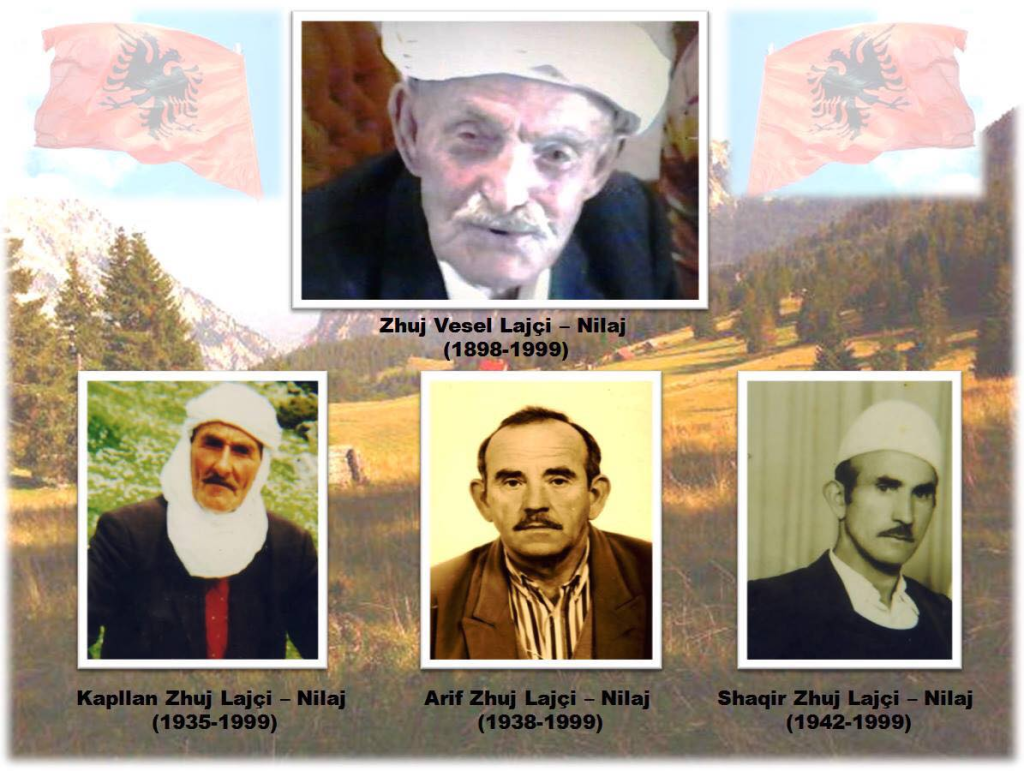
Albanian hero Zhuj Vesel Lajçi-Nilaj (1898-1999)
Zhuj Vesel Lajçi-Nilaj was born in 1898 in the village of Shtupeq i Vogël, he comes from the Nilaj family. The Nilajs belong to one of the branches of the Nikëdedaj brotherhood, which is the largest brotherhood of Lajçi. Zhuj’s father, Vesel Hetemi-Nilaj, was killed in an ambush by Serbs in 1919, when he was traveling from Rugova to the village of Carrabreg in Deçan to visit his family, who had moved there after the burning of Rugova.Albanian hero Zhuj Vesel Lajçi-Nilaj (1898-1999)Zhuj Vesel Lajçi-Nilaj was born in 1898 in the village of Shtupeq i Vogël, he comes from the Nilaj family. The Nilajs belong to one of the branches of the Nikëdedaj brotherhood, which is the largest brotherhood of Lajçi. Zhuj’s father, Vesel Hetemi-Nilaj, was killed in an ambush by Serbs in 1919, when he was traveling from Rugova to the village of Carrabreg in Deçan to visit his family, who had moved there after the burning of Rugova.
Orphaned at a young age, like many people from Rugova, Zhuj’s life was difficult, he had to deal with keeping his family alive in a very difficult time for the Albanian people, who were at that time occupied by Serbia.
The Second World War found Zhuj Veseli, together with his uncle Zenel Hetemin-Nilaj, aligned with the prominent men of Rugova, who mobilized to become the lord of Rugova by protecting it from the Serbian-Montenegrin invading appetites.
Zhuj Veseli at the beginning of the war joined the armed group “Volunteers”, that is, he was on the side of the prominent men of that time, such as Sak Faslia, Rize Zymeri, Sali Rama, Zhukë Haxhia and many other men who were clear about who was constantly endangering the ethnic Albanian lands.
As a member of this group, Zhuji was disciplined in the political and military duties with which he was charged by his superiors, remaining loyal to the national ideal until the end. In the winter of 1945, partisan forces entered Shtupeq i Vogël, where many men from the village were shot, but Zhuji managed to escape the partisan bullets by fleeing.
Being forced to take care of his family, after a few days he returned home again where he worked and acted until June 9, 1954, when, together with his uncle Zenel Hetemin, he was arrested by the UDB in Peja.
The indictment was prepared by Serbian and Montenegrin communists, but unfortunately they were also helped by some Albanian communists who were blinded to benefit from the communist power of that time, and who did not hesitate to become key witnesses in his trial that took place in Peja, on December 25, 1954.
For his military and political activity that Zhuji carried out as a member of the armed group “Volunteers” during the years 1941-1944 in the defense of Rugova, the District Court in Peja sentenced him to life imprisonment and sent him to serve his sentence in the notorious prison in Nish.
After 10 years of severe imprisonment in the prison cells of Nish and Idrizovo, he was released in 1964. Even after his release from prison, not only he personally but also his family continued to be under constant pressure from the UDB.
After his release from prison, Zhuji and his family lived in the village of Llabjan in Peja, where he had bought land before he was imprisoned.
Zhuj Veseli was a long-time activist of the Albanian National Movement in Shtupeq e Vogël and Rugova, he was a fighter with weapons in his hand in the 1940s, but he never stopped the political struggle with the szkjau.
Even after ten years of heavy prison, he did not give up his patriotic activity, heavy prison had never defeated him and brought him to his knees. After his release from prison, he was very active in the men’s chambers, always having the courage to give speeches in the national spirit. He was careful to educate the youth to the end, and often advised them to be vigilant and never trust the shkjau (the Serbs), as well as to always be prepared to fight until the complete liberation of the Albanian lands.
The Kosovo War, fought in the years 1997-1999 by the Kosovo Liberation Army, found Zhuj Veseli at the age of 101, but in good health for his age and the suffering he had experienced for almost a century. The saying “Water sleeps, the enemy does not sleep” was proven true this time too. Zhuj Veseli’s large family, which in May 1999 numbered more than 45 members, lived in the village of Llabjan in Peja.
On the night between 2 and 3 May 1999, at around 12 o’clock in the night, following a plan organized and directed by the military and police formations of the Serbian state in Peja, also assisted by local Serbs and Montenegrins, the houses of the Zhuj Veseli family were surrounded,
Zhuji, 101 years old, with his sons Kapllan, 64 years old, Arif, 61 years old and Shaqir, 57 years old, were taken out of the house. On 20 June 1999, their bodies were found carbonized in the yard of the Kabashi family houses in the village of Zahaq, houses in which the police and military forces of Serbia were stationed during the war.
Zhuj Veseli and his three sons were buried on 20 June 1999 in the cemetery of the village of Llabjan.

 Balkan Academia