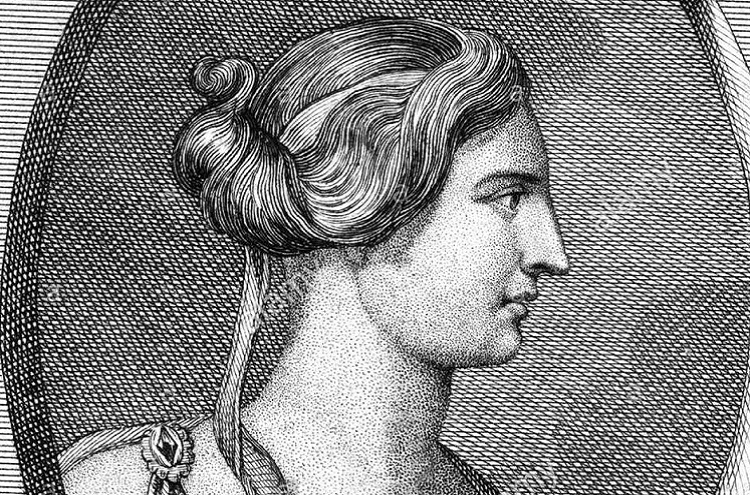

Material researched by Artur Vrekaj. Translation and editing by Petrit Latifi. Photo by Albanipedia.
Abstract
This paper re-examines the figure of Cynnane, daughter of Philip II of Macedon and the Illyrian princess Audata, who was described by Duris of Samos as “the Illyrian” and credited with training her daughter Eurydice in the art of war. Modern scholarship has often interpreted this epithet as evidence for an Illyrian cultural identity or even a matriarchal Illyrian tradition within the Argead dynasty. By reassessing literary testimony and onomastic evidence, this study challenges such conclusions. It argues that Duris’ characterization represents an external perception rather than proof of ethnic identity and demonstrates that the name Cynnane is more convincingly Greek than Illyrian. The case highlights the methodological risks of drawing broad historical conclusions from limited linguistic and epigraphic data.
Cynnane The Illyrian & The Perils of Onomastics
Stating that Olympias and Eurydice fought the first war ever between women, Duris of Samos explained the behaviour of Eurydice by reporting that she learned the art of war from Cynnane ‘the Illyrian’ (ἀσκηθεῖσαν τὰ πολεμικὰ παρὰ Κυννάνῃ τῇ Ἰλλυρίδι).1
Who was this Cynnane, or Cynna, as other sources call her? Born as the daughter of Philip II of Macedon and Audata, an Illyrian princess, she married Amyntas, Philip’s nephew, who was murdered after the succession of Alexander to Philip. This rather short-lived marriage still produced a daughter, the above-mentioned Eurydice. After Alexander’s death Cynnane managed to outmanoeuvre the plans of Antipater and Perdiccas and presented her daughter both to the army and the new king Philip III in order to arrange a marriage. She paid for this bold plan with her life but eventually suc-ceeded.2
Shorter notes
That this woman, daughter of the Macedonian king and reared up at the Macedonian court, is qualified by Duris as ‘the Illyrian’ seems remarkable: of course, she was the daughter of an Illyrian princess. But no one ever called Philip ‘the Illyrian’ although some authors contended that his mother was Illyrian, too.3
Duris’ epithet, together with the statement that Cynnane trained her daughter in the arts of war, led some scholars to the idea that Cynnane’s mother Audata had brought an Illyrian matriarchal tradition with her into the Argead dynasty: Johann Gustav Droysen in the nineteenth and Grace Macurdy in the early twentieth centuries already seem to have thought this way.4 The first to pronounce this idea prominently, though, was Sarah Pomeroy in the early 1980s.5
The idea was pushed further by Elizabeth Carney: in her important book on women and monarchy in Macedonia she deduced from Cynnane’s qualification by Duris that, if not her ethnicity, at least her ‘apparent cultural identity’ as Illyrian could be taken for granted.6 According to Carney an add-itional hint consists in Cynnane’s very name being Illyrian.7 The latter points at least, if not the whole story of a matrilineal hereditary Illyrian tradition, raise serious doubts.
First of all, if some Greek historian qualifies someone as ‘Illyrian’, this is an external judgement on a person he might not even have seen or spoken to. Such a statement reveals nothing about Cynnane’s cultural identity, and given the scanty evidence, we will never know if she felt more Macedonian or more Illyrian.
Secondly, her name: some ancient authors give it as Cynna, some as Cynane or Cynnane.8 Nearly absent in classical literature as it is, the name puzzled scholars for a long time, since they were quite unsure about its etymology. And, of course, a strange name in Macedonia could only be an Illyrian name especially as the only classical author naming another woman called Cynna is probably talking of a hetaira.9
Once the hundreds of Greek hetairai had successfully been ignored, this could only have been a barbarian, and so in spite of other voices10 the name turned Illyrian, for example in Krahe’s lexicon of Illyrian names of 1929.11
Further evidence for the Illyrian character of this name seemed to come from ono-mastic research on the Illyricum: the name Cinna is qualified as ‘Dardanian’ in the authoritative work of Wilkes on the Illyrians.12 If one undertakes the rather arduous task to search out the evidence for this so-called Dardanian name, one gets rather disappointed: the only source I was able to reconstruct is Papazoglu’s book on the Central Balkan tribes, citing but one inscription found near present-day Skopje, in antiquity probably part of Dardania.13
This inscription is a grave-stele from the second century A.D. naming three persons who all use the Roman naming system with nomen and cognomen.14 The woman mentioned is called Matri(—ia) Cinna.
From the onomastic point of view this is rather problematic evidence to postulate an Illyrian (or Dardanian) name Cinna in order to prove that Cynna(ne) is also Illyrian in its turn: the inscription is at least 400 years later and was erected within an empire that enclosed the whole Mediterranean and prompted a rather high rate of mobility.
This woman could just as well have been an immigrated Italian, Syrian or Macedonian, or the descendant of such immigrants. Of course, the geographic distribution of names could even in Roman times be a hint to the roots of a name but only if it is attested in a sufficient number of specimens.
One example without any further hints is complete-ly useless when it comes to origins. Flipping through the Clauss-Slaby database of Latin inscriptions renders no other record for a woman with this name within the wider region of the western Balkan Peninsula.15 One wonders if Papazoglu interpreted Cinna as Dardanian because this name reminded her of Cynna(ne), allegedly ‘Illyrian’…
If one looks the other way round, there are not many but at least a handful of Greek inscriptions from Greek regions that mention persons called Cynna or Cyn(n)ane. Most of these come from Macedonia and Thessaly. The oldest is as early as the fourth century B.C., others are from the third century B.c. or of uncertain date.
Another fourth-century inscription hails from the Greek polis of Nymphaeum on the Crimea.16 The name Cynnis, probably related, is at least mentioned at the Dalmatian coast, but on a Greek inscription which otherwise mentions only Greek names.17
If one assumes that Cinna is equal to a shortened version of Cynnane’s name after all, we should rather propose that the woman from second-century A.D. Scupi may have used a Romanized Greek name. Nevertheless, it is far more prudent to keep clear of any such conclusion: the name is spelled like the well-recorded Latin (or Etruscan) cogno-men Cinna, 18 which, of course, is attested only for males. 19
Until new evidence turns up we should abstain from guessing where this name, recorded in Roman imperial times, came from. After all, there is no convincing record for an ample use of the name Cynnane in Illyria, but we do have evidence that it was widely used in northern Greece as early as the late classical and early Hellenistic times.
Shorter notes
The case of Cynna(ne) is a nice example how dangerous a field onomastics can be: a somewhat careless interpretation of a single name, recorded only in the inscription from Skopje, can prompt far-reaching conclusions via different stages of scientific reception. Whatever Cynnane felt herself – or her parents intended her – to be, her name was sure-ly Greek and is no hint to a personal Illyrian identity or an Illyrian tradition within the Argead dynasty.
Reference and source
Historical Seminar of the University of Zurich. JENS BARTELS.
Footnotes
‘Kynna’, 209-11; Heckel (n. 1); E.D. Carney, Women and Monarchy in Macedonia (Norman, OK, 2000), esp. 58, 69-70 and 128-32.
- Ath. 13.10 (560 f=Duris FGrHist 76 F 52), unnecessarily corrected to Kúvvῃ by Kaibel. The reading of the codex Marcianus Venetus has already been defended by W. Heckel, ‘Kynnane the Illyrian’, RSA 13/14 (1983-4), 193-200, at ↩︎
- On the life of Cynnane, cf. inter alia H. Berve, Das Alexanderreich auf prosopographischer Grundlage, 2 vols. (Munich, 1926), 2.229 n. 456; M. Fluss, RE Supplement 6 (Stuttgart, 1935) s.v. ↩︎
- Eurydice, Philip’s mother, an ‘Illyrian’: Plut. Mor. 14B-C; Lib. Arg.D. pr. 18; Suda s.v. Κάρανος. On Eurydice, cf. also Carney (n. 2), 38-50. ↩︎
- J.G. Droysen, Geschichte des Hellenismus, vol. 2 (Basel, 19523), 60; G.H. Macurdy, Hellenistic Queens (Baltimore, 1932), 48-9. ↩︎
- S. Pomeroy, Women in Hellenistic Egypt (New York, 1984), 6-7 and 122. ↩︎
- Carney (n. 2), 275 n. 27. ↩︎
- Carney (n. 2), 275 n. 27, referring to J. Wilkes, The Illyrians (Oxford and Cambridge, MA, 1992). 86 ; cautiously Heckel (n. 1), 196. ↩︎
- Cf. the exhaustive analysis by Heckel (n. 1). ↩︎
- Ar. Eq. 765 (adduced by H. Krahe, Lexikon altillyrischer Personen [Heidelberg, 1929], 33 s.v. Cynna), Ar. Wasp. 1032 and Pax 755 with the respective scholia. ↩︎
- O. Hoffmann, The Macedonians, their language and their people (Göttingen, 1906), 220 claims the name to be Greek. ↩︎
- Krahe (n. 9), 33 s.v. Cynna; 151; in later works Krahe never mentioned the name again. Had his doubts, already mentioned in 1929, got too strong? ↩︎
- Wilkes (n. 7), 85-6. ↩︎
- F. Papazoglu, Central Balkan Tribes (Amsterdam, 1978), 228, 238, 241. ↩︎
- A. and J. Šašel, Latin inscriptions found in Yugoslavia between the years 1922 and 1940 and published (Ljubljana, 1986), 62 no. 1445. ↩︎
- Last search 23.5.2013. ↩︎
- 16 L. Gounaropoulou and M. Hatzopoulos (edd.), Inscriptions of Lower Macedonia A. Inscriptions of Veria (Athens, 1998), no. 23 (Macedonia, third century B.C.): [K]ynnana; ibid. no. 391 (Macedonia, early third century B.C.): Kynnana; SEG 32.583 (Atrax, Thessalia, fourth century B.C.): [K]ynnana; IG 9.2.334 (Mylai, Perrhaibia, unknown date): Kynnana; IG 9.2.568 (Larisa, unknown date): [K]y[n]ne; I. 1. Tolstoi, Греческие граффити древних городов северного причерноморья (Moscow, 1953), 81 no. 125 (Nymphaeum, fourth century B.c.): [Ky]nnana. Cf. also LGPN 4.204 and 3B.251. ↩︎
- SEG 40.514 from the polis and island of Issa (second or first century в.с.) mentions one Κυννὶς Καλλισθένεος. The name Κυννίς occurs already in a Greek inscription within a Greek context from Ephesus (fifth or fourth century в.с.): Ch. Börker and R. Merkelbach, Die Inschriften von Ephesos, vol. 2 (Bonn, 1979), no. 131. Cf. LGPN 5.260; another record comes from Kos (first century B.c. or A.D.): W.R. Paton and E.L. Hicks, The Inscriptions of Cos (Hildesheim, 1990), no. 124. Cf. also LGPN 1.279. Krahe (n. 9), 33 s.v. Cynnis: ‘Der Name kann griechisch sein; doch darf auch an illyr. Κύννα erinnert werden.’ Again there is no record from the Latin inscriptions of Illyria. ↩︎

 Balkan Academia