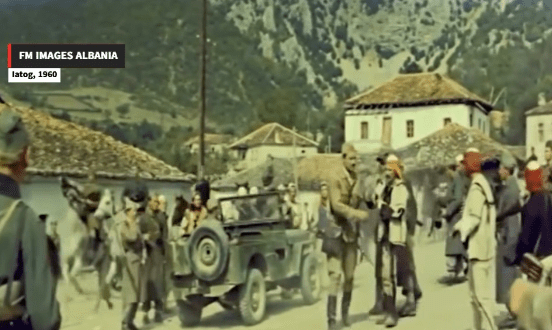

Photo: Screenshot from a 1960s socialist movie in Istog (Burimi).
Summary
Between 1912 and 1999, Serbian and Montenegrin invader forces committed many war crimes and atrocities against the Albanian civilian population in the villages of Burim (Istog). Many Serbian and Montenegrin (Slav) colonists also settled on Albanian villages whose inhabitants had been expelled or killed. Notorious Chetnik paramilitary vojvoda Milic Krstic (Milić Kërstić) is reported to have killed many Albanian civlians.
Arbana (Orrobërda)
In 1919 the Serbian and Montenegrin gendarmerie burned down several towers and killed several people. Seven families of Kacaks were moved to Albania between 1924-1934. During this period, 12 families of Serbian and Montenegrin settlers settled in this village, mainly in the houses and properties of the Kacaks.
Before the Serbian aggression of 1998-99, the village had 120 Albanian houses (not including the Hakaj neighborhood). All Albanian houses were burned and destroyed, except for 5 houses that survived. 14 people were killed from this settlement, of whom 3 were martyrs. The population was expelled from the village on March 28, 1999 and took refuge in Rozhajë, then in Albania, some in Tuz and Ulcinj. Laxha Hakaj administratively belongs to Arbana.
The current residents here were settled 150-200 years ago and came from Hakaj and Rugova. In 1938, Sokol Hakaj’s family moved to Izmir, Turkey. In 1999, this locality was burned for the third time, by Montenegrin Serbs. Before the war, this neighborhood had 35 houses with 350 Albanian residents. All were burned, except for those that were unrepaired. Two people were martyred and one person is missing. The population was displaced to the mountains on April 20, 1999, then to Rozhajë, later to Ulcinj and Shkodra.
Arbneshi (Sërbobrani)
In 1999 all 15 Albanian houses in the village were burned by Serbian forces.
Baja (Banja)
During the 1998–99 war Serbian forces destroyed 115 houses. Two villagers were killed and one is considered missing. On 27 March 1999 the Albanian population was forced to leave toward Montenegro.
Banjëza (Banjica)
In 1999 Serbian forces burned 15 Albanian houses and four villagers were killed. On 26 April 1999 the Albanian population left the village toward Montenegro.
Begaj (Llukafci i Begut)
In 1999 Serbian forces destroyed 53 Albanian houses. Three villagers were killed, including one identified as a martyr. On 29 March 1999 the Albanian population was forced to flee toward Rozhajë and Albania.
Istogu area (Dubova)
Serbian and Montenegrin troops burned the settlement three times: in 1912, 1944, and 1999. During the 1999 war, 32 Albanian houses were burned and six Albanian civilian villagers were killed. On 12 April 1999 the population was expelled toward Montenegro and then to Albania.
Kashicë (in Istogu area)
Serbian forces killed 12 villagers in 1999, of whom one is considered a martyr. On 8 May 1999 the population was deported to Albania. The aggressor burned 142 Albanian houses, the school, and the mosque. In the upper neighborhood 5 villagers were killed (one martyr). In the lower neighborhood on 29 August 1998 eight members of the Salihaj family and their nephew Nazmi Gashi from Vojnik of Skënderaj were massacred.
Lubozhda (in extended area)
During the 1999 war Serbian forces burned about 110 Albanian houses. Five Albanian civilians were killed, including four martyrs; a 14-year-old boy went missing. The population was expelled toward Montenegro and Albania on 24 March 1999.
Prigoda / Vrellë area
1913-1921
The population of Prigoda suffered a lot from the Serbian occupiers. In 1921, the gangs of Milić Kërstić killed the entire family of Dan Dreshaj and Mahmut Dema, with their sons Rama and Shabani, and their daughter Zoja.
Then they killed Istref Selimi and his son Syla with Latif Zeqiri, when they were in the mountains guarding their cattle. Statistical notes: In 1921 there were 40 houses, with 275 inhabitants, in 1948 – 49 houses with 343 inhabitants, in 1981 – 70 houses with 702 inhabitants (646 Albanians, 1 Serb, 3 Montenegrins, 51 Muslims, 1 other). In the winter of 1913 Serbian army forces imprisoned 27 men of the village Vrellë and after torture many of them died.
1998
During the 1998–99 war, Serbian forces burned 399 Albanian houses, two historic towers, the village health clinic, factory, library with over 8,000 books, and partially damaged the school and mosque. Twenty-eight villagers were killed, including seven martyrs, and seven persons are considered missing. The population left the village between 11 and 14 April 1999 toward Rozhajë in Montenegro and then to Ulcinj and Albania.
Ucë area (Istog)
In the winter of 1912 Serbian bands under Miliq Kërstiq with gendarmes rounded up 28 selected Albanian men from the Istog region and locked them in the Gjuriq mill in Istog where they were beaten to death and their skulls crushed. On 17 July 1920 Serbian forces rounded up 9 villagers, locked them in a tower and burned them alive, then burned and looted the village. During the 1998–99 war Serbian forces burned 19 Albanian houses and killed five villagers, including one elderly man, two children around 10 years old, and two young women. The population was expelled to Albania on 8 May 1999.
Zallc area (Istog region)
In May 1922 the Serbian gendarmerie killed Islam Zagraxhë with 15 companions and burned 13 houses in Zallc.
Gurrakoc area
When Serbian and Montenegrin armies returned after 1912 many houses were burned and some Albanians were killed and massacred. In the summer of 1920 bands under Miliq Kërstiq killed several shepherds and three villagers from Llukafci i Begut. Prior to the 1999 aggression Serbian forces burned 135 Albanian houses and later many Serbian houses as well. One civilian was killed. The population was expelled from the village on 28 March 1999 to Albania and Montenegro.
Lower Istog
In the summer of 1919, the gangs of the infamous voivode, Milić Kërstić, had gathered dozens of Albanians and killed 64 of them. According to the newspaper “Kosova”, these gangs, on February 15, 1920, killed Hysen Sejdiu along with his five sons, they also killed Keq Bajra, Emin Bajra, Ramiz Selman Llozhani, Murat Kostari and ninety other souls, women, children, old men and women, wrote “Kosova” of Constanta. According to this newspaper, the tragedy began around 10 am and ended around 1 pm. According to this newspaper, the Serbs killed and looted goods.
Cerrcë
This village, after the Serbian and Montenegrin invasions of 1912, suffered greatly. In 1912, the Serbs and Montenegrins killed 25 villagers, burned down three houses. In this village, in 1938, the brave Selman Kadrija killed the infamous Serbian voivode, Milić Kërstić, a great oppressor of the Albanian people.
Dardha (Zhakova)
From the action of the infamous Serbian voivode, Milić Krstić, there around 1920, 3 Albanian residents of this village died from torture. After 1920, 4 families moved to Turkey (Ferizaj, Hajzeraj, Salihaj). Statistical notes: In 1918 there were 260 inhabitants (7 Albanian families with 60 inhabitants and 18 Serbian families with 200 inhabitants). In 1948 there were 74 houses with 507 inhabitants. In 1981 there were 86 houses with 519 inhabitants (302 Albanians, 214 Serbs, 2 Black Montenegrins, 1 other).
According to the Serbian population census in 1991, there were 164 Serbian and 2 Montenegrin inhabitants. In 1999 this village had 73 Albanian houses with 429 inhabitants and 20 Serbian houses with 165 inhabitants. As a result of the war, all Albanian houses were burned and destroyed, as well as Serbian ones. The Albanian population was deported to Albania and Montenegro.
Gashaj (Shushica)
The Serbian criminal, the notorious voivode, Milić Kërstiqi, also committed atrocities in Shushicë. According to historical documents, he shot 8 Albanians in this settlement in the spring of 1921, and 10 others in July of that year. Between the two world wars, 70 settler families settled in this settlement.
Statistical notes: In 1871, there were 25 Albanian houses, in 1903, 3 Serbian families were registered, they may also be from the nearby village of Bellopojë. In 1921, there were 85 houses with 702 inhabitants. In 1942, 812 inhabitants were registered, of whom 414 were male and 398 were female. In 1948, there were 160 houses, 1139 inhabitants. In 1981, there were 195 houses with 1723 inhabitants (1672 Albanians, 13 Serbs, 38 Montenegrins).
According to the Serbian census of 1991, there were 9 Serbs, 6 Montenegrins and 4 Croats. At the beginning of 1999, the village had 240 houses, with 2,395 Albanian inhabitants. 142 houses, the school, and the village mosque were burned by the Serbian aggressor. 5 people were killed from the upper neighborhood, of whom one was a martyr, while from the lower neighborhood, eight members of the Salihaj family and their nephew from Vojnik i Skënderaj, Nazmi Gashi, were massacred on August 29, 1998. On April 14, the population was deported to Albania.The homes of Serbs and Montenegrins were later destroyed.
Krasniqja (Kovraga)
In 1919, the gangs of Milić Kërstiqi caught 12 men by surprise and burned them in an Albanian tower, in the Pitulić neighborhood. In addition to the Shyti family, in 1924 several Vërbić families also moved to Turkey. In the period between the two world wars, the Serbian-Montenegrin government settled 31 settler families here, Serbian and Montenegrin, mainly in Upper and Middle Kovraga.
According to the register of these colonies, from 1926-1938 the Serbian government settled 74 settler families with 331 members in these areas: Kovraga, Verić and Gurrakoc. This colony, as has been said and stated many times, was formed with Serbian strategic policies, due to the fact that these settlements lie along the Peja-Mitrovicë highway.
Statistical notes: At the end of the century. 19 there were 10 houses, among them 4 towers, in 1921 there were 42 houses with 348 inhabitants in 1948 – 84 houses with 513 inhabitants in 1981 – 156 houses with 1084 inhabitants (622 Albanians, 229 Serbs, 29 Montenegrins, 174 Muslims,30 others).
According to the Serbian census of 1991 (the Albanians boycotted that census), there were 429 Serbs and 1 Yugoslav in Kovragë. On the eve of the war, Kovragë had 120 Albanian houses with about 800 inhabitants and about 30 Serbian and Montenegrin houses with about 200 inhabitants, 12 Bosniak houses and 12 Ashkali. According to the informant, 120 houses were burned and destroyed in this settlement during the 1999 war, including Serbian and Montenegrin ones.
Uca
This settlement has suffered greatly from Serbian barbarism. In the winter of 1912, the gangs of Milić Kërstić and gendarmes gathered 28 selected people from the Istog district and locked them in the Gjurić mill in Istog. These selected Albanians were beaten to death, and even had their heads crushed with millstones until they died. Among them were also men from Uca.
On July 17, 1920, the Serbs took 9 people and locked them in a tower where they burned them alive, then burned and looted the village. When Serbia returned to Kosovo, in 1918 new crimes occurred. Thus. “Kosovo” of Constanta, Romania, in 1932 wrote: “In the village of Uça, the Serbs captured Murat Rexhep Selman with 8 friends and sent them to a tower in Kovragë. They tied his hands and feet, locked him inside and set fire to the tower, burning them alive. Then they returned and burned and looted the village”.
In 1923, a family of settlers with 5 members was colonized, other Serbian families had come, one from Rakoši originating from Kuršumli, the other in 1953, came from Kolasin i Ibar. During this time and until the end of the communist and partisan violence from the beginning of the 60s, more than 70 people have suffered from this settlement. Due to the violence of the Serbian government, many families have moved from this settlement to Albania and Turkey.
In 1924, the Halitaj family left for Albania with 25 members, half of whom died on the way. They settled in Katundi e Ri, near Durrës. The family of Ferat Bardhi in 1920 also moved to Rroshbull in Albania, the family of Sali Idrizi went to Albania in 1918. The families of Ramadan Hyseni and Ibish Tal also went and settled in Albania at that time. Three brothers of the Smajlaj family in 1956 moved to Turkey.
Statistical notes: According to the guide J. Muller, in 1838 Uça had 10 houses with 50 inhabitants, in 1918 there were 60 Albanian families with 700 inhabitants, in 1948 – 83 houses with 725 inhabitants, in 1981 – 124 houses with 1160 inhabitants (1147 Albanians, 13 Serbs). According to the Serbian census of 1991, this settlement had 17 Serbs. At the beginning of 1999 there were about 150 houses.
The Serbian aggressor burned and destroyed all the houses along with the auxiliary buildings, only the school and the village mosque survived, which were damaged. Two people were burned, one martyr was killed in Koshare. Before the war, in defense of the Albanian school, on January 31, 1992, three inhabitants of this village were killed.
On March 27, 1999, the population abandoned the village and settled in Fushe e Madhe.They stayed there for a few days, then went to Rozhaja, and from there to Ulcinj and Albania. Some stayed in the Vojdoll
Dasami (Saradani)
The Serbian massacres in this settlement have never stopped. According to the newspaper “Kosova” published by Albanian emigrants in Constanta, Romania, Serbian forces here, on 22.5.1922, killed Shaban Hajdari and burned four houses. Only Albanians lived in this settlement. After 1928, colonization with Serbs and Montenegrins began. Then 9 families of settlers settled here.
Around 1956, 2 Elshani families, 3 Kabashi and 1 Mavraj families moved to Turkey, and one Elshani family went to Albania. In 1918, the Serbs burned several towers of great cultural-historical importance. Statistical notes: Around 1905 there were 20 Albanian houses, in 1921 there were 40 houses with 445 inhabitants. In 1948, 91 houses with 706 inhabitants, in 1981 there were 129 houses with 1605 inhabitants (1585 Albanians, 4 Serbs, 16 Montenegrins).
According to the Serbian census of 1991, the village had 3 Serb inhabitants, the Albanians boycotted that census. At the end of 1998, this village had 265 houses, with 2115 Albanian inhabitants and only one Serbian family. In 1999, 84 houses and 22 other buildings were burned and destroyed by the Serbian aggressor. 15 people were killed and massacred, mainly young people, among them two martyrs, while two are missing.
A mass grave with 14 victims was discovered in the Mavraj neighborhood (9 from Saradrani, 2 from Zabljak, 2 from Nabërgjan and 1 from Sverka e Pejës). On May 6-8, 1999, the population was deported to Albania and Montenegro. The school and ambulance were also damaged. This village previously housed more than 70,000 residents from various parts of Kosovo.
Dreja
In 1919, the Serbian army burned the village and killed two local residents, six residents of the nearby village of Shalinovc and a friend of the house. The Kokaj family also suffered in this massacre. In the period between the two world wars, 4 families of Montenegrin settlers settled here.
According to the 1921 census, Dreja had 12 houses with 60 inhabitants, in 1948 there were 31 houses with 197 inhabitants, in 1981 there were 50 houses with 438 inhabitants (12 Serbs, 2 Montenegrins, 10 Muslims). According to the 1991 Serbian census, there were 14 Serbs and 11 Egyptians here.
Before the Serbian aggression in the spring of 1999, Dreja had 68 families, with about 300 Albanian inhabitants. 6 Ashkali families, 2 Serbian families with 8 inhabitants, while in the outside world there were 224 inhabitants. One person was killed. The population was expelled and settled in other villages on March 27, 1999, and was deported to Albania on May 8 of that year.
Drejana (Dubrava)
On March 28, 1999, the Albanian population was deported towards Rozhaja to Montenegro, and then to Ulcinj and Albania. In this locality there existed (and still exists) the infamous Dubrava prison, where Serbian forces on May 19-22 of that year killed and massacred 97 Albanian prisoners from all parts of Kosovo.
There is evidence that many more people were killed in that massacre. Some prisoners from that time are still missing, among them the Albanian intellectual. Mr. Ukshin Hoti. In this locality, after the war, a KFOR base was established.
The Bridge of Zallc (Ura e Zallcit)
Serbs burned and shelled 33 Albanian houses in 1999. 5 KLA members were martyred in this settlement, 3 people were killed before the offensive, 2 people were taken from the displaced persons column and massacred, all young. On May 8, 1999, all the residents were deported to Albania.
Frashni (Zaballci)
Serbs burned and shelled 33 Albanian houses in 1999. 5 KLA members were martyred in this settlement, 3 people were killed before the offensive, 2 people were taken from the displaced persons column and massacred, all young. On May 8, 1999, all the residents were deported to Albania.
Gurrasi (Sudenica)
During the attack on the village on April 13, 1999, 263 houses were burned and destroyed, the village mosque, built in 1803, was shelled and partially burned, as well as the cultural center. On April 23, 9 people were executed and massacred, including four girls and four old men.
A common cemetery was discovered in the village. The population was expelled towards Montenegro on April 13 and then towards Albania. During the war, a large mass of the Albanian population, expelled from other parts of the Istog Municipality, stayed in this settlement for a while.
Kaliqani
Before the Serbian aggression, there were 153 houses with 1630 inhabitants. More than 98 percent of the village was burned, and several towers of cultural and historical value were also burned and destroyed, such as the three-story tower of Lash Uka, with a characteristic style.
The village mosque, the house of culture, the school and its documentation were burned. 4 villagers and 43 refugees sheltered here were killed, among the killed and massacred, there were women, the elderly and even children and sick people. Among the massacred were eight members of the Rugova family from Cerrca, whose bodies the Serbs burned. On April 13, the population took refuge in the mountains and then moved to Rozhaja and further to Ulcinj and Shkodra. Tuz and Malësi e Madhe.
Pemishtja (Paladishta)
In 1998, the neighborhoods belonging to the Municipality of Skenderaj had 90 houses with Albanian residents. Only 11 houses escaped the burning by the Serbian occupier. 7 residents were killed (one woman), among them two martyrs. In the neighborhoods belonging to the Municipality of Istog there are 50 houses, of which 70% were burned. 20 residents were killed here (19 from the Imeraj family). A mass grave (Te Kodra e Rakoshit) with 97 people killed in the Dubrava Prison massacre was discovered.
Rakoshi
Before the Serbian aggression of 1998-99, Rakoshi had 160 Albanian houses with 1050 inhabitants, 6 Serbian houses with 22 inhabitants and a Roma family with 8 members. The aggressor burned 141 houses, then in revenge the Serbian houses were burned. Three people are considered missing. In a mass grave on Kodër i Rakoshi, it is considered that the massacred people of Dubrava Prison, who were from all parts of Kosovo, were buried.
Truhuboc
At the end of 1998, there were about 100 houses with 750 Albanian inhabitants. Serbian forces destroyed and burned 62 houses, 3 inhabitants were killed, of whom 2 were martyrs and a young man was massacred. On May 8, 1999, the population was expelled towards Montenegro and Albania.
Verrishta (Lluga)
Before the Serbian aggression in 1998-99, this settlement had 126 houses with 887 inhabitants. The aggressors burned 49 houses, killed 4 people, of whom a man and a woman were massacred and thrown into a well, and a teacher was martyred. On March 27, 1999, the population was deported to Albania and Montenegro.
Source
Taken from the book by Dr. Jusuf Osmani: “Settlement of Kosovo – Source (Istogu)”. Prepared for publication: Rrustem Rugova

 Balkan Academia