
Abstract
This article critically examines the ideological narrative presented by Serbian author Miroljub Jevtić in his book Albanians and Islam. Although framed as an academic study, Jevtić’s work relies on polemical language, cultural stereotyping, and nationalist assumptions rather than empirical research. The analysis demonstrates how Albanian political elites are depicted through dehumanizing metaphors, while Albanian society is portrayed as morally and intellectually deficient. Islam is treated instrumentally, acknowledged as a historical marker of Albanian identity yet simultaneously presented as an obstacle to Serbian political dominance. By denying Albanian agency and promoting a vision of cultural assimilation and territorial expansion, Jevtić’s narrative reveals itself as propaganda rather than scholarship, illustrating how academic authority can be mobilized to legitimize nationalist and hegemonic projects.
Background
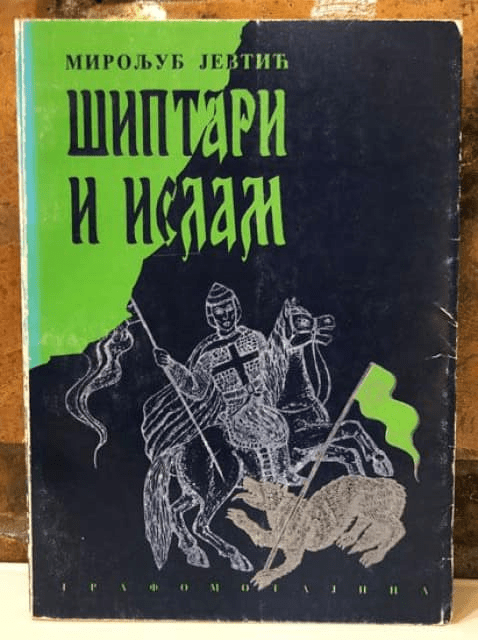
Miroljub Jevtic is a professor, doctor of politics and sociology at the University of Belgrade, he is very well known in Serbia and among Albanians in the former Yugoslavia. Prof Dr Miroljub Jevtic is an expert on the Albanian mentality. Miroljub Jevtic knows the mentality of Albanians very well, because he was born in Vranje in 1955, Vranje is only 17 kilometers from Bujanovac, he has written a book about Albanians and Islam.
Serbian author Miroljub Jevtic, in his book “The Albanian of Islam – ALBANIANS AND ISLAM” writes:
“Albanian leaders hate their people and everything spiritual, such as the Islamic religion, just to look as European as possible. Kosovo leaders are shepherds in European clothes, who learned the term atheism from Serbia.
The distinguished leaders of the Albanians, due to their European complex, hate their people and everything spiritual, such as Islam, among them, so we are the winners when this happens, because every time the Albanian people expect something more from their leaders, they are disappointed in them because they are all without morals and are the offspring of the atheism that I personally managed to impose on them in their literature, and I am proud of this because they are patriots, which these shepherds learned as a term from us Serbs.
We reached such a level that the secular Albanian leaders are proud of our Orthodoxy or the Catholic cross in Kosovo, at a time when there Orthodoxy and Catholicism are minorities.
Everything autochthonous Albanian that preserved Albanians as a majority from Slavism was Islam. And very soon, without noticing the Albanians, they will eat like us, drink like us, sleep and have fun like us and within twenty years Serbia will have this province as part of its own, including Albania.“
Critical analysis
Miroljub Jevtić, a Serbian professor of political science and sociology, presents himself as an expert on Albanian society in his book Albanians and Islam. However, a close reading of the cited passages reveals a discourse that is ideological rather than scholarly, relying heavily on stereotypes, generalizations, and openly propagandistic language. Instead of employing empirical analysis, Jevtić constructs a politicized narrative that delegitimizes Albanian identity by portraying Albanians as morally deficient, intellectually inferior, and manipulable.
A central feature of Jevtić’s argument is the dehumanizing characterization of Albanian political leaders, whom he repeatedly labels as “shepherds” and accuses of hating their own people and spiritual traditions. Such language is not analytical but polemical, designed to provoke contempt rather than understanding. By attributing a supposed “European complex” to Albanian elites, Jevtić reduces complex political and cultural dynamics to psychological defects, a classic propaganda technique that replaces structural analysis with cultural essentialism.
Jevtić further claims personal responsibility for imposing atheism on Albanian intellectual life, presenting Serbian influence as civilizationally superior and Albanians as passive recipients of ideological manipulation. This assertion lacks academic credibility and exposes the author’s self-positioning as an ideological actor rather than an objective observer. His framing reinforces a colonial logic in which Serbian culture is portrayed as dominant and formative, while Albanian agency is denied.
The treatment of Islam in Jevtić’s work is particularly problematic. Although he acknowledges that Islam historically functioned as a key marker preserving Albanian distinctiveness from Slavization, he simultaneously depicts it as an obstacle that can be eroded to facilitate Serbian political control. This instrumental view of religion reduces Islam to a tool of ethnic resistance or submission, ignoring its theological, social, and historical complexity within Albanian society.
Finally, Jevtić’s prediction that Albanians will soon “eat, drink, sleep and have fun like us” and that Serbia will regain Kosovo and even Albania reveals the explicitly nationalist and expansionist intent underlying his narrative. Such statements abandon any pretense of academic neutrality and instead articulate a vision of cultural absorption and political domination. In this sense, Albanians and Islam functions less as a scholarly study and more as an example of intellectualized nationalism, where academic authority is used to legitimize assimilationist and hegemonic political goals.
In conclusion, Jevtić’s work exemplifies how pseudo-academic discourse can be employed to advance nationalist propaganda. Its reliance on derogatory language, denial of Albanian agency, and explicit political ambitions fundamentally undermine its credibility as serious scholarship and situate it within the broader tradition of ideological writings aimed at cultural and political domination rather than genuine analysis.
Reference
“The Shepherd of Islam”. p.150. Miroljub Jevtic

 Balkan Academia