
by Lulzim Osmanaj. Translation Petrit Latifi
Abstract
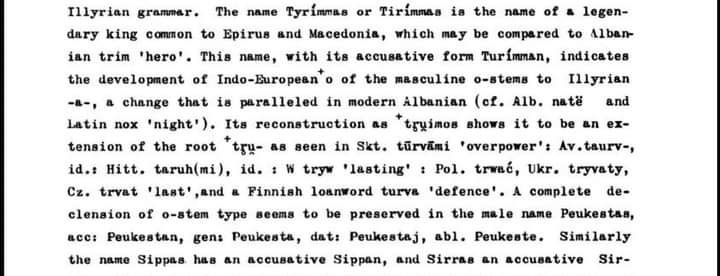
This paper examines Illyrian onomastics as a source of evidence for Indo-European grammatical continuity, with particular attention to its relevance for the historical development of Albanian. The legendary name Tyrimmas / Tirimmas, widely attested in the mytho-historical tradition of Epirus and Macedonia, is analyzed as a linguistic fossil reflecting inherited Indo-European phonological and morphological patterns. On the basis of its comparison with Albanian trim ‘hero’, the accusative form Turimman is interpreted as exhibiting a characteristic Illyrian sound development, namely the shift of Proto-Indo-European o to a, a process that finds clear parallels in Albanian phonology.
The reconstructed form *truimos is further connected to the Indo-European root tru-, denoting endurance, strength, and dominance, as attested in Avestan (taurv-), Hittite (taruh-mi), Slavic (trwać, tryvaty, trvat), and in the Finnish loanword turva ‘protection’. Beyond lexical correspondences, the study emphasizes the value of proper names as grammatical evidence, highlighting the preservation of full o-stem declensional patterns in Illyrian anthroponyms such as Peukestas, with its attested case forms (Peukestan, Peukesta, Peukestaj, Peukeste), as well as parallel formations (Sippas / Sippan, Sirras) that retain archaic masculine accusative morphology.
Taken together, these onomastic and morphological data support the hypothesis of structural continuity between Illyrian and Albanian, situating Albanian within the Indo-European family not only through shared vocabulary but also through inherited grammatical architecture.
Illyrian onomastics as evidence of Indo-European grammatical developments
The legendary name Tyrimmas / Tirimmas, known as a common mythic-historical figure in Epirus and Macedonia, should be analyzed as important linguistic evidence for Indo-European continuity in Illyrian and modern Albanian.
Starting from the comparison with the Albanian trim ‘hero’, it will be argued that the accusative form Turimman reflects a characteristic phonetic development of Illyrian, specifically the transition of Indo-European o to -a, a process that finds direct parallelism in modern Albanian, as illustrated by the relation night : nox.
The hypothetical reconstruction *truimos will be interpreted as an extension of the root tru-, widely documented in other Indo-European languages with meanings related to endurance, strength and rule, including Avestan (taurv-), Hittite (taruh-mi), Slavic languages (trwać, tryvaty, trvat) and even the Finnish loanword turva ‘protection’.
In this context, the essay will emphasize the importance of onomastics as a grammatical source, analyzing the preservation of a full o-theme type declension in nouns such as Peukestas, with its case forms (Peukestan, Peukesta, Peukestaj, Peukeste), as well as parallel examples such as Sippas / Sippan and Sirras, where the accusative displays archaic features of masculine inflection.
Thus, these onomastic and morphological data reinforce the thesis of a structural continuity between Illyrian and Albanian, placing Albanian in a broader Indo-European context not only lexically, but also grammatically.
References
Hamp, E. P. (1966). The position of Albanian. In H. Birnbaum & J. Puhvel (Eds.),
Ancient Indo-European Dialects (pp. 97–108). Berkeley: University of California Press.

 Balkan Academia