
Abstract
This section examines the experiences of Gjilan and its surrounding areas under successive foreign occupations between 1912 and 1918. Following the collapse of Ottoman authority, local Albanian leaders, including Idriz Seferi, organized volunteer forces to resist Serbian advances. Despite initial resistance, the Serbian army captured Gjilan in October 1912, establishing brutal administrative and military control accompanied by massacres, expropriations, and forced colonization. During the First World War, the area was occupied by Bulgarian forces, who exploited and oppressed the local population. The period resulted in severe demographic, economic, and cultural losses, widespread migration, and the continuation of Albanian resistance movements.
This section, extracted from ““Gjilani me rrethina. Monografia komplet te gjitha kapitujt nga Ideri IX”, discusses Serbian and Bulgarian atrocities and war crimes committed against the Albanians of Gjilan from 1912 to 1918.
Cited:
Gjilan on the eve of the Balkan Wars
After the success of the general uprising of 1912, local government bodies were formed in Gjilan, such as: Commission – People’s Council, headed by Idriz Seferi. The Ottoman government organs, such as the kajmekam and military organs, had only a formal presence, and most of them had left and taken refuge in Skopje.
That there was no longer Ottoman power in Gjilan can be concluded from the case of Mydyr of Upper Morava and the case of Kajmekam of Gjilan, when Sali Aga gave a group of rebels a deadline of 48 hours to abandon the city and despite the forces he gathered and the help he received from Pristina, he did not dare to undertake any attack against the rebel forces.
Also based on the press notes of the time and Serbian correspondence, it is learned that Idriz Seferi and several other leaders have power in Gjilan and the surrounding area. They decide on everything and everyone turns to them, both Albanians and others.
The Gjilan Council, seeing that the situation was very serious and that it was facing a great danger, took measures to prepare the population. One of the measures taken was the reconciliation of the conflicts and hostilities throughout the Kazan of Gjilan. By the end of September
In 1912, an assembly of all the leaders of Kaza was held, in which a pledge was made to stop the revenges and forgive the bloodshed. Four prominent people from this area were chosen to secure the pledge: Idriz Seferi for Karadak, Ahmet Aga of the Mufti’s Office and Tahir Budrika for Upper Morava, and Murat Bilalli from Bresalci for Lower Morava.
The Serbian government had already sent emissaries to Kosovo many years ago to prepare the ground for the invasion of Kosovo and other Albanian territories. This can also be seen from the documents, which speak of the supply of Serbs-komitas with weapons, who directed horses loaded with weapons mainly to Serbian villagers in the Pristina and Gjilan districts.
When these weapons were discovered by Turkish gendarmerie patrols, as happened in Gracanica, the Serbs declared that they were carrying the rifles on behalf of Albanian Kachaks. Also, the case of July 1907 of the penetration of the Komitas’ detachment into the village of Pasjan, which was soon liquidated.
The Serbian government had made continuous efforts to contact prominent figures of the Albanian insurgents against the Ottoman Empire, such as Idriz Seferi, Sait Aga and others, in order to neutralize and paralyze the resistance of Albanians against Serbia in the Gjilan and wider areas.
Captain Božin Simić was assigned to negotiate with Idriz Seferi, who asked Idriz for a neutral stance in the event of a war with Turkey, but to this offer from Serbia, Idriz Seferi would clearly respond: I will be loyal to the agreement, according to which I will help in the event of a war with Austria, while in the event that Serbia attacks Turkey I will be on the side of the Sultan.
Under these circumstances, the population of Gjilan and the surrounding area will begin preparations for a defensive war from a new invasion, this time from the neighboring country, Serbia. The Gjilan leadership knew that the country must be defended at the border, so the leaders of the uprising had agreed at the Skopje meeting to organize volunteers to defend the country from Serbian attacks.
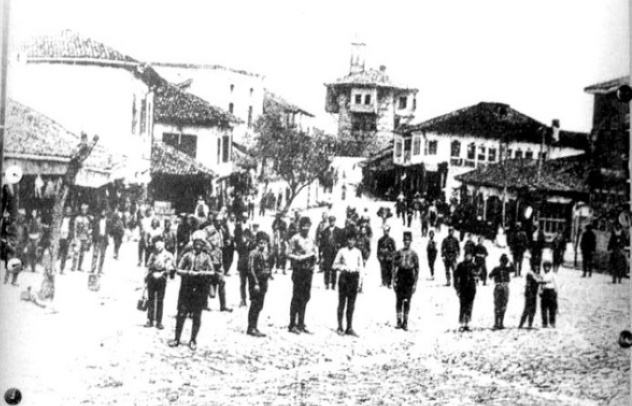
At the meeting that was held at the Clock Tower in Gjilan, many volunteers gathered ready to fight in defense of the country. Idriz Seferi, at the head of the Albanian volunteers, was to defend the border in the northern part of Kaza, in Sfircë, while Salih Aga with volunteers from Preševo and others the border in Ristofc.
These days the Cairo newspaper: Al-Mahrusa, had published the news that Idriz Seferi, a prominent Albanian commander, had decided to march to the Serbian border at the head of 6,000 Albanian fighters.
Idriz Seferi was responsible for organizing volunteer forces in the Gjilan, Morava and Karadak areas, and managed to gather 6,000 fighters, who were thrown onto the border with Serbia, where together with the country’s forces they faced off for a while against units of the Third Serbian Army. The fighting in this area of Kosovo continued for 7 days, starting from the time of the Serbian army’s attack on October 15.
The occupation of Gjilan and the establishment of Serbian administration
The Gjilan volunteers under the leadership of Idriz Seferi and others, although exhausted from earlier uprisings against Ottoman rule, resisted the new invader, Serbia. They faced the Serbian army, which was numerically and armed to the teeth, preventing for a time the penetration of the Gjilan territory.
The forces led by Idriz Seferi, after fierce fighting, especially in Sfircë in Gjilan and Novosello in Bujanovac, withdrew partly towards Kumanovo and partly towards Gjilan. There were also battles with Serbian forces in Trnoc and Rahovice in Presevo, and especially in the Končuli Gorge, which the Serbs managed to capture on October 21, 1912, ensuring the penetration towards Gjilan.
On October 22, the Serbian army, after breaking the border at Merdar, had penetrated as far as Pristina. The Serbian 3rd Army was positioned, dividing into two parts, with the aim of continuing towards Ferizaj and Skopje, and towards Gjilan and Kumanovo.
The city’s population was in a state of great uncertainty, especially the Albanian population, unlike the Serbian population, which had long been expecting the arrival of the Serbian army and “liberation” from the Ottomans. The day before Gjilan was occupied by the regular army, the city had been surrounded by Serbian volunteer units, but the city’s defense had declared that it would only surrender to them if the regular army was present.
It seems that the city had some kind of defense organization, but it was insufficient for any successful defense. According to some sources, at night in Gazhanja, a patrol encountered Lazar Stojkovi, a Gjilan resident, a member of the committee’s ranks, dressed in Turkish clothes. The patrol stopped him, but after declaring that he wanted to talk to the members of the Council, he was brought to the member in charge. He asked the question: Will Gjilan be surrendered without a fight, or will the armed people fight?
Contact with the army in Konçul was not possible, while in Gjilan, on October 24, 1912, units of the regular Serbian army that had come from Pristina entered without encountering resistance. On that occasion, a considerable amount of ammunition and other military material was seized from two weapons depots. In this way, for Gjilan, as in all of Kosovo, a centuries-old Ottoman rule ended and another, more brutal, foreign rule began.
The Serbian army, upon entering the city, will immediately begin establishing power. The army was under the command of Lieutenant Colonel Alimpije Marjanović. A day later, the Headquarters of the 3rd Army arrived in Gjilan, headed by Commander Božo Janković and Chief of Staff Dušan Pešić. The headquarters was located in Tinko Katanić’s house, from where he led the 3rd Army.
The city’s governing bodies were also elected, with Toma Popovici appointed as mayor of Gjilan, Živko Popovici as protocol keeper, Ilija Popovici as notary, Giga Katanici as treasurer, while two Serbs and two Albanians, Nasko Neshiqi and Haxhi Llaqko Neshiqi and Ismet Basha and Sylejman Efendi Agushi, were elected as advisors. Spiro Stankovic was appointed as chief of the Gjilan district.
The Serbian occupation of Gjilan and its surroundings was accompanied by an arrogance and massacre unprecedented until then, especially in the villages of Gjilan. This chauvinistic enterprise was intended to cause fear in the Albanian population, which from the beginning had made it known to Serbia that it would not agree in any way with the new occupation, therefore, from time to time, the uprising would be the philosophy of life of the locals. At the same time, the invader wanted to encourage the migration of the Albanian population which had already begun and was growing.
Regarding the Serbian atrocities in Gjilan and its surroundings, the foreign press, as well as the Serbian press, and the diplomatic missions of Austria-Hungary in Serbia gathered a lot of information about the reprisals of the Serbian government. Thus, the consul of Skopje informed Vienna about the acts of rape of Albanian women (of the Catholic religion) in the villages of Letnicë and Shosharë on the Gjilan side.
London newspaper Daily Telegraph published correspondence from Vienna about the massacres in the villages of Shoshare (near Skopje), Letnica, Vërban, Sefer, Lubishte, Gjylekar, Selishte, etc. Under external pressure, the Serbian government was forced to conduct research into the terror caused by its army.
The prefect of Gjilan, Toma Popović, known for his brutality, had also gone to assess the situation, but he allegedly had not heard anything about the rapes in the mentioned villages. General Mišić also sent his officer there for the same purpose.
The military officer’s findings contradicted the prefect’s denials. From these investigations it emerged that in the above-mentioned villages, raids were carried out on all houses (with the exception of the priest’s residence and the church) to collect weapons and calm the population.
The committees of the Narodna Odbrana were usually in charge of this mission. As R. Novine observed and protested, it was the armed committees who entered the houses after midnight, took the men out and sent them bound to the police station. There they were declared stowaways and beaten.
Initially, the Serbian military regime will also conduct a population census that will to serve for the organization of the Serbian administration in Kosovo. The territory of Kosovo was divided into these districts; Pristina, Prizren, Novi Pazar, Kumanovo and Skopje. The districts were Gjilan and the surrounding area Complete monograph with all chapters from I to IX
the largest administrative units; each district was divided into several districts and the districts into several municipalities. In the district of Prishtina there were these districts: the District of Prishtina, Vučitërne, Gjilan, Ferizaj and Llap. The District of Gjilan had 15 municipalities with 195 villages according to the census of April 1913, carried out by the military regime.
In that census, among other things, one can also see the number of municipalities, villages and houses by nationality as well as the number of population. According to this census, the District of Gjilan had; 15 municipalities, 195 villages, 6629 Albanian houses, 3135 Serbian houses, 628 Turkish houses and 872 other houses, a total of 11264 houses with 76579 inhabitants, of whom 39004 were males and 37575 were females.
According to the statistical records of 1913 and 1921 of the Serbian government, although they are not real, it is seen that the number of inhabitants of Gjilan has decreased by 1000 from 7,762 in 1913 to 6727 in 1921. This is the result of the migration to Turkey, but also of the numerous murders during the First World War and the years after it. Immediately after the Serbian occupation of Gjilan at the end of 1913, the settlement of Serbian and Montenegrin colonist families in the city and its districts began.
The Serbian government after the Balkan Wars and especially after the First World War brought many Serbian and Montenegrin colonist families from Vraja, Vlasotince and Prokuplje to Gjilan and its surroundings, as well as to other areas. Many colonist families came from Lika and Herzegovina, etc.
Most of these colonist families received land from the agrarian reform, while another part, on their own initiative, from the passive areas of Serbia settled in the common properties or on the lands left empty by those who were forcibly displaced to the fertile plains of the Upper and Lower Morava. The Albanian population, forced by the arrival of the colonists, migrated to Turkey and other countries.
The Serbian government in Kosovo, based on a law from 1866, also decided on the naming of settlements in the Serbian language and granting city status to several settlements, including Gjilan. The judicial system was also established, while the powers of the courts were divided according to the administrative arrangement and the importance of the cases. Religious courts were even formed for Muslims, which dealt mainly with family matters and for which Sharia law was used.
Through these courts, the confiscations and expropriations of Albanians will also begin. They did not even take into account the old family land and house ownership deeds from the Ottoman period, as well as the contracts of that time.
Immediately after the Serbian army penetrated Kosovo, including Gjilan, to neutralize Albanian patriotic and leading figures, the Serbian government organized their persecution and
imprisonment. Thus, during November and December 1912, the Serbian regime managed to Gjilan and the surrounding area Complete monograph with all chapters from I to IX
to imprison and send to Kalemegdan the leaders; from Pristina Shaban Pasha of Gjinollëve, Xhemajl ben Sylejmani, Rushit ben, Muharrem Efendi, Ibrahim ben Kokolari from Vučitërna; Hasan Prishtina from Mitrovica, Nexhip ben Draga from Skopje, former MP Seit Hoxha, Qamil Beg from Peja, Jashar Pasha, and from Gjilan the leaders of the uprising in those areas, Idriz Seferi with Kasumi and Mustafa Mysini, a professor at the Gymnasium in Skopje.
Albanian leaders, including Idriz Seferi and Kasumi from Gjilan, were held in exile without trial until April 10, 1913, when, by order of the Serbian Prime Minister, Nikola Pashiq, 14 people were immediately released from prison, including Idriz Seferi and Kosumi, but with instructions for the district police authorities to follow them at every step.
Idriz Seferi’s activity against the Serbian government would continue even after his release from prison; this is evident from the coordination of armed actions carried out by patriotic squads at Serbian police posts. He also contacted the Vlora Government, in which Hasan Prishtina was now one of the ministers, with whom he established contact through his envoys, Hamdi Kurteshi from Pozherani and Mustafa Kabashi.
After meetings with Hasan, Idrizi received the order to continue the war by preparing for an imminent uprising. Under these circumstances, despite the measures of the Serbian government, the population of Gjilan did not agree with the Serbian occupation, but it continued to resist the new invader in various forms.
The economic situation of Gjilan and the surrounding area was quite difficult, the population of this region’s main activity was agriculture and livestock farming, and a characteristic of Gjilan, unlike other regions, was the cultivation of tobacco. The economic situation had worsened greatly from the fighting in recent years against both the Ottoman and Serbian governments. In the city of Gjilan, the population also engaged in crafts and trade. In Gjilan, various crafts were practiced, but the most common were: saraq (leatherworker), goldsmith, tyfekgjinja, farrier, vorbëtar, etc.
The population of the city, according to a report by the Serbian army, was numerically quite large for the time. Gjilan had 7767 inhabitants, while the Gjilan District, according to ethnic affiliation, in this report had: Serbs 21349, Orthodox Roma 2732, Catholics 1864, Turks 4357, Albanians 44354, Muslim Roma 3075, so a total of 77731 inhabitants.
The winter of 1912/1913 was very difficult for Gjilan. Hunger had gripped these areas. According to the reports of the police inspectorate and other leaders of the Ministry of The Interior Ministry, in January and February 1913, stated that there was a shortage of grain in the Gjilan and Llapi District and that corn should be urgently sent to alleviate the hunger.
Gjilan and the surrounding area Complete monograph with all chapters from I to IX
Gjilan during the Second Balkan War
The goals of the First Balkan War, of the Alliance, were not aimed at liberating peoples from Ottoman captivity. This was seen very quickly with the beginning of the Second Balkan War, when wars began between the former allies to conquer as many foreign lands as possible, but now by the allies. At the end of June 1913, the war began between Bulgaria and Serbia, Greece and Turkey, which in early August 1913 ended with the defeat of Bulgaria and territorial gains of Serbia, Greece and Romania.
In these circumstances, Gjilan and its surroundings found themselves in a very difficult situation. The Serbian regime, which had long since begun preparations for a possible war with Bulgaria over Macedonia, aimed to use the population of this area as a military force. Through the creation of volunteer units, it had mobilized a large number of soldiers from all ethnicities. All those who joined the ranks of this army enjoyed several benefits, including clothes, if possible, Serbian military hats (they were not obliged to wear the shakaca if they did not want to). They were provided with one loaf of bread a day and were paid 0.50 pesos each day. They also had a monthly income, which was determined according to military rank.
However, it seems that this form of recruitment was not very successful, which is also evident from the fact that at the end of May 1913, the state bodies brought to Ferizaj 1400 mobilized from Mitrovica and Gjilan, while from Ferizaj and the surrounding area barely 107 Serbs and Albanians were mobilized. That these troops would indeed be used for the purposes of the war against Bulgaria can be seen from the “Report of the 3rd Army, dated June 6, 1913, sent to the Supreme Command of the Serbian Army, that at the beginning of June 230 mobilized people were sent from Kosovo to Veles, 65 of whom belonged to the Mohammedan faith and 165 of whom were Christians.” Apparently the Serbian army did not trust these troops, especially those that included Albanians, so the request of the commander of the 3rd Army, Božo Janković, was clear: such units are not usable for the army, so they must be disbanded because not only are they not useful, but they can be very harmful in times of war.
The economic and social situation after the Balkan wars was very difficult; the branches The main branches of the economy were agriculture and livestock, but also crafts.
According to the 1914 census, out of the total number of craft workshops, the numerical situation by branches was as follows: 4 saddlers, 12 shoemakers, 14 menders, 14 barbers, 7 tinsmiths, 3 tinsmiths, 4 blacksmiths, 5 carpenters, 2 silversmiths, 8 bakers, 3
blacksmiths, 15 butchers, 13 farriers, 14 blacksmiths, 8 carpenters, 4 cartwrights, 2 mufatgjinja, 7 jorganxinja, 5 tyfekxinja, 18 mehoxinja, 40 bashkqevanxinja and several other crafts. During the First World War, the number of craftsmen and workers in Gjilan decreased, as some workshops were destroyed by the war, and a number of others moved to other countries inside and outside Yugoslavia, especially to Turkey. However, crafts still remain an important branch of the economy in the Gjilan region in general.
Gjilan during World War I
During the First World War 1914-1918, most of Kosovo was occupied by Austro-Hungarian military forces, while Gjilan and the surrounding area were occupied by Bulgarian military forces. Gjilan was apparently occupied by Bulgarian military forces moreOctober 21, 1914as well as Kumanovo and Skopje, in which case the Serbian army was cut off from the south, from the allied Greek troops. This will force the Serbian army to begin its retreat towards Albania to escape annihilation.
The Bulgarian invaders forcibly oppressed the population in the area they had occupied and, at the same time, exploited the wealth of these lands. Reprisals and crimes, especially against Albanians, were daily occurrences. The inhabitants of this area were robbed by the Bulgarian army and administration, fines were a daily occurrence. The population was hit hardest by the requisition of property by the invaders. The inhabitants, especially the young people of this area, were forcibly mobilized and sent to the construction of the Veles-Prilep and Gostivar-Kirchevo railways, to the construction of various roads for the military needs of Bulgaria, and were sent to the war fronts from which most of them never returned.
The Bulgarians carried out the greatest massacre against Albanians, especially in the villages of Upper Morava. They carried out massacres on innocent and defenseless people.
The difficult situation of the population of Gjilan and the surrounding area under the Bulgarian occupation resulted in their resistance, which expanded in December 1916, when the chetas began to operate, fighting with weapons against the Bulgarian occupation. The chetas enjoyed the support of the entire population of Kosovo.
The fact that the resistance was quite strong is evidenced by the documents of the Bulgarian military authorities. One such document of 25.XII.1916 announced the military inspection in Skopje:
Gjilan and the surrounding area Complete monograph with all chapters from I to IX
“I regret to inform you that in some settlements of the Gjilan and Kaçanik districts, fugitives have appeared, who in organized groups have killed Bulgarian soldiers.”
In early October 1918, on the eve of the end of World War I, French and Serbian military forces, which had broken through the Salonika Front, quickly penetrated from Macedonia into Kosovo. The first to enter Gjilan and its surroundings were the French forces, followed by the Serbian ones. The French forces established civil power in Kosovo. They did the same in Gjilan, establishing a sub-prefect, military command posts and a temporary police administration.
During the penetration of French and Serbian troops into Gjilan and the surrounding area, the Albanian population remained calm and did not resist. Later, during the middle of October, after the beginning of the establishment of the Serbian administration, opposition to the establishment of this political power will begin, which will lead to the development of continuous resistance against the Serbian government.
Gjilan and its surroundings, in the period 1912-1918, were in a very difficult situation. After long uprisings against the Ottoman government, it was forced to fight for several years against foreign powers, the Serbian and Bulgarian ones. All this situation hindered the development and progress of Gjilan and its surroundings in all aspects, such as in the economic, educational, cultural aspects, etc. The consequences of these wars were very great. During this period, the population of Gjilan and its surroundings decreased, there was a very large migration to Turkey and other countries; thousands of people were killed; the economy suffered great losses from the continuous destruction and looting, from expropriations, etc. Trade and crafts suffered a noticeable decline; there was a reduction in the number of shops and workshops and the practice of various crafts. There was also a great stagnation in the educational and cultural aspects, and the few secular and religious schools ceased their work. In this regard, there will be an increase for the Serbian population.
The worst thing was that the population of Gjilan and the surrounding area knew that for them the struggle for liberation was not over, but had to be consolidated and continued even after the end of World War I for many decades.
References
- Abdyli, Tahir,Hasan Pristina, Pristina, 1990.
- Cana, Zechariah,Serbian policy towards the Albanian question, 1903-1913, Pristina, 2006.
- Cana, Zechariah,Serbian Social Democracy and the Albanian Question 1903-1914, Pristina, 1986.
- Group of authors,History of Albania and Albanians, Prizren, 2001.
- Institute of History,The life and work of Idriz Seferi,Pristina,2003.
- Osmani, Yusuf,Settlements of Kosovo-Gjilan, Pristina, 2004.
- Ratkoceri, Ghana,Idriz Seferi and the national movement in Southeast Kosovo, Tiran, 2000.
- Rexhepi, Fehmi,Gjilan and the surrounding area during World War II 1941-1945, Institute of History, Prishtina, 1998.
- Rushiti, Lemon,Political and social circumstances in Kosovo 1912-1918, Pristina, 1986.
- Selmani, Alireza,Gjilan and the District 1908-1912, Pristina, 1998.
- Stankovic, Bogumir,The Kosovo Pomoravla in the Revolution 1941-1945, Nish, 1975.
- Shala, Xheladin,The Albanian Question and Serbian Diplomacy 1912-1913, Pristina, 2006.
Source
“Gjilani me rrethina. Monografia komplet te gjitha kapitujt nga Ideri IX”. 2012. p. 178. Authored by Sabri Tahiri, Mehmet Halimi, Sabile Keqmezi, Fehmi Rexhepi, Aliriza Selmani, Ismajl Kurteshi, Lirije Kajtazi, Emin Selimi, Reshat Ramadani, Ejup Haziri, Enver Sadiku and Salih Mustafa.


 Balkan Academia