
by Prof. Dr. Liman Rushiti. Translation Petrit Latifi
Abstract
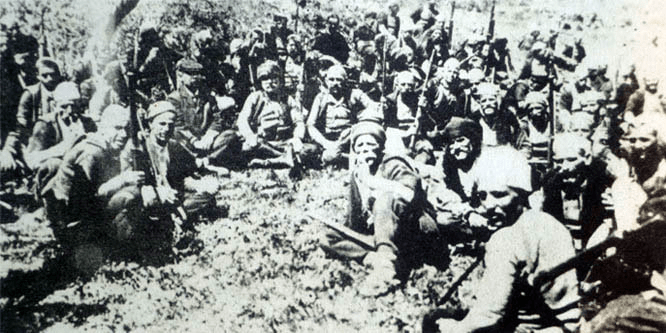
The Kaçak movement in Anamorava represented the Albanian guerrilla struggle against Yugoslav and Serbian occupation from 1918 to 1939. Rooted in centuries of anti-Ottoman resistance, the movement evolved from small, locally motivated groups into a coordinated national liberation force under the Kosovo National Defense Committee. Led by figures such as Azem Bejtë-Galica, Hasan Prishtina, and local commanders like Lotë Vaku and Xheladin Limani, Kaçak detachments resisted colonization, land expropriations, massacres, and forced displacement. Despite repeated suppression, imprisonment, and exile, the movement persisted as both a military and political effort, mobilizing thousands of fighters and maintaining Albanian national identity in occupied territories.
This section, extracted from ““Gjilani me rrethina. Monografia komplet te gjitha kapitujt nga Ideri IX”, discusses the Albanian “kachak” liberation movement of Anamarova during the Yugoslav and Serbian oppression (1918-1939).
Liberation Movement – Kaçake in Anamorava
The Kaçaka movement in Albanian lands, in guerrilla form, has been present since the 16th-17th centuries during the period of Ottoman rule. In this form and formation, it existed until the 1940s.
According to documents, the Kaçake Movement, at first, had an economic character, appearing in small groups, inclined towards narrow self-interests. However, over time, it took on a political character. So fromAlbanian League of PrizrenHence, the Kaçake Movement takes on a primarily political character, becoming massive as a popular movement, it resists with arms in hand against foreign occupying regimes, and especially against the brutal regime of monarchist Yugoslavia.
This guerrilla movement joined the insurgents during the anti-Ottoman and later anti-Serb uprisings, while in peacetime it operated independently under the leadership of the commanders of the squads, which consisted of groups of 3 to 30 and up to 60 people.
At the beginning of the 20th century, this Movement was presented as a primarily militant and national liberation organization. It cannot be ruled out that with its namefugitiveSome looters also operated, but they were quickly unmasked and did not enjoy support from the broad masses of the people.
There have also been cases of Cubans who have gone to the mountains for fratricide or revenge, such as the case of Beqë Ballanca in the Gjilan district and another case in the Kumanovo district and in other places.
The Kaçake Movement manifested itself on a large scale after the First Balkan War, when the vast majority of Albanian lands were occupied by Serbia and Montenegro. The Albanian people, although they changed their occupier from the Ottomans to the Serbo-Montenegrins, did not stop the fight for national liberation, but continued it even during the First World War, even consolidating the ranks of the Movement more and more.
After the end of this war, the Kacchan detachments were consolidated and even better organized, while, with the formation of the Committee –Kosovo National DefenseIn 1918, with its headquarters in Shkodra, the Kaçake Movement took on a national liberation character, therefore, we can affirm that this Movement, which for centuries had only a military wing, with the formation of the Committee, also gained a political wing. From now on, the Kaçake detachments were led by a political wing led byHoxha Kadri Prishtina, Hasan Prishtina,
Bajram Currit, Bedri
Pejanit Qamil Balaand others. This is how the military structures appointed by the Committee in question were formed. In early November 1918, with the proposal of Hasan Prishtina and Bajram Curri,Azem Bejtë-Galicaand officially appointed commander of the armed Cossack detachments in the occupied Albanian lands, starting from Dibra to Pazar i Ri.
While the commanders of the detachments were appointed by the detachments themselves, choosing from among them the most deserving and cleverest brave, the most experienced and most proven guerrilla strategist. These detachments consisted of 3, 20, 30 and 50 and up to 60 proven fighters, who cooperated with each other and, when necessary, joined forces. Orders were received from the detachment leader, while he received them from the regional leader or even from the supreme commander – Azem Galica.
The Kaçaka movement was always massifying. Thus, in 1919, due to the great oppression, massacres, and plunder of the people by the occupying Serbian government, preparations began for a general national war, which also spread to Anamorava, mobilizing around 10,000 insurgents with weapons.
Kosovo National Defense Committee initiated the uprising with which they proved to the European Great Powers that the Albanians of the conquered and occupied lands do not agree with the chauvinist and anti-Albanian Serbian regime, so they seek support for national liberation from this savage and barbaric occupier.
For this purpose, the branches of the Kosovo Committee in all the occupied Albanian lands in Kosovo and Macedonia, up to the New Bazaar, are charged with collecting data on the robberies, rapes, murders and other hostile actions of the Serbian state organs against the Albanian population. The Committee would use this data for protests before the governments of European states.
In March 1919, the preparatory measures for the start of a general uprising were almost completed. Tracts calling for and calling for an uprising had also begun to be distributed. This work was carried out through members of the chetas. The uprising was planned to break out in Drenica, precisely on May 6, 1919 – St. George’s Day, but it began first, on April 24 in Radishevë – the birthplace of the legendary Shota, led by Azem Galica.
The flame of war spread throughout the Albanian lands of Kosovo. Thus, the fire of this uprising also spread to Anamorava. In the Gjilan district, the call for an uprising was given by Lotë Vaku with his squad, who with a lightning action against the Serbian gendarmerie, which had gone to plunder the villages of the Gjilan Highlands in Karadak and which then spread to the villages of Upper Morava, in Kabash and in Beguncë and other villages, led by Xheladin Limani (Xhel Guri), Islam Ali Jusufi –
Drenogllava, Ali Ramadani – Kabashi, Murtez and Liman Sylejmani-Begunca, Fazli Ajeti-Çaushi from Godeni and other leaders of the Kachak chetas in Anamorava.
The most famous leader of the anti-Ottoman uprisings of 1910 at the Battle of Thermopylae in the Kaçanik Gorge was Idriz Seferi-Kreshnik of Karadak, who until 1913 stood with a rifle in his hand, but due to old age and other circumstances, after that year he withdrew from the life of a Kaçak, but nevertheless, with his long experience, he gave instructions and advice for liberation from Serbian captivity.
The Kaçake Movement,According to the actions of the chetas, it was divided into 16 operational zones. Gjilan and Karadak were part of the thirteenth zone with the most famous leaders of the chetas, such as: Lotë Vaku, Xheladin Limani (Xhel Guri), Ali Nekoshtaku, Behxhet Runica, etc. The uprising was suppressed in June – July 1919, but the resistance with rifles in hand continued.
The Kaçak Movement among the mountains continued even further. It is worth mentioning that in this operational area, the leader authorized by the Kosovo Defense Committee and responsible for the areas of Pristina, Llapi, Ferizaj, Karadak, Gostivar and Pazar i Ri was the famous Ibush Vuçitërnalia, popularly known as Ibush Aga, who was also a member of the presidency of the Kosovo Defense Committee in Shkodra.
The Karadak-Gnjilane area, together with that of Ferizaj, formed a natural connection with the operational area of Skopje, Tetovo-Gostivar, and even that of Dibra and Manastir. This connection is also evidenced by the case when on June 20, 1920, Hasan Prishtina, accompanied by Azem Bejta, traveled to Sofia, Bulgaria to coordinate cooperation with the VMRO Committee, based in Sofia, for joint resistance in the war against the Serbian occupying power, where the area in question played an important role.
Hasan did not appear in public, but he was accompanied by Azem Bejta, who ensured his trip to Sofia, where he stayed from June 5-7, 1920. From this consultation, after returning from Sofia, Bulgaria, followedAssembly of the Kaçaka Movement in Murgull i Llapi, held on June 17-20, 1920, in which from the Gjilan-Karadak area, Xhel Guri and Lotë Vaku participated, accompanied by Xhelë Guri’s squad.
This squad also included the 1912 Kaçak, Sali Staneci, whose family was kidnapped by the Serbian army in October 1912 and forced to surrender. Sali surrendered, but now the Serbian regime forced him to change both his religion and his name, and in order to save his family, he agreed to change his religion and name from Sali to Sava, so his comrades in the Shpoti called him Sali Sava, who never let go of his rifle in the fight against the Serbian occupying power until 1927, when he lost all trace of him.
In 1918, his platoon was joined by Jusuf Baftjari alias Hoxhë Lipovica, who, after killing the leader of the Serbian gendarme unit, massacred his family. He remained in the mountains until 1921, when he surrendered and was sentenced to 20 years in prison, of which he served 13 years.
It is also worth mentioning the conflict of the armed Kachak group, led by Jakup Deda of Gjilan and Jusuf Kajolli of Gjylekar, with the Bulgarian occupier in Gjilan in 1918. The conflict began after a dispute with the Bulgarians and after a fierce and unequal fight, during the night, surrounded in a house near the center, after the house burned down, Jakup Deda and Jusuf Kajolli were killed with 5-6 other Kachak, some escaped the siege.
It is also worth mentioning the case of the Kachak Xhafer Jabuqa of Livoqit i Epërm, who after executing the gendarmerie commander named Lubo in the center of Gjilan, joins the Kachak units, and then in a fierce fight with the gendarmes is killed in 1927 in the village of Zhegër.
A bitter story was also experienced by the old Kaçak since 1912 – Ismail Lotë Vaku from Poliçka e Gallapit, born in 1896, during the First Balkan War, he was a soldier in the Turkish army at that time, with whom he went as far as Edirne, but together with Ferat Zarbinca he returned to his homeland and when he returned he found everything burned and ruined, so from that moment he swore in the Albanian oath that he would never let go of his rifle to fight Serbia and its regime.
He started a family in his homeland, but as a Çeta leader we find him until the fall of 1924. After the murder of Commander Azem Galica, he settled with his family in Albania. Until 1941-1945 he remained free in his family, while from 1945-1947 he remained a Kaçak in the mountains, when he surrendered to the authorities of communist Yugoslavia, which sentenced him to 12 years of hard labor, of which he served 9 years.
He died in 1962 in Velekince. Xheladin Limani – Xhelë Guri, was killed on August 23, 1927 in the mountains of Kurbalija, while from Ballanca in Upper Morava there was also the group consisting of Jakup, Fetah and Zenel Ballanca, who also had their own people under their command. From Godeni, well-known Kaçaks who were part of the Kaçak Movement were: Fazli Ajeti-Çaushi, since he was the leader of the gang they called him Çaush, Tahir, Sejdi and Fejzullah Godeni; From Remnik, the well-known Kaçak Halim Remnik and his cousin Sejdiu went to Turkey after 1923 with their families.
From Begraca, there was Lil Begraca, who in the fall of 1923, with 14 other friends, moved to Turkey, where, in agreement with the Yugoslav gendarmerie, they boarded the train at the Gërlica station armed and handed over their weapons after the train left Skopje.
‘From Drenoglava, the well-known Kaçak was Ilsam Ali Jusufi, while from Kabashi, Ali Ramadan Kabashi, Tafë Kabashi, Vesel Haliti, Liman Murtez Sulejmani from Begunca, while from Zhitia, there were Ismail, Sejdi and Shefki Zhitia, along with Brahim and Qazim Gumnishta and Tahir Zhegoci. Tafë Kabashi was the leader of the gang until
1926 when he and his friends went to Albania, among whom was Jonuz Topi-Strezoci, who in 1928 with seven people returned from Albania, but all traces of him were lost, while Tafa returned from Albania in 1939, on which occasion a manhunt was organized for his capture. Tafa was captured in a mill and tried in prison, where he found himself during World War II.
After 1923, the Kachak Xhumë Mirashi, who was an associate of Lil Begraca, also operated in the territory of Gjilan, who did not go to Turkey, but operated in the territory of Gjilan until 1927, when in Lower Livočin, in a battle with Serbian gendarmes after killing a Serbian chaplain, he was seriously injured and died from this wound.
The Kaçak National Liberation Movement in Anamorava developed within the framework of the Kaçak Movement in Kosovo. It therefore fought against the oppressive yoke of the occupier and its oppressive forms, such as the Agrarian Reform and colonization and displacement to Turkey and elsewhere, it fought against Serbian violence and massacres, thus it fought for national liberation.
References
- Azem Bejtë-Galica, Pristina 2009.
- Kadriu, Ibrahim,Ramiz Cernica – symbol of national unity, Pristina 2011.
- Kosovo National Defense Committee; Tirana 2004.
- Rushiti, Liman,Memories of the Kaçaka Movement, Pristina 2003.
- Rushiti, Liman,The Kaçaka Movement in Kosovo 1918-1928, Pristina 1981.
Source
“Gjilani me rrethina. Monografia komplet te gjitha kapitujt nga Ideri IX”. 2012. p. 178. Authored by Sabri Tahiri, Mehmet Halimi, Sabile Keqmezi, Fehmi Rexhepi, Aliriza Selmani, Ismajl Kurteshi, Lirije Kajtazi, Emin Selimi, Reshat Ramadani, Ejup Haziri, Enver Sadiku and Salih Mustafa.


 Balkan Academia