
The passage discusses land ownership in the Skopje Plain near the end of Ottoman rule, naming prominent Muslim landowners (beys and pashas), the existence of vakuf (religious endowment) lands, and the social-economic changes after the Ottoman withdrawal in 1912.
Abstract
This text examines patterns of land ownership in the Skopje Plain (Skopsko Polje) during the final years of Ottoman administration and the early post-Ottoman period. It identifies major Muslim landholding families and individuals, describes the presence of vakuf lands whose revenues supported religious institutions, and notes the fragmentation of smaller estates across surrounding villages. The passage highlights how the liberation from Ottoman rule in 1912 triggered significant social and economic change among the local Macedonian population. Overall, the document provides valuable insight into late Ottoman agrarian structures, elite land concentration, religious land endowments, and the transition toward new social realities in the Balkans.
Translated:
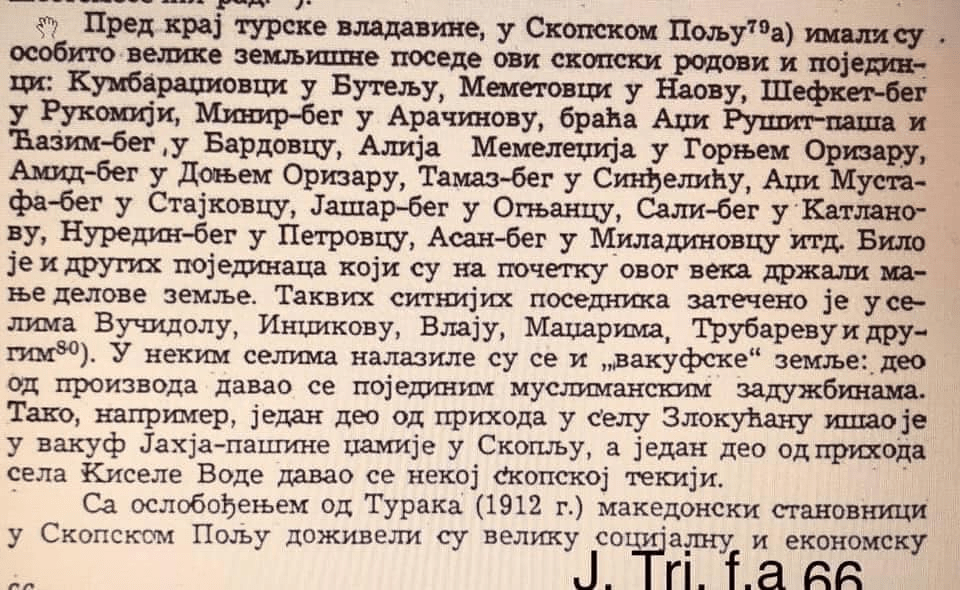
“Towards the end of Turkish rule, in Skopje Poljuča, the following Skopje families and individuals had particularly large land holdings: the Kumbaradži family in Butelj, the Memet family in Naovo, Shefket-beg in Rukomija, Minir-beg in Aračinovo, the brothers Adži Rushit-paša and Ćazim-beg in Bardovac, Alija Memeledžija in Gornji Orizar, Amid-beg in Donji Orizar, Tamaz-beg in Sinđelić, Adži Mustafa-beg in Stajkovac, Jašar-beg in Ognjanac, Sali-beg in Katlanovo, Nuredin-beg in Petrovac, Asan-beg in Miladinovac, etc.
There were also other individuals who held smaller parts of the land at the beginning of this century. Such smaller landowners were found in the villages of Vučidol, Indžikovo, Vlaj, Madžari, Trubarevo and others. 80) Some villages also had “wakuf” lands: part of the produce was given to individual Muslim foundations.
For example, part of the income in the village of Zlokućan went to the waqf of the Yahya Pasha Mosque in Skopje, and part of the income from the village of Kisele Voda was given to a Skopje tekke. With the liberation from the Turks (1912), the Macedonian inhabitants of Skopje experienced great social and economic change.”

 Balkan Academia