
Abstract
This article delves into the history of oppression, atrocities, and war crimes committed against Albanians in the town of Gjilan, situated in Kosovo, during the period between 1945 and 1990. The study highlights the role of the Yugoslav and Serbian communist regimes in systematically suppressing the Albanian population, employing violence, imprisonment, forced assimilation, and other forms of repression. By analyzing historical records, testimonies, and declassified documents, the article sheds light on the experiences of the victims, the methods used to suppress Albanian cultural and political identity, and the lasting consequences of such practices. The paper contextualizes these events within the broader framework of communist policies in Yugoslavia and Serbia, offering insights into the tragic legacy of ethnic conflict that continued to shape the region for decades.
This section, extracted from ““Gjilani me rrethina. Monografia komplet te gjitha kapitujt nga Ideri IX”, discusses the Serbian and Yugoslav oppression of Albanians of Gjilan between 1945-1990.
Cited:
The Assembly of Prizren (8-10 July 1945)
Kosovo, crushed by military power, will arrive on July 8-10, 1945 at the Second Conference of the National Council for Kosovo, which was held in Prizren. As is now known, this conference was held under pressure and under the threat of gunfire. The majority of the delegates were Serbs and Montenegrins, but to create confusion among the Albanian delegates, they had worn white turbans.
This assembly arbitrarily declared illegal and corrected the centuries-old will and aspirations of the people of Kosovo, expressed at the First Conference of the National Council for Kosovo and the Dukagjini Plain, held in the village of Bujan in the Gjakova Highlands (December 31, 1943-January 1 and 2, 1944).
The conference was held in wartime and precisely at the time when the other nations of Yugoslavia also established the highest organs of power emerging from the National Council, at a time when each nation was realizing, according to its own wishes, his will the right to self-determination, but for Albanians, in all likelihood, these principles did not apply.
Following in the footsteps of Albanian nationalism, the Bujan meeting (December 31, 1943 and January 1 and 2, 1944), defined as a major goal the unification of Albanian lands. These decisions that were taken at this meeting were not a manifestation of any extreme nationalism, although later its decisions were not respected.
The right of self-determination of the Albanian people for the war and the sacrifice they made was not taken into account. The subsequent period proved that this fragmentation was the main source of dissatisfaction that occurred in the Albanian population.
The Prizren Assembly conducted its work under Yugoslav military administration, under total occupation. In the Resolution of the Prizren Assembly, it was declared that Kosovo “with the will of its population it joined Federal Serbia within the framework of the Yugoslav Federation”.
Such a solution of the issue “with the will of the population of Kosovo itself” against the logic of the objective character of the national structure of Kosovo and the vast space, and with the continuity of the Albanian ethnic majority in the Balkans, not only did not close historically the problem of Kosovo and the Albanian one, but reopened this issue, virtually, in a new historical context, on a geopolitical scale in the Balkans. All this that followed influenced the nationalist forces in Kosovo to react harshly to the decisions that the Assembly brought in an arbitrary manner.
The Prizren Assembly was neither the first nor the last to pass decisions to annex Kosovo from Serbia and Yugoslavia. The annexation by this federal unit had begun earlier, while the Yugoslav rulers formally demanded only a “people’s verdict”
In fact, on November 9-12, 1944 in Belgrade, at the meeting of the Anti-Fascist Assembly of the National Liberation of Serbia, before Tito received a group of Albanians from Kosovo, who came to inquire about its vital fate, there was talk of Kosovo.
More precisely, there was talk of Kosovo on September 2, 1944, when the Main Staff of the UNC and AP of Kosovo, by order of the Supreme Staff of the UNC and APJ, was placed under the command of the Main Staff of the UNC and AP of Serbia. From that time on, the Main Staff of the UNC of Kosovo became the Operational Staff of the UNC and AP of Kosovo.
In February 1945, a meeting was organized at the Central Committee of the Communist Party of Yugoslavia, where, among other issues, Kosovo and its future status were discussed. From all this, it emerged that the best and most just solution was for “Kosovo and Metohija to join Albania, while Albania would enter the Yugoslav Federation.
But, since the circumstances international organizations are not favorable to such a step – for the unification of Kosovo with Albania and the entry of Albania into the Yugoslav Federation, Kosovo and Metohija as an autonomy should join Serbia, but there were also proposals that Kosovo should belong only to Montenegro, because they had a similar history and a similar mentality to the Albanians.
In the documents of the Anti-Fascist Assembly of National Liberation of Serbia, which was held on 7-9 April 1945 in Belgrade, Dushan Mugosha and Mehmet Hoxha participated as guests from Kosovo, who discussed in the session, and according to the document it was said that they expressed the desire on behalf of the people of Kosovo that “Kosovo be under federal Serbia” and from these discussions that took place in Belgrade it can be concluded that Kosovo joined Serbia arbitrarily, based on the discussions that were held by two guests, it was well known based on historical documents that Kosovo and its people never discussed, were asked and voted for it to remain within the framework of federal Serbia.
As a result, in order to reach legal decisions, the Second Assembly of the Provincial National Liberation Council of Kosovo and the Dukagjin Plain was convened. The Assembly meeting was held on July 8-10, 1945, and this entire gathering was subject to various pressures, because many prominent patriots and patriots participated, who did not accept, even at the cost of their lives, that the Albanian lands would remain under the former Yugoslavia.
Those who opposed such a step were later found guilty and imprisoned without justification, and some were even secretly liquidated by the organs of the National Liberation Front. There were many of them, but we are mentioning only some of those who belonged to the Gjilan side, such as: Ramiz Cërnica, Adem Stançiqi, Hasan Dylgjeri and some others. But, on this occasion, I would only dwell on the reaction of the prominent patriot of Anamorava, Ramiz Cërnica, who openly came out in the Assembly against the devouring positions of Serbia, saying that:
“We are Albanians, we have one language and one blood with the Albanians of Albania… Where have you seen in the history of humanity that a child turns his back on his mother and embraces his stepmother? This is neither logical nor acceptable for us Albanians, but after this discussion, an unprecedented commotion followed in the hall.”
Some of the leaders asked for his speech to be interrupted, some asked for him to be thrown out, and many other proposals were made. But Ramiz Cërnica’s ordeal did not end there; he was later pursued and arrested by the organs of the OZN, where he was sentenced to 20 years in prison.
Even after leaving prison, he was not left alone; at the same time, the other members who participated in the Assembly and did not agree with the decisions made in it were also followed by the Udbaš and some of them spent years in Yugoslav prisons.
The annexation of Kosovo by Serbia, as we will see later, was only part of the injustice done to Albanians in communist Yugoslavia, because the Kosovo issue was not entirely an Albanian issue. The injustice done to the Albanian people in the former Yugoslavia was further aggravated by the fragmentation of the territories in which Albanians were the sole population or the overwhelming majority into three Yugoslav republics: the Republic of Serbia, Macedonia and Montenegro.
Kosovo, not only did not join the mother state, but it was annexed, not only by the territories inhabited entirely by Albanians in Western Macedonia and Montenegro, but also by Preševo, Bujanovac and Medveđa, in which Albanians were the overwhelming majority.
At the end of 1945, immediately after the end of the war, all the problems related to Kosovo and its future were raised and attempts were made to solve them within the framework of Tito’s Yugoslavia. During the war, the leaders of the Communist Party of Yugoslavia had promised that the future of Kosovo would be solved by the people living there themselves, with the understanding of the parties and popular democratic regimes that would be established in Albania and Yugoslavia, after the victory over fascism.
During the war, it was constantly said and written that after it (the war), the Moscow Declaration, the Atlantic Charter, the Tehran Declaration, Tito’s letter published in the newspaper “Proleter”, the Bujan Resolution, and many other documents of historical importance would be respected.
After the annexation of Kosovo, a dark period began for the Albanian people, a real ordeal. Mass massacres of innocent people began again, and many patriots and intellectuals were liquidated. In Gjilan and its surroundings and in many other places in Kosovo, genocide was being carried out.
Jusuf Ibrahimi from Gjilan, who was the Commander of the Youth Battalion, and many others were liquidated. Even though it was occupied, Kosovo was still treated as a dangerous and unsafe area because it was inhabited by a non-Slavic majority population, oppressed and discriminated against, which is why there was fear among the occupiers.
The year 1945, it is worth mentioning that among the population of Gjilan and the surrounding area, will be remembered as the bloodiest year in the history of Kosovo, because thousands of Albanians will be shot, many others will disappear without a trace, thousands will be put in prisons and placed in camps, hundreds and thousands of others will be exposed to the world (as in Turkey, Greece and other countries), and many others will be killed outside Kosovo. All of this will be done under the guise of some illusory “brotherhood-unity”.
Albanian delegation meets with Tito
Given the political developments of the first months of 1945, the unprecedented genocide and terror against the innocent Albanian population, on the initiative of some Albanian patriots, a position was taken to discuss the issue of Kosovo with Tito himself, because during the war, self-determination of peoples had been promised and said many times.
Based on these promises, the Albanian people actively participated in the war for liberation from fascism, and for the unification of Albanian lands into a single state. The visit of the Albanian delegation to Belgrade took place on April 6, 1945, and according to the documents it was stated that the main topic was the future status of Kosovo and the agrarian issue.
The delegation was also attended by representatives from the Gjilan district: Mehmet Hoxha, Halim Spahija, Mehmet Krileva, Qamil Luzha, Demë Taraku, Ahmet Nishku, Hilmi Zariqi, Rifat Berisha, Ismajl Haxhi-Kaçaniku, Ahmet Efendi Mitrovica, Vesel Rexhepi, etc.
They (the Albanian delegation) had prepared seven written requests, which they submitted to Tito, and in those points it was requested:
- The agrarian law should be improved.
- Administration to be conducted in Albanian in Kosovo
- Bring teachers from Albania to Kosovo
- Land sales made with threats from Serbs should not be accepted
- Innocent prisoners pardoned
- To guarantee the use of the national flag and
- To recognize the right to self-determination
Tito accepted the first five (5) points, according to a statement by Qamil Luzha, but he publicly rejected the last two, and from this it was very clear what awaited the Albanians. At the Third Conference of the CPJ for Kosovo, Blagoje Neshkovic denied any participation of Albanians in the LANÇ, saying that “You in Kosovo and in the Dukagjini Plain do not have anyone who does not have a rifle and these people can rise up in rebellion at any moment,” continuing further that “as for political victory, it is clear that it cannot even be spoken of, because we are quite far from it. The people are not with us. We are seeing that the Albanians in the largest number are against the National Liberation Movement.
These assessments were made when Tito, in talks with the delegation of Kosovo Albanians in April 1945, in one way accepted, but in another rebuked the delegation for not being with the LANÇ. At the Founding Congress of the PKS, 8-12 May 1945, he introduces the discussion with the Albanian delegation, recounting to those present what he had told the Albanians at the meeting:
“We know that you were with the German army and that you fought against us, but that does not mean that we will call you to account…We do not want the Albanians in Kosovo to be second- or third-class citizens. We want you to have your rights, equality, to have your own language, your own teachers, to feel like you are in your own country.” (Tito had probably forgotten that the Albanians were in their own land, and they – the Serbs – were the occupiers themselves, who wanted to feel like they were in their own country.)
Formation of the Supreme Headquarters of the Albanian People’s Democratic Army in Kosovo
All these injustices, with reason, created dissatisfaction among the Albanians. For this reason, a faster and better organization was expected by patriots and intellectuals. In this period and under this constant pressure, nationalist forces arose and acted, which in an organized manner, through illegal organizations, articulated their primary and supreme goals and demands, which were: the liberation of Kosovo and the unification with the mother state – Albania.
The core of the nationalist forces for the formation of the Albanian Democratic Army is found somewhere in November 1944. After the formation of the Supreme Headquarters of Kosovo of Adem Gllavica on December 1, 1944, the idea was born that in every part of Kosovo, where Albanians live, illegal organizations, as well as smaller groups of Albanian illegals, should be formed.
In the wake of this activity of patriotic movements, many Albanian patriotic organizations were formed, with a certain time interval, which were manifested especially after 1944 and at the beginning of 1945. In these years, both throughout Kosovo and in the vicinity of Gjilan, powerful nationalist organizations were formed such as: Albanian National Democratic Organization (ONDSH) and others. less well known.
These nationalist groups widely represented the young Albanian intelligentsia, which aspired to a united and democratic Albania.
On the other hand, it is necessary to underline that Albanian nationalism has an essential difference from other Balkan nationalisms. It was not extreme in its activity, it did not put forward violent territorial revisionism, it was not based on religious fundamentalism and ethnic exclusivism.
During this time, the urgent and indispensable need arose for the leaders of the movement to operate in deep underground. This meant that a different organization had to be created, which the course of events imposed, from the previous one.
During this period, many prominent patriots were formed, acted and at the same time were discovered. Many people were shot and many others were sentenced to many years in prison. Thus, on August 15-16, 1945, Adem Gllavica as commander of the Supreme Staff of Kosovo took the position of inviting the leaders of the Albanian underground, and representatives of all illegal organizations.
The gathering was held in Kopilaçë, a place between Upper Morava and Karadak of Skopje. The main leaders of the nationalist forces such as: Hysen Tërpeza, Adem Gllavica, Ibrahim Haki-Kelmendi, Luan Gashi, Tefik Tanisheci, Hasan Kabashi, Dinë Hoxha, Qazim Llugaxhiu, Sylë Hotla, Hoxhë Lipovica, etc. had come to this meeting. Also participating were many members of the ONDSH, such as: Qemal Ali Skenderi, Mexhid Haki-Zyberi, Xhemail Bllacaetj, who represented the ONDSH CC in Skopje.
The Kopilaça rally lasted two days, and from there the most important historical positions emerged, and the Albanian resistance movement will consider the rally as the III Congress of the National Front or as it would later be called the First Congress of ONDSH.
The decisions that were of great importance and weight for the movement were: The Albanian Resistance Movement was decided to be called the “Movement for the Liberation of Albanian Lands”. Among other decisions, the Congress took the position that the Central Committee of the ONDSH in Skopje would be the highest party body of the Movement for the Liberation of Albanian Lands.
All nationalists who fought for the liberation of Albanian lands would be called the “Albanian People’s Democratic Army”. It was also decided at this congress that, given the large number of fighters, units and groups that were in the field and were under arms, a better and more advanced organization would be established.
Five battalions were formed at the Congress. Each battalion will have a Command Staff within its framework, which will act under its orders where the need arises. At this same gathering, the battalion commanders were also appointed, according to the terrain they were from.
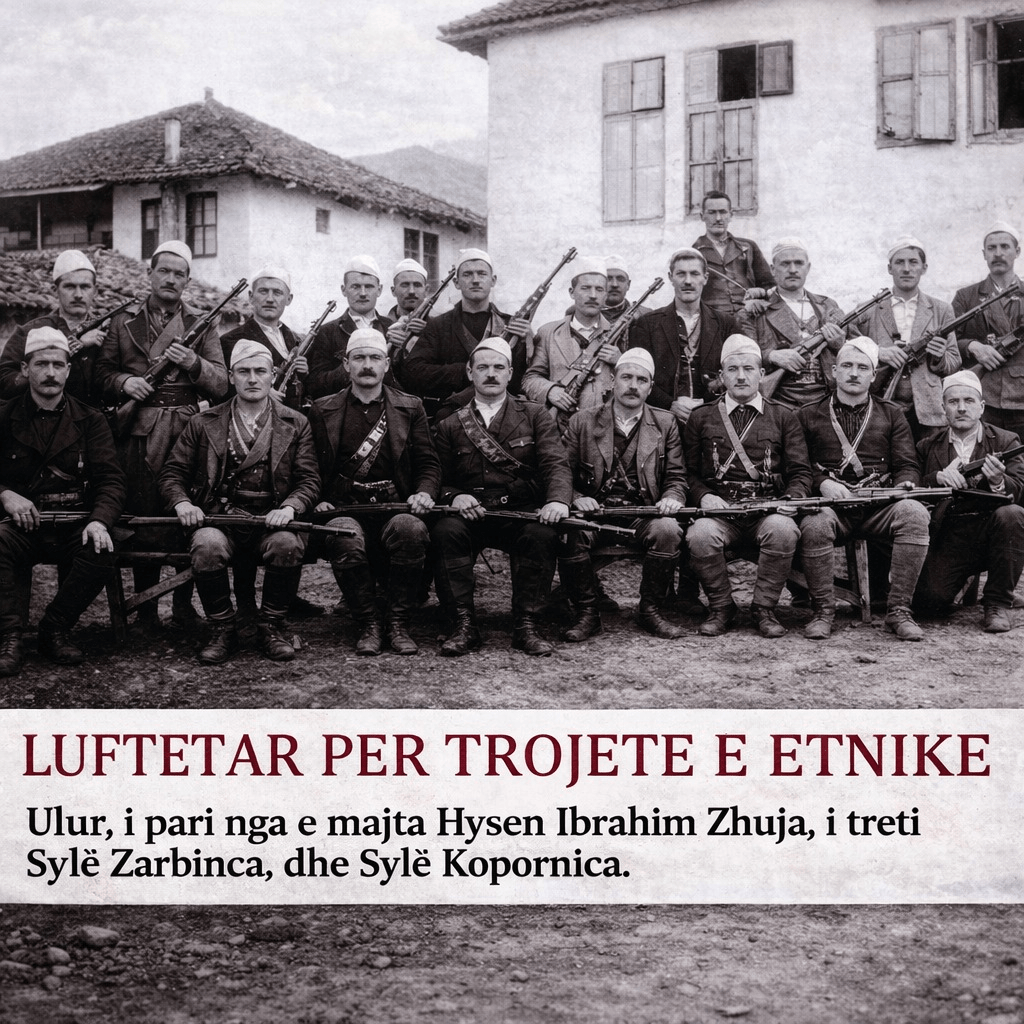
Hysen Terpeza
The commander of the First Battalion, which would have the Kopilaçës Mountains and the main part of Karadak as its operating area, was the patriot Hasan Kabashi, while the Second Battalion was assigned to operate in the Presedeli Mountains under the leadership of Bajrush Gjakli.
The Third Battalion, which would operate in the Keçekolla Mountains, was assigned to be led by Rexhep Okllapi. Shaban Haliti was appointed as the leader of the Fourth Battalion and would operate in the Jezerc and Budakovë Mountains. While in the Kaçanik and Skopje Mountains, the Fifth Battalion was assigned to operate under the leadership of Din Hoxha, who was a seasoned fighter and had rich organizational experience.
At this same gathering, the “War Headquarters” was also formed. Hysen Tërpeza was appointed Supreme Commander of the “Albanian People’s Democratic Army”. The following were appointed to participate in the War Headquarters: Adem Gllavica, Luan Gashi and Ibrahim Kelmendi, who were assigned to the propaganda sector, but who would also operate in the areas of Skopje and Tetovo under the care of Ibrahim Kelmendi, and in the areas of Suhareka and Prizren under the care of Luan Gashi. From this Congress, the Supreme Headquarters also approved the platform for addressing the Albanian people with a proclamation.
The proclamation, which was drafted by Adem Glavica, Abdullah Musliu and Ibrahim Cërnilla-Grainca, included the main points of the current situation in Kosovo, such as: acts of communist betrayal, of Yugoslav communists against Albanian communist and anti-fascist allies, then in a large part the forms of Yugoslav violence against the Albanian people were included. Among other things, it rejects any imposed connection of Kosovo with Serbia and Yugoslavia.
The OZNA was aware of all the activities carried out by the Albanian People’s Democratic Army and members of the illegal organizations and followed their every move with special care. It had taken punitive measures against the nationalist forces, the ONDSH members and their families. It often happened that in the numerous actions the UPDSH would leave with heavy losses, because the OZNA followed their every move, so it was not a coincidence that they were discovered.
Mithat Frashëri and Muharrem Bajraktari were aware of all that was happening in Kosovo. It was quite natural that at the beginning of October 1945, a request would come from them for the passage of the resistance forces to Greece, and many nationalist personalities reacted to this request, but the CC of the NDSH in Skopje also reacted to it.
The leaders of the UPDSH Combat Headquarters and the Albanian resistance movement, following the request of Muharrem Bajraktari and Mithat Frashëri, had two alternatives before them: to stay in Kosovo, to wage a type of war that would differ from what had been waged until then, and which, given the dire situation that had been created in the country, could result in great casualties, both among the fighters and among the general Albanian population, as intensive pursuit and arrest of the supporters of the illegals and all those who sheltered and helped the freedom fighters began.
The second alternative was that for the leaders of the movement it was even closer and more acceptable to them, leaving the country as a good chance, to save the fighters and to spare the population from the mistreatment of the OZNA and the UDB.
The position was taken to support the first alternative, because the best way was the exile of the fighters outside the homeland, which would later enter the service of the Anglo-American global plans for the destabilization and overthrow of the communist power in Albania and Yugoslavia, while the issue of the liberation and unification of the Albanian lands annexed by Yugoslavia would come as a result of changes in the system of the two neighboring countries, Albania and Yugoslavia.
On November 28, 1945, the Commander of the General Staff of the UPDSH, Hysen Tërpeza, with the First Battalion, took a position to cross the border. This battalion initially consisted of about 100 people, but during the journey the number of fighters kept increasing. Thus, upon crossing the border, this group reached over 300 fighters.
The people followed the departure of the fighters with great concern and with tears in their eyes. Everywhere they went, they were followed with pain. Was it possible that these brave freedom fighters were only followed by the people, or were they also followed with the greatest care by the OZNA and its collaborators.
The Yugoslav Army was informed in time about the departure of the fighters. Thus, in the territory of Macedonia, near the Yugoslav-Greek border, they encountered an ambush by the Yugoslav Army, where a fierce battle ensued between them.
The Second Battalion, led by Adem Glavica, also took a stand to leave the country. This group, on December 31, 1945, crossed the Yugoslav-Greek border. On the way, like the First Battalion, they were ambushed by large forces of the Yugoslav Army. In this clash, too, there were heavy losses on both sides.
This group was not joined by Ajet Gërguri, who returned to Drenica with several fighters and continued the armed struggle until he was discovered and arrested. Mulla Idriz Gjilani and his friends did not leave the country, as well as the Hetë Kokës Group, Ali and Limon Staneci, Hoxhë Lipovica, Hajdar Malisheva and others. Later, most of them were liquidated by the UDB forces and the Yugoslav army, such as Xheladin Kurbaliu, Muharrem Fejza, Faik Taliri, Adem Kaçari-Tupalla, Hoxhë Lipovica, Shyt Mareci, etc.
Although these groups left Kosovo, the new consolidation took place very quickly, and more than 55 illegal groups and patriotic-political organizations operated in Kosovo, such as the LNDSH, Prof. Ymer Berisha’s “Besa Kombëtare”, Ajet Gërguri’s “Organizata NO-2”, all of which maintained close ties with the CC of the ONDSH in Skopje.
Formation of the Albanian National Democratic Organization (ONDSH)
In these newly created circumstances (1945), Kosovo and the Albanians gained an inferior status compared to the other republics and peoples of Yugoslavia, therefore, their anger was quite natural, and they began to manifest that anger in various ways of organization.
The Albanian people threw themselves into the uprising, which Tito’s “partisans” put down with blood. From an open form of war, they were forced to go underground and form illegal Albanian patriotic political organizations for the unification of Albanian lands.
One of these organizations that undoubtedly caused a stir was the Albanian National Democratic Movement (LNDSH) in Kosovo, Macedonia and other Albanian areas in the former Yugoslavia. The patriotic actions and feelings of Albanians, their love for their homeland, their transparent display of desire and centuries-old aspirations for national unity, were not only ignored, but were considered as “Albanian-Romanian” and grist for the enemy’s mill.
The recent history of Eastern Kosovo, in particular of Anamorava, as part of the history of the Albanian people as a whole, has gone through extremely difficult and extremely dramatic periods, therefore, it is worth noting that after the “liberation” of Gjilan and Ferizaj on November 16 and 17, 1944, a new stage of the development of the people’s dissatisfaction with the new government began. From this time, the Albanian armed resistance against the establishment of partisan power began in these areas.
With the emergence of the LNDSH, for the Albanians of Kosovo in general and Anamorava in particular, a new stage begins in the movement for liberation and national unification, a chapter in the efforts to create an Albanian state – an Ethnic Albania, that is, not a big or small Albania, but a normal Albania with its historical and ethnic borders.
Formation of the Central Committee of ONDSH in Skopje
The Central Committee of the ONDSH in Skopje was formed in April 1945 and also carried out its activities in Kosovo and Macedonia. This Committee had a longer operational life than the CC of Prizren, temporarily until 1946, when its activities were discovered.
Throughout the entire time, the Skopje committee was very active because it also maintained connections with foreign representatives in Skopje, such as the English, American, French, Turkish representations, etc. There is no doubt that Gjon Sereqi, Hysni Morana and Gjilanas like Halim Orana, Haki Sërmaxhaj and Hamdi Berisha, etc. had a particularly important role in the CC of Skopje.
At the I (III) Congress of the ONDSH held in Kopilaçë, not all the other guests participated, and their non-attendance meant that the Central Committee of the ONDSH was not elected, and all this was left to be done later, at the next congress, where other delegates would also gather. It was decided that the next congress would be held on June 1, 1945 (respectively, it was scheduled to be held ten months ago by the I Congress of the ONDSH). All representatives of all ONDSH committees operating at that time were invited to this great gathering of national resistance.
The IV Congress of the ONDSH was scheduled to be held in even more unfavorable conditions than the first one held in Kopilaçë. However, the precise moment required such an action, because in the meantime, the members of the CC of the ONDSH in Prizren were discovered and arrested.
This was also the reason that conditioned the taking of preliminary measures, because administrative-military power had been installed in Kosovo and any illegal action was difficult. This influenced the urgent measures to be taken in the matter of organization. According to some available data, only 12 delegates participated in the Congress, because the political situation was very serious and tense.
Every action or movement was followed with suspicion by the government bodies. However, those present took the position that the Congress should carry out its work, because in the future no one could predict the improvement of the political situation in the country.
A new leadership of ONDSH emerged from this Congress. The distinguished patriot and activist Halim Orana from Gjilan was elected Chairman, Qemajl Skënderi was elected Vice-Chairman and Azem Morana, Secretary of the organization, while members of the CC of ONDSH were proposed and elected: Hamdi Berisha, Mehmet Bushi, Hysen Rudi, Januz Balla, Mahmut Dumani, Hasan Bilalli, Mulla Haki Efendi Sërmaxhaj, Osman Cani and Mitat Tershana.
The Congress was also greeted by Luan Gashi, who had come from Perugia, Italy and who at that time was secretary of the National Front Committee. During the work it carried out, the Congress approved a series of documents, which later had great historical importance. The delegates approved by acclamation the “Organization Scheme” and the “Program of the Movement for the Liberation of Albanian Lands”.
At the Congress, it is worth mentioning that special gratitude was expressed to Halim Orana for his work and drafting of documents, because without his commitment, the work of the Congress would have been weaker and not at the proper level.
The Congress also approved the Program of the “Movement for the Liberation of Albanian Lands”, which in the future had an echo and facilitated the further work of the members of the movement. The program in question had five points:
1. Complete freedom and independence with rights of self-government based on the expressed will
2. Albanian lands meant all the places where Albanians live, in
60% regardless of what the province or country is called and who it is occupied by.
3. The movement does not have a hostile stance against any neighboring people, nor against political parties, it only insists that culturally and with weapons it will strive to achieve the centuries-old ideals of the Albanian nation to be free and self-governing in its own state with ethnic borders.
4. Once ethnic borders are established, regardless of other border conditions: strategic, economic, political, etc., the population of national minorities will be exchanged in a friendly manner, attracting Albanians who will remain outside the borders instead of those who will be displaced and expelled.
5. In times of peace, the Movement will not cease, but will continue as a guardian of the rights of the Albanian people, both internal and external, to organize a truly democratic regime and for friendly relations with the neighboring Balkan peoples.
In order to make the work in the field work better, they undertook and made many organizational changes. Before the IV Congress, the village and commune committees from the Gjilan district were directly connected to the Central Committee of the ONDSH in Skopje, and not to the Gjilan district committee. This form of work had been hindered, therefore, from the IV Congress, Haki Sermaxhaj was the main leader for the Gjilan district and in this respect the organization and activity was more successful in every direction.
At the beginning of 1946, despite the engagement of large military forces and prosecution bodies, despite the violence, murders, and imprisonments, the political-military activity of the Albanian Anti-Yugoslav Resistance Movement not only did not cease, but on the contrary, continued the fight for the liberation of the Albanian lands under new conditions of reorganization.
The organizational network of the ONDSH CC in Skopje expanded, with the formation of new committees in Kosovo and Macedonia, transforming into a mass movement. It should be noted that even the leaders of the ONDSH themselves were forced to admit that at that time, within the framework of the Albanian Anti-Yugoslav Resistance Movement, led by the ONDSH CC, over 30,000 people, soldiers, auxiliaries, and comrades-in-arms, that is, active members, organized in 54 committees and numerous guerrilla units in the Albanian territories under Yugoslav occupation.
In the spring of 1946, the ONDSH District Committee was formed in Gjilan, which was directly connected to the ONDSH Central Committee in Skopje.
It is worth noting that this committee included a large number of intellectuals from that area, a large part of merchants and a considerable number of civil servants who worked in state bodies, because after all, even in the ONDSH Program, it was stated that the more members of the ONDSH join the ranks of the Communist Party, of power, the easier it will be to discover the intentions of the occupier.
It should be noted that members of the Gjilan Regional Committee were: Myderriz Haki Taib Efendiu (37 years old), Hamdi Berisha (20 years old), Maliq Sahit Çollaku (38 years old), Mumin Jakupi (30), Ramadan Agushi (26 years old), Jakup Malisheva (40 years old), Arif Salihu-Rogaçica (40 years old), Mulla Riza Osmani (42 years old) and Destan S. Budrika (33 years old). From the ranks of this leadership, two were also members of the CC of the ONDSH in Skopje: Myderriz Haki Taib Efendiu and Hamdi Mulla Ymer Berisha.
The Democratic Committee of Albanian Youth also acted quite actively, extending its activities to the villages of Dardana (formerly Kamenica). This committee. They were led by Hamdi Berisha, Haki Efendi Sermaxhaj, Ramadan Agushi, Destan Budrika, Jakup Malisheva, etc.
After the completion of the proceedings of the 4th congress held in Skopje, Haki Taib Efendiu participated as a representative from Anamorava, on which occasion he had requested to be relieved of his position as the committee leader, but the leadership of the CC of the ONDSH in Skopje took the position that his request would be considered later.
At the meeting he called, immediately after returning from Skopje, the mayor asked to be relieved of his position as chairman.
The Regional Committee, proposing that Rexhep Shemë Dajkoci, an active and determined personality, be appointed as the operational chairman. Myderriz was loved and appreciated by the members of the committee, although it was difficult for him to leave the position of chairman, and at the suggestion of those present, Rexhep Shema will formally accept the position of chairman, in order to carry out the work in the field, where Haki Efendiu could not go, while Myderriz Haki Efendiu will remain the nominal chairman of the committee.
Who was Halim Orana?
The great patriot and intellectual from Gjilan, Halim Orana was born in 1914 in Gjilan. He completed primary school in his hometown, while secondary school – Normal School in
Skopje. He was the first lawyer from Gjilan. He had already started dealing with political issues and problems that burdened the Albanian people early on. During the L.D.B. he was appointed ambassador of the state
Albanian in the independent Croatian state in Zagreb. Immediately after the great betrayal that was done to Kosovo in 1945, he was involved in the LNDSH. He was the chairman of the Central Committee of the NDSH. On June 1, on his initiative, the Fourth Congress of the NDSH was called and held in Skopje.
With his involvement, many NDSH committees were formed in Macedonia also in Kosovo. In 1947, the activities of the Central Committee of the NDSH and Halim Orana himself were discovered by the organs of the OZN. He was imprisoned and quickly sentenced to death, in which case he was shot in the military prison in Belgrade.
Myderriz Haki, Ef. Sermaxhaj
The great patriot Myderriz Haki ef. Sermaxhaj was born on October 14, 1914 in the village of Hogosht, municipality of Dardana (former Kamenica). He completed primary school in his hometown, while he started his Madrasah in Gjilan and finished it in Skopje. For a while he worked as a religious teacher in Gjilan.
Mulla Haki, like many other patriots, seeing that his country was being plundered by the centuries-old occupier, was committed to protecting the Albanian lands. He was an organizer of the defense of the Eastern Kosovo border and a member of the Regional Committee of the Second League of Prizren for the sub-prefecture of Gjilan. In 1945 he joined the Movement of
Mulla Haki ef. Sermaxhaj
NDSH and was elected Chairman of the ONDSH Regional Committee of this sub-prefecture and a member of the ONDSH CC in Skopje. Mulla Haki ef. Sermaxhaj was also a participant in the Fourth Congress of ONDSH that was held in Skopje on June 1, 1946. With the discovery of the ONDSH activity, the patriotic activity of Mulla Haki ef. Sermaxhaj was also discovered. He was arrested on October 13, 1946. In the Gjilan court process, he was sentenced to 20 years in prison.
In the Mitrovica Srem prison where he was sent to guard the prison, due to the severe mistreatment he suffered from the guards and the extremely difficult conditions, the patriot died on March 27, 1948 from tuberculosis, after only 8-9 months of staying in the Mitrovica Srem prison hospital. He was buried by his prison comrades in the Mitrovica Srem prison cemetery.
The V Congress of ONDSH and its echo in Anamorava
Regarding the holding of the Fifth Congress of the NDSH, the members of the Gjilan Regional Committee and other members of the NDSH in Anamorava were notified through Kemajl Skënder. The Committee had held a meeting of the presidency on July 21.
The meeting was held at the house of Maliq Sahiti, where the decision to hold the Congress was approved. This Committee also appointed the delegates who would participate in it: Rexhep Shema-Dajkoci, Hamdi Berisha and if possible Myderriz Haki Efendiu, while Maliq Çollaku had also proposed Ramadan Agushi, who had not been in good health that day, and therefore had not been able to participate in the Congress, where the leaders of the Albanian underground would gather.
The V Congress was called to be held on June 25, 1946 in the Lipovica mountains of Drenica, but in order to lose track of the Yugoslav security agencies, it was announced that it would be held in Kozmaç. This tactic, which was used by the leaders of the ONDSH, was successful, because the Congress was held without being discovered by the prosecution agencies.
Over 250 delegates participated in the Congress, which is why it is considered to have been the most massive in the Albanian underground of Kosovo. However, on the eve of the Congress, on July 14, Hamdi Berisha was imprisoned and two days later most of the members of the CC of the ONDSH in Skopje were arrested, therefore, only Rexhep Shema participated in the Lipovica Congress as a representative of the Gjilan District Committee, while on behalf of the NDSH activists from the Dardana side, at the proposal of Rexhep Shema, Bajram Kryeziu from Rogačica participated – this information is also confirmed by Ibrahim Cërnilla given to the investigator on August 5, 1946, while on behalf of the armed resistance forces of Eastern Kosovo, Shytë Mareci participated, with 3-4 followers.
However, two main options emerged at the Congress: 1. Staying in Kosovo, regardless of the circumstances and conditions, and 2. The other option supported the temporary landing of the Committee in Albania, where the all-Albanian forces would be coordinated. The militant wing of the Congress supported the first option, even after a long consultation, as if an agreement had been reached on the formation of an armed formation for penetration into Albania.
The group of Ajet Gërgur and Gjon Sereq, pursued by the UDB and the Yugoslav People’s Defense, despite planning to cross into Albania and join Muharrem Bajraktar’s forces, did not succeed. They were divided into two groups. The group of Ajet Gërgur, consisting of 16 people, among whom was the prominent intellectual
Ibrahim Lutfiu, crossed into the Sankoc Mountains, while Gjon Serreq’s group crossed into Has in Prizren, then returned to Blinaja near Ribar in Lipjan, while from mid-August 1946, accompanied by Osman Abaz Gagica, crossed into the areas of Eastern Kosovo in the territory of Dardana (former Kamenica).
The trial against ONDSH members in Gjilan (1947)
During the years 1945-1948, military and civil courts in Gjilan, Prishtina, Peja, Prizren, Skopje and Tetovo were transformed into centers of lynching and inquisition. At first, the arrested were asked to cooperate with the authorities to reveal their comrades and other members of the organization, and when this method was unsuccessful, then long judicial processes began, where severe sentences were pronounced, with death or at least 20 years of imprisonment.
Later, Albanians were sent to the most notorious prisons throughout Yugoslavia, to suffer and perform the most difficult tasks, and often even to be liquidated.
The trial of the members of the ONDSH of Anamorava, which was held from 1 to 7 February 1947, is well known, and was popularly known as the trial of the “Hamdi Berisha Group”. The trial of the Gjilan group was given great publicity, with the sole purpose of instilling fear and uncertainty in the broad, freedom-loving masses.
This trial was one of the largest trials held after 1945 in Anamorava. During the trial, the Albanian population was extremely worried and feverishly awaited its epilogue. However, Albanians everywhere were not sure about the future, they were not sure about themselves and their relatives. Everything had taken the form of terror and uncertainty. Freedom-loving people were breathing like asthmatics.
According to the judgment of the District Court in Gjilan P. No. 18/47, it is stated that this trial was led by a council composed of the president Zaharija Orgjinikidze (Russian), chairman of the council, as well as lay judges Isak Selmani and Hafiz Kaculi, members of the council, and the clerk Milorad Nikolić.
Of them (the prisoners), the majority were educated, merchants and well-established peasants. All these patriots were accused of a criminal offense under Article 3, paragraphs 8 and 14 of the law on the confirmation of the amendment and supplementation of the law on criminal offenses against the people and against the state.
This entire indictment was represented by the public prosecutor of the KAKM, Ali Shukriu. He persistently demanded that the most draconian sentences that had been given to the members of the NDSH be imposed, which had been given until then. Indeed, that is what happened, neither people, nor years, nor torture were spared just to force them to sign self-incriminating statements.
Of the 37 people who appeared before the court, 32 patriots were sentenced to staggering years of imprisonment. One of them, Hamdi Berisha, was sentenced to death (shooting), five others were acquitted of the indictment. It is worth mentioning that their trial was not held in the courtroom, where ordinary trials were usually held, but this trial was held in the Gjilan physical education hall, called “Sokollana”.
The interest in participating in this trial was extremely high, because the relatives of the accused wanted to at least see their loved ones, while the Serbian population of Gjilan and the surrounding area had expressed the desire to follow the trial in the hall. A total of 37 people appeared before the jury, while 32 people were convicted as guilty, and 5 of them were acquitted as innocent.
Hamdi Berisha was sentenced to death by firing squad, while 31 people were sentenced to a total of 427 years in prison, or the average for each prisoner was 10 years, 8 months and 4 days. The average age of the convicts was 30 years and 25 days, which means that they were at their best age, when they could contribute both to the family and to the national aspect.
Most of the convicts were intellectuals, 11 people; were clerks, 1 teacher, 8 traders, 1 librarian, 1 was a priest, 1 chairman of the People’s Council, 2 workers, 4 farmers, 1 coffee shop owner, 1 saddler, 1 mechanic. This statistic does not give the profession of the people who were acquitted of the indictment.
The patriot’s big no – Ramiz Cernica
Ramiz Cerrnica as a patriot, not by chance entered history. The political activity of the patriot can be divided into three periods: the activity of the pre-war period, the period during the war and the post-war period. It should be noted that throughout his political life, he was characterized and distinguished by his position as a democrat, which even in later years, remained pro-Western until the end of his life.
During, but also after, Ramiz Cernica did not stop his patriotic political activity for a moment. However, what characterizes him and secures him a respected place in the patriotic pantheon was his speech at the ―famousǁ Assembly of Prizren in 1945.
The discussion was short, sharp and open. He closed his speech with dignity and pride by saying “Not with Serbia, but with Albania…”After this, an unprecedented commotion arose in the hall. The authorities were prepared for everything, but they had not expected a brave man to come out with such a speech. The meeting was urgently interrupted. There was
proposals for Ramiz Cërnica to be arrested, but there was fear of how others would react. Fadil Hoxha and Xhavit Nimani, seeing the tense situation, pulled the discussant aside, advising him that they could not protect him from the threats and attacks that would be made to him from now on, while Ali Shukriu had intervened to interrupt Ramiz Cërnica’s speech while he was discussing, and to arrest him or give him the task of capturing Hasan Remnik, who was on the run, because they knew that Hasan Remnik often consulted with him and had great influence over him.
Ramiz Cernica throughout his life was not a man who could be bought or sold, regardless of the price they offered him, so such an offer was absurd. He had looked at them for a long time, and had laughed contemptuously.
Although he knew the epilogue, he was proud of what he had done and that he had openly stated, in the Assembly, his disagreement. But, after his arrival home, surveillance and escorts by the Udbaş began at every step. The patriot was aware of the consequences of the speech, and it did not take long for Ramiz Cernica to be arrested. The military judge, in the absence of facts, released him as innocent.
The UDB’s pursuits and follow-ups, even though he was declared innocent, never stopped. Not long after, he was arrested again, but this time the investigators were more vigilant, “staging the facts”, and the District Court in Gjilan sentenced him to 20 years in prison. The Public Prosecutor Gernolub Popovic even requested that the death penalty be imposed, arguing that Ramiz Cërnica was a dangerous person for the people and for the new communist government.
After several amnesties that followed in the following years, Ramiz Cernica spent a full 13 years in the prisons of the former Yugoslavia. It is known that it was an unwritten rule for all political prisoners who were sentenced to more than ten years in prison. They sent them to serve their sentence in the infamous prison of Mitrovica in Srem.
The patriot, who had also made a name for himself for his patriotic activities, was the son of Baca Ramiz, Raif Halimi-Cernica, who was initially sentenced to death by the military courts of the time, which was later reduced to 20 years in prison. After the sentence was pronounced, Raif Halimi-Cernica was sent to serve his sentence in this prison, where he later learned that his father, Ramiz Cernica, had also happened to be there.
After some conversations among his friends, Baca Ramiz goes to the ward where Raifi was, and then he goes to a room with the boy he had been longing for for many years. But this “idyll” between them did not last long (three years), as some prisoners discovered what they were like and then separated them. Baca Ramiz was released from prison in 1956, but his ordeal did not end there. He was sentenced two more times, accusing him of having once again acted against the people and the state.
Ramiz Cerrnica died in 1979. Death, they say, found him deeply saddened by the fate and future of the Albanian people of Kosovo, of the friends he had left behind in prison, but also of other patriots whom the anti-Albanian regime had imprisoned and sentenced to many years in prison.
Women of the municipality of Gjilan in the national resistance
A special chapter in this whole mess, the misery and misery of the Albanian population, as always and not only here, as usual throughout history, is also occupied by the Albanian woman. For the heavy burden that they faced and did not face, they carried it on their shoulders, like granite pillars, true heroines. Our mothers, sisters and women undoubtedly deserve eternal monuments and worthy respect as survivors.
The Albanian woman never agreed with the injustices that happened to her throughout history. She not only did not agree with it, but was also an active participant in all the movements and organizations that were undertaken to escape from centuries of slavery, for which the Albanian people paid the blood of freedom with great sacrifices.
With her love for freedom, she found ways and opportunities to be active in all forms of resistance that were undertaken for the freedom of the people, sometimes directly, sometimes in the background. She, with high dignity, was where the men were and where she was placed for the sharp destinies of the country.
After 1945, the Albanian woman was the same woman of the National Renaissance, only a little more advanced in terms of educational attainment. She could not stand idly by while watching the successive attacks and numerous massacres that occurred against the Albanian population. She engaged herself, showing rare bravery, in nationalist organizations and fought persistently for the realization of the highest national goals.
The number of them who came out to defend their homes and the freedom they had long awaited was great. They acted in an organized manner, where the need required it. With the formation of the Albanian National Democratic Organization, within its framework, in municipal committees of the NDSH, as a form of organization, the NDSH women’s committees were also applied, which operated mainly with women, although they also operated in other forms, because in some parts of Kosovo their organization was not that easy.
According to some data, there was no special women’s organization in Anamorava. However, researching in the field, it is noted that the women of this part of Kosovo mostly operated within the framework of the NDSH, but their greatest activity comes to light in the background of the NDSH’s activities, helping men in various ways.
It is worth mentioning the message of Professor Ymer Berisha and other leaders of the National Movement who requested that as many women as possible be engaged and included in the ranks of the NDSH. The primary task was that they be engaged in carrying mail, collecting aid, distributing it, distributing posters in the city, collecting sanitary material, in the numerous visits that would be made to the families of members who had fled to the mountains, who had been shot, etc. Albanian women played a special role in terms of propaganda, encouraging other women that freedom was near and would come very soon.
In the years 1945-1952, with the discovery of members of illegal organizations, the intense anti-Yugoslav activity of the women of Anamorava was also discovered. They too would find themselves in the dark benches of the court, sentenced to staggering years of imprisonment.
Mother Zarife from Gjyrishec in Dardanës was the most typical example of a woman who sacrificed everything just to see her country free once and for all. Even at the cost of sacrificing her life and her entire family, she bravely cared for and guarded Mulla Idrizi from Gjilan, in a sarcophagus made in the wall with a length of 397 cm and a width of 80 cm.
In this sarcophagus, she guarded the freedom fighter for two full years. Thanks to the bravery and great love of mother Zarife for her homeland, she took care of him with devotion, as if she had a member of her closest family. Mother Zarife experienced the discovery of the imam and his arrest very hard.
At the moment of arrest, not understanding Mulla Idrizi’s good intentions towards her family, he surrendered without firing a single bullet. Mother Zarifa, surprised by the imam’s behavior, asks him not to surrender “without a fight” and tells him:
“Hoxha, let the cannon be made, please don’t give up.” Not knowing that the hoxha, with that calm and wise behavior, was at the same time saving her and her family from the greatest tragedy that could happen. After this event, mother Zarifja was not spared from insults, mistreatment and wanderings through the various prisons of Gjilan and Kamenica. While her sons rotted in the Yugoslav casemates as collaborators and collaborators of the patriot.
Albanian women, like men, were held in filthy and dirty dungeons, even as hostages for their husbands, sons, and fathers. The most flagrant case, which should certainly be mentioned, is that of Mulla Idrizi’s great wife – mother Hatixha from Gjilan.
Mother Hatixha was born in 1915, in Gjilan. She was the daughter of Bajram Rexhep Nallbani, a family known for its patriotic tradition. Although she was uneducated, after her marriage to Mulla Idrizi, she learned to read and write from her husband, because he was a great lover of women’s education, as he often said, that without a wife
Without an educated nation, there can be no developed nation, because the greatest sin of man is if women remain uneducated.
Mother Hatixhe was not alone in this prison, as she had been taken hostage in the absence of her husband. Other women who had been arrested for the same reason, such as Nexhibe Terpeza, the wife of Hysen Terpeza, also joined her in this prison.
During the Ranković period 1945-1966, many Albanian intellectuals and students in the municipality of Gjilan were mistreated and convicted in numerous political trials.
The woman from Anamorava is also found in the black bank in 1968, as an active participant and leader in the student and pupil demonstrations. However, we must mention the young student Vaide Halimi-Brahen, who carried the Albanian national flag in the demonstrations. In the demonstrations of 1981, women were a pillar, a moral and political force. They were the first in the ranks of the demonstrators.
Albanian women would fill the prisons in the years 1981-1991. They were accused of being counter-revolutionaries, nationalists, separatists… In the most notorious Yugoslav prisons they stood stoically, defending with their lives the national ideal, unity, and spirit of freedom. They were aware that without effort and without joint activity there is no success in any area of life, least of all in national liberation.
The years 1990-1999 are the mostthe culmination of the political-military movement in Kosovo, and in the recent history of the Albanian nation. It should rightly be considered the glorious period of the Kosovo Liberation Army (KLA), in which Albanian women also participated and fell on the altar of freedom with unparalleled courage.It is necessary to mention the patriot Hanumshahe Avdullahu, who with unparalleled heroism stood and sacrificed herself on the altar of freedom.
Requisition and collectivization (1945-1948)
Against the Albanian people, in addition to persecution for “hostile” activities, during the years 1945-1948, the Yugoslav government also invented confiscation, nationalization and agrarian reforms, especially changing property relations in areas inhabited by Albanians.
All these measures that were taken, greatly damaged the Albanian people in general, but in Anamorava in particular, who were known as great resisters of the new government and did not go unpunished. The families that the government had declared as “enemies of the people” were damaged. Immediately after being declared guilty by the court, their land, houses, shops and all other assets they had were confiscated.
The measure of the accumulation of “surpluses” (requisitions) among the people, especially in grain and meat, but which did not leave aside other material goods that the Albanians already had in short supply. The government at that time invented the “vishak” (surpluses) only to exhaust this already very impoverished people. One thing was known, that after this the people had a noose around their necks from the daily pressures, and many Albanian families were forced to move outside Yugoslavia.
The infamous action that was applied throughout Kosovo did not bypass Gjilan and the surrounding villages. Even today, many people remember the “time of the veil”, when the pans where the last of the family’s flour was left were cleaned with brooms, while people who tried to hide the flour or livestock suffered badly.
In many files of political prisoners, I have come across that they were sentenced to many years in prison, simply because they did not give up grain or other things that they did not have at all, or had in small quantities. According to one of the data we have, it was said that during the months of April-May 1945 alone, 3,760,000 kilograms of grain and 1,570,000 kilograms of meat were requisitioned from the Albanian villages of Kosovo.
To collect material goods, the government used unprecedented violence, to the point that the economic situation of Albanian families came to the brink of collapse. According to data, in 1947, Kosovo was one of the most backward regions in the Balkans and beyond.
The accumulation of surpluses, according to the data, was not intended to last only within two or three years, but it was clear that the collection action had lasted for years. According to an archival document from 1945-1946, in the name of the “surplus” from a total of 32 families, 303 hectares of land had been expropriated, of which 252 ha of arable land and 52 ha of mountains and pastures, while in 1953 another 26 ha were allocated mainly to Serbian and Montenegrin families who had recently arrived as settlers.
In addition to taking grain, meat, beans and other things, the authorities invented another form of violence against the peasants, applying the Russian collective farm model, collectivizing property in the form of agricultural cooperatives, which would later prove to be a failed step of Yugoslav politics.
To escape this great evil, the people in all of Kosovo as well as in the municipality of Gjilan had decided to resist and oppose the cooperative model, which was imposed on them by force. Their reaction resulted in the imprisonment of many Albanians, calling them enemies of the people and the people’s power.
The formation of agricultural cooperatives was not successful, although a total of 16 of them were formed in the municipality of Gjilan. Even today, in the archival materials there are many complaints written by the peasants about the unsatisfactory economic situation, so the organs of the UDB also took various measures, and at this time Many Albanians in the municipality of Gjilan will be imprisoned and given severe sentences.
Albanians and the Information Bureau
Yugoslav-Soviet relations began to deteriorate towards the end of 1947, when it was thought that good relations between the two countries had reached their peak. Yugoslavia was a member of the Information Bureau established at Stalin’s initiative. After 1948, the planned Yugoslav annexation of Albania became impossible.
Until 1948, the ideological ties between Yugoslavia and Albania had left the Kosovo issue off the agenda, but after the breakdown of relations between Yugoslavia and the Soviet Union, with the support of Stalin, the Albanian press paid more attention to the persecution and numerous injustices that were done to Albanians in Tito’s Yugoslavia.
In this major political turning point in Yugoslavia, Albanians thought it was the right moment to once again raise their voices about the injustices that were done to them in 1945 (at the Prizren Assembly). They began and increased the intensity of the formation of illegal groups and organizations in Kosovo that aimed to expose the Yugoslav occupation policy and the secession of Albanian lands to join Albania.
The groups and organizations that were formed during that period, above all, had a national character, but for other purposes they were pro-communist. And, for this very reason, during the legal proceedings organized after their discovery, they were called “informbureaucratic groups.”
Some of these groups organized after 1948 were discovered. According to the statistical records of the former district courts, in 1948, 305 people were convicted under the Law on Criminal Offenses against the People and the State (55 for war crimes, 42 for treason, terrorism, diversion and escape, 153 for harboring, 6 for espionage and 49 for hostile propaganda).
In 1949 (only for 10 months) there is data that 90 people were charged under the same law for criminal offenses against the people and the state. 12 were convicted for war crimes, 32 for treason, terrorism, diversion and escape, 13 for harboring, 2 for espionage, 27 for espionage and agitation and 4 for sabotage.
Without hesitation, it can be said that in all historical periods this people has known how to fight for the sacred cause, for the freedom of the country. One of the distinguished patriots of that time, who dedicated his entire life to the fight for the unification of the Albanian lands and their independence, was Hasan Remniku and his friends, who never agreed with the fact that Kosovo was occupied and had remained annexed by Serbia and Yugoslavia. For this reason, 1949 was a year of direct conflict and active resistance.
The year 1949 also marked the beginning of the guerrilla and organized war in Kosovo. Belgrade took the most extreme measures against it. Their balance sheet in Gjilan and its surroundings alone was tragic. In these heroic clashes, the brave fell: Hasan Remniku, Mustafa Koka with his pregnant wife Rabija, Agush Mehmeti with his wife Qibrien, and to instill terror in the population, the authorities exhibited their corpses in Prizren and Gjilan.
ONDSH’s activities continue even after 1948 in Anamorava
Although many court cases were organized against the members of the NDSH, their illegal activity would not stop even in the following years. Seeing the difficult and miserable situation in which the Albanians were trapped, in Gjilan and the surrounding area the initiative was reopened to form or continue its activity of the Albanian National Democratic Organization. This initiative was taken by the patriots of this area: Ramadan Bejte Ramadani from Gjilan, Ramiz Murat Osmani from Makreshi, Agush Mehmeti from Bresalci.
On July 1, 1949, ONDSH was formed, with the ONDSH program of 1945-1947, which aimed to liberate and unite Albanian lands in Ethnic Albania. According to the data and testimonies of the participants, it was said that the first constitutive meeting was held at night, in a field planted with tobacco, near the Stanishor and Gllama taps in Gjilan. It is said that over twenty people attended this meeting, who also became members of the new organization. People from almost the entire Gjilan area attended this gathering.
Ramadan Bejta was elected chairman of the organization, Agush Mehmeti vice-chairman and Ibush Mehmeti secretary. Also at this meeting, several groups were formed to organize field work. Ramdan Bejta was appointed responsible for the Gjilan group; Agush Mehmeti was appointed responsible for the Bresalc group, while Ramiz Osmani and Imami Musli Osmani were appointed for Makresh (which was divided into two groups).
Although new in formation, the organization was consolidated in a short time and during the frequent meetings it held, it took on the task of carrying out many activities and actions in the field. It is worth mentioning the first case of an action that caused an extraordinary stir in Anamorava, such as the cutting of five telephone poles on the Gjilan-Bujanovac line, in Breza, Shillova, on October 21, 1949. The next day, on October 22, 1949, the patriot Agush Mehmeti, in collaboration with Hasan Remnik, killed the secretary of the People’s Council of
Country, Petar Marković. The organization, after this success on the ground, took many other initiatives to cause even greater damage to the occupiers.
Although they had taken many initiatives, after a month, the members of the OZN were tracked down, and after much persecution they were arrested on 12, 14 and 16 November 1949. The trial was organized at the District Court in Gjilan from 7-11 April 1950. They were sentenced: Ramiz Osmani to 18 years in prison, Shefki Osmani to 20 years in prison, Nuhi Mustafa to 15 years in prison, Zylfi Isufi to 16 years in prison, Mulla Musli Osmani to 8 years in prison, Ramadan Bejta was sentenced to be shot, Agush Mehmeti was sentenced to be shot, Ibush Mehmeti to 20 years in prison, Selman Selimi to 17 years in prison, and Hysen Aliu to 18 years in prison.
Weapons collection action and torture against Albanians
The pressures on Albanians after the end of the LDB, in Kosovo in general and in Gjilan in particular, did not stop. But over the years, the methods of violence against Albanians increased. The action of collecting weapons was a special chapter of the methods of violence in the recent history of Kosovo. According to the VII plenum of the LKS CC, it was organized without the knowledge and consent of the Provincial Committee.
Despite the fact that this action was the only one of its kind in Yugoslavia, the Provincial Committee and other organizations only supported the collection of illegal weapons. The methods by which this action was carried out exceeded all normal norms, powers and rights of the State Security bodies. During this period, in the municipality of Gjilan as well,
They committed great torture and ill-treatment that will be remembered. Torture became the favorite form of the Udbaš. It was repeated from week to week and from month to month. They started with the investigation, moved on to beatings to the most drastic measures of torture. Individual violence, with liquidations, was a well-known and ongoing practice and tradition in Serbian terrorist organizations, only in this case the UDB turns them into a new practice, in new situations. During this period the Security
The State Police in Kosovo opened 22,038 personal files, of which 240 were for Albanian political figures. On that occasion, the 4 Albanian members of the Central Committee of the LKJ, 16 members of the Provincial Committee, and a large number of political and social workers were not spared, from the secretaries of labor organizations to the deputies of all assemblies.
In this action, among other things, over 30,000 Albanians were beaten and over 100 Albanians died from torture. In the Niš prison alone, there were over 2,000 Albanians imprisoned, and in the Mitrovica prison over 700. The situation was no better in Idrizovo in Macedonia, in Pristina, in Goli Otok and other places throughout Yugoslavia.
Gjilan-center, behind the former prison building “Kausha”
Albanians were held in prisons without any defined status of prisoners. There is no evidence that they were considered political prisoners. However, the truth is that every action of this nature had a political background, so that as many Albanians as possible would abandon their homes and seek salvation outside Kosovo and outside the borders of the former Yugoslavia.
During research in the archives of the district courts for these arrested, there is uncertainty and confusion. For example, it is recorded that “person NN” is arrested for illegal possession of weapons, but the dilemma is posed as to where to place these innocent persons. And it is quite clear that all of this that happened in the field of Yugoslav justice had a political background.
During this period, Albanians were fired, taxed, personal enmities were fabricated, and discredited. Mass arrests and torture were used as effective means to force them to abandon their country. According to Yugoslav statistics, in Kosovo alone in 1954, 2,981 Albanians were tried, while in 1956, there were 3,213 of them. Arrests, trials, and torture always had the aim of denationalization. Even in the most mundane cases, the background was political.
In Kosovo, Macedonia, Serbia and Montenegro, various forms were applied and efforts were made to assimilate, denationalize Albanians and change the national structure of the population, whether by pressuring people to register as Turks, Muslims, “Macedonian-Muslims”, Yugoslavs and what not. To increase the pressure on the local Albanians, they began to bring in new settlers from different parts of Yugoslavia and even from the diaspora.
In the years 1956-1958, besides being imprisoned as tragic victims of the weapons collection action, Albanians were also arrested for obstructing the migration of their compatriots to Turkey. The migration of Albanians was done deliberately by ―Socialist Yugoslavia― and under the leadership of the UDB.
It was understood that the displacement was carried out with pressure and terror from the state itself: with weapons, with police, with resources, with administrative measures, even taking their property. After 1945, the measure of colonization began to be applied, as in the years 1913-1941, which lasted until 1966.
These tendencies were also manifested after 1981. Measures of persecution, surveillance and processing were applied against a large number of political cadres, and especially intellectuals, while some others were accused of ―certain hostile actsǁ.
The last group of ONDSH members to be sentenced in Anamorava in 1956
The trial that was once considered to be the last group of ONDSH members, in Anamorava, on June 23, 1956, at the District Court in Gjilan was known as the trial against three people: Ali Peci-Boletini, Emrush Bejta and Selim Buzuku.
This group also included the well-known patriot from Letanci i Podujevo – Shaban Shala. For this trial, the chairman of the trial group was appointed Ratomir Paternogić and the lay judges Svetka Stojanović and Slobodan Živković, with Zagorka Gruić as the trial judge.
The patriots were accused of being traitors to the people, gangs and spies working on behalf of other Western countries. These epithets did not escape even the group that was convicted in the District Court in Gjilan, accused of criminal offenses against the state and the people under Article 110, point 1 and Article 117, points 1 and 2 of the Criminal Code. “In the name of the people and the state, we declare you guilty…” The following were sentenced:
1. Ali Peci, teacher, (1934), Zhashë, 13. 09. 1956. article 110, 117/ 1, 2 LP. (8 years in prison)
2. Emrush Bejta, teacher, (1934), Përlepnica, 13.09.1956. article 117/1,2 LP. (2 years in prison)
3. Selim Buzuku, farmer, (1922), Tugjec, 13. 09. 1956. article 117/ 1,2 LP. (3 years imprisonment)
Albanians from the Gjilan municipality were also convicted in other courts throughout Yugoslavia. Shefqet Zymberi was also sentenced to 3 years in prison, being arrested in 1962 and released in 1965.
Formation of the organization “Revolutionary Committee for the Union of Kosovo with Albania”
The organization “Revolutionary Committee for the Union of Kosovo with Albania” was formed in May 1960. Initially, the organizers and founders of the organization were: Kadri Halimi, Ali Aliu and Ramadan Hoxha. All three had previously been politically persecuted (1952-1954), and had experienced the ordeal of the prisons of Goli Otok like Kadri Halimi and Ali Aliu, while Ramadan Hoxha had been in the Mitrovica Prison.
Srem. The activity of this organization was mainly carried out in the form of trios, and based on the documents it was seen that there was a considerable number of members. This too, as well as
Kadri Halimi
Other illegal organizations had their own program, which was mainly based on the demands of the Albanian League of Prizren, the League of Peja, the Bujan Conference and the Albanian National Democratic Organization.
The organizers of the organization were of the opinion that once representatives from the municipalities and districts where the committees had been formed were elected, their representatives would participate in the Assembly, and its close leadership and president will
were elected by secret ballot, but until then he organization would be led by a temporary body called the “Revolutionary Committee for the Union of Kosovo with Albania.”
The organization’s immediate demands were later incorporated into the organization’s program, which were:
1. To stop the repression of Albanians,
2. To eliminate injustice and discrimination,
3. Allow the free use of national symbols, the official use of the Albanian flag as well as its private use,
4. Albanian should be an equal official language in the administration and everywhere in everyday life,
5. To employ as many Albanians as possible in every area of economic and social life, especially in leading countries. To aim to achieve the proportion of the total number in the structure of the population in the field of employment.
6. More housing should also be provided to employed Albanians, namely in proportion to the number of employees, because at that time Albanians used a very small and negligible percentage of the social housing stock.
7. 8. 9.
Albanian high school graduates should be allowed to study at the University of Tirana, Faculties and universities were opened in Pristina and elsewhere, To open a university in the Albanian language in Pristina for Albanians living in their lands in Yugoslavia,
10. To reopen the Albanological Institute of Pristina, which was closed in 1957.
These were the ten demands that the organizers had included in the organization’s program, which were later partially realized.
After intense activity by the members of the organization, committees of the organization were formed in a very short time in many cities and villages where Albanians lived. According to the organizers, they estimated that over 200 people were members, while according to government data, it was said that over 3,000 people adhered to it.
This may be so, because all members who were engaged in the organization were free to engage other people independently, only that they were required to have a verified patriotic biography. As is known, the illegal activity functioned in the form of a trio and it was quite possible that the exact number of members was not even known.
Over 40 people were accused and convicted in the trials. All of them were charged with criminal offenses of endangering the territorial integrity of Yugoslavia, according to Article 101, point 1 of the Criminal Code of Yugoslavia.
These were: Kadri Halimi, (7, 6), Ali Aliu, ( 8 ), Ramadan Hoxha, (8 ), Hyrije Hana, (5 ), Hasan Dumani, (5), Zenel Hajrizi, (5), Beqë Heta, (5), Enver Tali, (5), Amir Gashi, (5), Enver Selimi, (5), Sheh Tefik Mustafa, ( 4), Zeqir
Hajrizi, (4 ), Mustafa Mehmeti, (4 ), Ali Xhelili, (3, 6), Arif Heda, (3, 6), Haki Agushi, (3, 6 ), Sadri Imeri, (3), Asllan Mareci, (3), Ilmi Ferizi, (3), Fevzi Aliu, (3), Nehat Selimi, (3), Nuredin Aliu, (3), Banush Ademi, (3), Ismail Selimi, (3), Mulla Nuredin Xhemaili, (2, 6), Mafak Ahmeti, (2), Ilmi Avdiu, (2), Selman Hasani, (2), Ramiz Ahmeti- Cernica, (1, 6), Muharrem Jakupi, (1, 6), Hamit Ibrahimi, (1), Jahi Ajeti, (1), Liman Jashari, ( 1), Zahir
Sakipi, (1), Sabri Mareci, (1), Bajram Kokolari, (1), Hetem Ajdini, (1), Miftar Mustafa,
(1), Ramadan Rexha, (1), Jetish Depca, (1).
The illegal organization “Mujo Ulqinaku”
During the years of terror and violence, in 1962, an illegal organization was formed in Gjilan. ―Mujo Ulqinakuǁ, which was led by the poet Rexhep Elmazi. The organization in its program had as its supreme goal the commitment and struggle for national liberation and unification. Within two years of the organization’s operation, its members, who were mainly young, had carried out several actions in Gjilan and the surrounding area, such as writing and distributing numerous slogans, raising national flags and distributing many posters in many neighborhoods and villages.
In 1964, in April, the organization “Mujo Ulqinaku”, at the proposal of the leadership of the LRBSH organization, respectively after the contact that Rexhep Elmazi had with Zeqir Gërvalla and after becoming acquainted with the program of the organization, the members of Gjilan unanimously decided to join the largest organization, which had its branches throughout Kosovo.
The new committee of the newly formed organization is again led by Rexhep Elmazi, also making many students and pupils from Gjilan members. As soon as the committee is formed, additional activities begin. It is decided that on April 12 and 13, 1964, in Gjilan, the national flags will be raised, a total of five pieces by Rexhep Elmazi, Fehmi Elmazi, Isa Bajrami and Abdyl Qerimi.
The committee for the indicated activity is distinguished: Rexhep Elmazi, Fehmi Elmazi, Isa Bajrami, Abdyl Qerimi, Beqir Musliu, Isa Azizi, Elmaz Bajrami, Mehdi Bajrami, Rafet Bajrami, Gani Ahmeti, Shefki Hoda, Vehbi Hoda, etc.
On May 31, 1964, the LRBSH Committee in Gjilan held another meeting in which its governing bodies were constituted. Rexhep Elmazi (―Luliǁ) was elected chairman of the Gjilan Committee, Isa Bajrami, (―Kokaǁ), secretary, Abdyl Qerimi, (―Shytiǁ) secretary for information and Fehmi Elmazi, (―Hakiuǁ) treasurer. In truth, the Gjilan Committee operated very briefly, but the intense activity of its members is striking, due to the great commitment to carrying out various actions.
The Committee was discovered and many of its members were sentenced to many years in prison. On August 10 and 11, 1964, a trial was organized against the members of this committee: Rexhep Elmazi was sentenced to 9 years, Fehmi Elmazi to 4 years, Isa Bajrami to 7 years and Abdyl Qerimi to 3 years (all will be sentenced to the so-called heavy prison sentence).
Brioni Plenum (July 1, 1966)
Although there was a tendency for this historical period to be forgotten, or its assessments and decisions to be distorted, the importance of the Brijuni Plenum and this entire period, had and still has historical importance, especially in terms of the violence, terror and measures of surveillance and persecution that were applied to Albanians immediately after World War II and later.
In the period 1966-1981, Albanians had a somewhat more tolerable life and breathed more freely. Compared to the time before the plenum, the time that would follow was certainly somewhat more tolerable. It would be a mistake to believe that at this time Albanians had been completely liberated from political and state oppression and violence.
Even after the Brijuni Plenum, Yugoslavia remained a police state, and its dictatorship was expressed precisely against the Albanian population by attempting again with the same terror and the same injustices.
But, at this time, a more perfidious and cunning policy is particularly noticeable, which Tito began to skillfully apply to the most backward and most exploited part of the former Yugoslavia – Kosovo. It is noticeable, immediately after the Brioni Plenum (1966), that it supposedly revised the policy of “mistakes” towards the Albanians, and was supposedly opening them up to “doors of perspective” for Albanians. The plenum blamed Serbian nationalism or
in short, to the Minister of Internal Affairs of Yugoslavia Aleksandër Ranković. If Ranković was the executioner who committed all those crimes, the question arises, where was the Central Committee of the PKJ, the Central Committee of the PKS, not to mention the members of the party leadership of Kosovo.
That is, how can the displacement of hundreds of thousands of Albanians from their lands be explained; the action of collecting weapons, and finally who signed and activated the Yugoslav-Turkish Convention of 1938. Statistics show that from 1953-1960, over 283,000 Albanians were displaced from Kosovo and other Albanian territories to the former Yugoslavia.
According to a report by the commission formed by the Municipal Committee of Gjilan, after the Brioni Plenum, which was tasked with assessing abuses by the Yugoslav security organs, it was found that in the SPB Sector in Gjilan (the former district), by that time over 8,000 files had been opened for Albanians from this area, intellectuals and others, who were considered “suspicious” and were followed around.
The same document stated that out of 70 people employed in this sector, only 8 of them were Albanians, but none of them were in a leadership position. Although the Brioni Plenum was held and the genocidal policy of Aleksandar Ranković was condemned, the following years prove the opposite, that Yugoslav policy even after the plenum was not a policy of principles and freedom, but simply a policy of deceptive principles and manipulative freedom.
The 1968 demonstrations
The student youth and the few intellectuals, after 1945 that came to expression after 1966, were simply a youth that aspired to fight for national rights, about permanent engagement against slavery and the secular occupier. They had well understood that they differed greatly from that world youth, because they had clear freedom-loving goals, duties and obligations, from those that were happening in the world.
Albanians in those years fought for permission to use the national flag, for the opening of schools in the Albanian language, they sought the university that they did not have and what not.
Above all, Albanians lacked the freedom that they had so much sought, fought and committed themselves to investigating them and seeing how enslaved they were, that same youth took upon themselves the greatest, but also the most dignified, obligation to organize and come to the forefront of them, organizing the demonstrations of 1968 , which will mark an important time in the history of Kosovo.
Scenes from the 1968 Demonstrations
The political group of the demonstrations had assigned Asllan Kastrati the task of organizing them in Gjilan and the surrounding area. On November 10, 1968, he traveled to Gjilan and met with Rexhep Mala, Fatmir Salihu and Irfan Shaqiri.
From that day on, there were daily meetings between the students who had undertaken to organize demonstrations, and in different houses. When the need arose to write slogans, they secured a bunker, which was located near Fatmir Salihu’s house. For the first time
They last met on November 26, 1968, and in this meeting all tasks were assigned and with With the utmost precision, everything was prepared and ready for the next festive day, as Rexhep Mala called it. The demonstration was scheduled to begin at 12:05, starting from the High School of
Economics and continuing towards the bus station. According to the data provided by the organizers, it is said that over 2000 Albanians participated in the demonstrations in Gjilan and the surrounding area. People who had not been able to organize demonstrations in their own localities had rushed to join the demonstrators in the city of Gjilan.
People from Vitia, Kamenica, Kaçanik, Presheva, Bujanovac were going to come there. From the organizers who had taken over the organization of the demonstrations, it is understood that everything that happened in Gjilan those days was followed with care and vigilance, because every movement was under surveillance.
At the head of the demonstrations were their organizers. The brave girl Vahide Hoxha from the village of Cerrnica in Gjilan was assigned to carry the Albanian national flag, while Mehmet Emini was assigned to carry the Yugoslav flag.
As in other centers of Kosovo where it was decided to hold demonstrations, in Gjilan, the same slogans were written and displayed. In the streets of Gjilan, the demonstrators chanted these slogans: “We want self-determination”, “We want the university”, “We want the constitution”,
“Constitution-Republic”. etc. Although the security forces and numerous LKJ activists tried to calm the crowd, they did not succeed. When the demonstrators peacefully marched through the streets chanting the aforementioned slogans, the police intervened, using rubber batons and violence.
Even the demonstrators in Gjilan did not stand idly by. The students and pupils who stood out for their courage were: Ilmi Ramadani, Vahide Hoxha, Zija Shemsiu, Fetije Bajrami, Mynivere Kastrati, Vildane Ahmeti, Fazli Abdullahu, Xhavit Dërmaku, Njazi Korça, Shemsedin Kastrati, etc.
The demonstration lasted four hours and it can be said that it was a complete success. After the demonstration ended, the majority of the organizers continued their way to Pristina, to join their comrades in the demonstrations.
For their involvement, organization and participation in the demonstrations, Udba investigators began to track down the organizers and participants. Many Albanians were arrested and many of them were convicted, but Yugoslav politics, as always, was cautious with a specific goal, which it did not want to arouse curiosity in the international public because it constantly said that it had finished working with bureaucratic forces in 1966 (at the Brioni Plenum).
For participating in demonstrations, in Gjilan, the following will be sentenced: 1. Irfan Shaqiri, a student from Gjilan, to 1 year in prison, Beqir Qerimi, (student), to 1 month in prison, while, through a speedy procedure, the misdemeanor judge of the Municipal Court of Gjilan, sentenced: Fatmir F. Salihu to 30, Rexhep Mala to 25 and Ahmet Hoti to 20 days in prison.
The 1981 demonstrations and state repression against Albanians
The demonstrations of Albanian students in Kosovo were organized and began on March 11, 1981. That same night, starting from the lowest to the highest instances, from the provinces, republics to the federation, from the grassroots organizations to the Central Committee of the LKJ, they gathered and discussed the events in Kosovo.
Everyone was in a hurry to see who would propose the most draconian measures first, who would present the most oppressive and inhumane plans against those who participated in the demonstrations.
With the outbreak of demonstrations by students at the University of Kosovo, it was once again proven that all this was a revolt accumulated over generations and centuries, moving from the activity of illegal organizations and groups, which had been sacrificed, to open and legal demands.
The students of that generation bled, faced the Yugoslav army only with the strength of a spirit full of freedom. Their resistance preceded all unresolved ethnic issues, which the world was informed about in the following years. Albanian youth in the former Yugoslavia discovered not only the critical situation of their people, but also the conflict that existed, hidden on a universal historical, human and national scale in the Balkans.
In a cyclical manner, students and people, in various forms, through the decades expressed and manifested their dissatisfaction. And, they remained the only people who were most confronted with the legitimate demand for freedom and independence, as a just historical issue, created in the time cycle of historical injustices. They, two decades before the end of this millennium, would demand only what was theirs – their right, they demanded that this enslaved part gain the deserved freedom.
This demand will strike the conscience of the countries of the world as a historical delay. Only five days later, on April 1 and 2, the entire people showed solidarity with the demands of the demonstrators. According to official data at the time, during these demonstrations there were 9 killed and 15 injured, while Serbian police forces had
Hydajet Hyseni during the 1981 Demonstrations
2 killed and 17 injured. In these demonstrations, the people of Kosovo rose up as one body and poured out all their resentment, all their revolt and all their hatred against the oppression, exploitation, injustice and repression they had experienced during decades of slavery in the former Yugoslavia.
They lasted long throughout the spring of 1981 and are considered to have been the largest demonstrations in the Balkan Peninsula and Eastern Europe after World War II. In them, in various forms, the entire Albanian people participated. The demonstrations of 1981 were the most successful and convincing REFERENDUM signed with the blood of our people.
The demands of the Gjilan demonstrations in the spring of ’81 were dominated by slogans for “Kosovo-Republic”. This is also argued by other slogans, such as: “Kosovo for Kosovars”, “We want a Republic”, “Constitutional Republic, now with hatred, now with war”, “We want the national flag”, “We want the unification of Albanian lands” and others. The Yugoslav leadership responded to these legitimate demands of the Albanian people with fire and iron.
After the events of March 11, it wasn’t long before Belgrade declared a state of emergency in Kosovo on April 2, 1981, banning more than two people from gathering together in public places. It suspended classes in primary and secondary schools, and the University.
The student dormitories and pupils in Pristina were closed. In the following days, student demonstrations continued throughout Kosovo. After these demonstrations, the authorities ordered the end of lectures at the University ten days before the deadline.
The circulation of mail and all telephone connections were interrupted. Police and military patrols checked all passers-by and vehicles in traffic. Thus, Kosovo was isolated from other parts of the former Yugoslavia, making efforts to sever all its connections with the world.
Although international opinion considered these demonstrations peaceful, although these The demonstrations were democratic, national and peaceful in nature, and numerous police and military units from every Yugoslav republic flooded into Kosovo. Tear gas bombs, rubber batons and whips, and rubber bullets were used against the empty-handed demonstrators.
The police also sued poisonous chemicals, firearms, tanks, helicopters, armored vehicles, fighter jets, even the type “MIG-21”. In the protest march there were killed and wounded, arrested and fled abroad; even only in Western countries, where there was hope for democracy and certainly not in Eastern and communist countries.
Almost an entire generation, in various forms of genocide, was sacrificed on the holy altar of the homeland, for the Republic of Kosovo. Although the demands put forward in the demonstrations were fair, legal and did not go beyond the framework of the Constitution of the SFRY, they were nevertheless considered “counter-revolutionary”, while the students and participants were labeled “enemies”, “counter-revolutionaries” and “Albanian irredentists”.
These epithets served as basic categories with which demonstrations and demonstrators were defined, characterized and punished. These epithets were used solely to legitimize and justify the measures and means of violence that were applied in these events.
Against the “enemies of the people”, the occupier used the most drastic measures: he beat them, mistreated them, tortured them, arrested them and sentenced them to severe imprisonment of up to 15 years, while isolation measures were also applied to their families.
The most macabre case was the liquidation of Albanians in exile, Jusuf Gërvalla, Kadri Zeka, Bardhosh Gërvalla, Enver Hadri, etc. The murders and atrocities against Albanians did not stop. They continued until the last years of the 20th century.
The Gjilan Group Trial, 1982
On January 11, 1984, two young Albanians are killed: Rexhep Malae Nuhi Berisha, while Zija Shemsiu is killed in the Central Prison in Belgrade. These were not the only ones. The horrific acts of murder continue on the streets, in homes, in schools, in the army and in other public places.
The slogan of that spring of ’81“Republic, constitution – here with hatred, here with war”, warned that for such a purpose, if the need arises, there will be a fight. This was evidence of a signal from then on, the precursor of a nucleus of this force, which under the name KLA, Kosovo Liberation Army, will appear at the most appropriate historical moment, for the protection of both the people and the Albanian lands, which was the effort and desire of generations of bloodshed for centuries.
The demonstrations of 1981 would be used as an alibi to imprison almost a third of the Albanian population living under Yugoslavia. During this period, the Serbian government considered peaceful demonstrations, political manifestations, and the just demands of students, who justly and with reason sought a solution to the political status of Albanians and Kosovo, as serious political criminal offenses.
Such a massive and demonstrative explosion of popular discontent was only a logical consequence of the partial fulfillment of the students’ demands from the events of 1968, when their main demand – that of advancing the political and legal status of Kosovo in the Republic – had been skillfully evaded.
It is known that two days after the demonstrations of March 26, 1981, precisely on March 28, the Federation and Serbia unjustly interfered with the powers of the Secretariat of Internal Affairs of Kosovo, even though the 1974 Constitution of Kosovo had granted us “ensuring autonomy”.
On this occasion, about 70 thousand Albanians were imprisoned, with misdemeanors and serious imprisonment they would be sentenced to up to 15-20 years, while over 700 thousand people passed through the hands of the police. From this it can be concluded that every third Albanian experienced close “contact” with the police, whether through investigations, or through imprisonment and punishment for criminal offenses or even for misdemeanors of a political nature.
Some of the political prisoners were taken out of prisons in coffins. Thus, even after how many years it is not known exactly how the prisoner Zija Shemsiu was liquidated, in the Belgrade prison, etc. All of this was done under the pretext that, by participating in demonstrations and forming various illegal organizations, they had committed criminal offenses.
The dissolution of the LK organizations, and the expulsion of members, became a daily occurrence. The main motivation was that “they were not able to differentiate.” The organizations were dispersed in working enterprises, but also in villages. This campaign, which was undertaken by the government, severely affected the population of the municipality of Gjilan.
Short biography of Kadri Zeka
Kadri Zeka was born on April 25, 1953 in the village of Poliçka. He finished primary school in Desivojca. In 1968 his family moved to Gjilan and here he finished high school. In 1972 he enrolled in the Faculty of Law in Prishtina, journalism department. In 1973 Kadri Zeka joined the organized ranks of “Group Revolutionize”. ‘
He was in a cell with the martyrRexhep Mala,Hilmi Ramadani and Hydajet Hyseni. Initially Kadriu was a member of the cell, and after the arrests of the members of the Revolutionary Group in 1974 and 1975, Kadriu moved to the Steering Committee (which was the highest body of the Organization).
He remained in this capacity until the end of his life. In the meantime, he worked as a journalist at Radio Prishtina. Kadri Zeka was very diligent in expanding the ranks and for this purpose he went to work and live for a time in the Gollakut Highlands (teacher at the Dardana High School). He maintained secret connections with Rexhep Mala and other friends even during their stay in prison.
After systematic investigations by the UDB, around March 1978, his activities were investigated. Initially, Kadri went to Turkey for a few weeks, but since there was nothing new, he returned to Kosovo. Later, Kadri Zeka goes to Switzerland, to the city of S. Gallen, where he is helped by members of the Organization, such as: Hasan Mala, Kadri Abdullahu, etc. In Switzerland, Kadriu is very active: he makes contact with Albanian organizations in exile; he establishes connections with sympathizers of the Albanian cause in
Kadri Zeka
Switzerland and Germany and maintains regular contacts with Albania’s representations abroad. In addition to this activity, he prepared the publication and wrote himself many articles for the newspaper “Liria”. In addition to the organ of the Organization that belonged to him, he also prepared and published other publications, such as “Songs of Freedom”, a collection of poems, which became a collective anthem of the Kosovar youth.
Then, he prepared and published the collection of articles from the foreign press “About Events in Kosovo” as well as Vasa Čubrilović’s well-known study “The Migration of Albanians”. He contributed to the compilation and distribution of “Theses on the Popular Front for the Republic of Kosovo”. With his direct care, thousands of copies of these publications were introduced and distributed in Kosovo.
Kadri Zeka has found in the Gërvalla brothers friends of ideal, of struggle and of effort. They will act together for about a year. Despite the intrigues of the UDB, they will not be divided, but will work to strengthen the Independence Movement and to create, through daily actions, a single organization on a national scale, structured and prepared to face the demands and challenges of the time, therefore, it is no coincidence that not even death separated them.
He is secretly assassinated by the Yugoslav UDB onJanuary 17 1982in Untergrupenbach, near the city of Heilbronn, Stuttgart region (Germany). After the last war in Kosovo, the Kadri Zeka Museum was inaugurated in his native village, Polička, in 2007.
Isolation – the preferred punitive measure of those in power
TThe treatment of political prisoners from 1981 onwards was also carried out by two groups of Albanian intellectuals, who were included in the police measure “isolation”. This was implemented in the prisons of Kosovo and Serbia together with the ritual of mistreatment as well as against other prisoners.
As for the exact number of the first group of those isolated after 81, unfortunately, there is no data. This is known for the last group of those isolated, for those of March 1989, when 237 people were included in this measure. From the municipality of Gjilan, the following people were in isolation: Basri Musmurati, Avdi Limani, Ali Mehmeti, Begzat Osmani, Fejzullah Fejzullahu, Fazli Abdullahu, Fatmir Salihu, Hydajet Hyseni, Ilmi Ramadani, Njazi Korça, Riza Latifi, Sabri Bunjaku, Sadri Sherifi, Sami Hoxha, Shaip Ismaili, Shemsi Syla, Ismet Ramadani, Rrahim Azemi, etc.
The measure of isolation was actually a punitive measure against intellectuals who were suspected of being or could become enemies of the government. With such a police operation, which was ordered by the secretary of the SPB of Kosovo (J. K.), they were deprived of their freedom. “Dangerous intellectuals”, keeping them in custody for months, without proof of their political guilt. The provincial secretary, using his powers, had ordered that these persons be sent to designated places of residence outside Kosovo.
Sent to the prisons of Vraja, Leskovac, Niš and Belgrade, the isolated ones were brutally mistreated, tortured by the state security service and prison staff. Thus, the Kosovo intelligentsia found itself between a rock and a hard place.
It either had to declare itself for the political platform of the LKJ, imposed by the party leader and the Yugoslav presidency, or it would find itself behind bars, in isolation and arrest, in prison and deportation. It was at that time that the so-called fearsome term was introduced into the political jargon of Kosovo. “spearmen”, who immediately qualified you as dangerous, an enemy of coexistence and brotherhood-unity. There was no third way. Meanwhile, the opportunism of the majority was equated with nationalism and Albanian irredentism. All of this was done deliberately.
Manifestations for the protection of Kosovo’s Autonomy
Serbia’s genocidal policy towards Albanians was continuous and systematic. Such a criminal policy was evident since the end of the LDB, and continued until 1968, 1981, and especially came to light after 1989, when Serbia undertook a series of planned and organized actions and actions with the aim of destroying the constitutional autonomy, which defined Kosovo as a federal unit of the former Yugoslavia.
In order to suppress Kosovo’s autonomy, Serbian authorities had already begun an unprecedented campaign against Kosovo and Albanians in general. The adoption of the Serbian Constitution was preceded by many bloody events, prepared and implemented by Serbian chauvinist leaders, led by Slobodan Milosevic.
After seven years of anti-Albanian propaganda and political, psychological and physical pressure, the practice of stripping them of all rights followed, while the Albanians’ cup of patience was full, so the miners’ strikes in Stantërg, which took place on November 17, 1989, were expected, because Serbia had taken the last, but most dangerous steps to destroy and suppress even the little autonomy that remained to Kosovo.
In the fall of 1989, the miners set off on foot from Mitrovica to Pristina, to react democratically because for seven years in a row they had been exposed to contempt, insults, insults, pressures and political and state terror. They were not the only ones to react to the numerous injustices, but their crowd was joined by villagers, intellectuals, student youth and finally the entire people of Kosovo.
Tens of thousands of Albanians rose up in peaceful demonstrations. Peaceful demonstrations took place throughout Kosovo. Serbian authorities used force to disperse the demonstrators, establishing Serbian control over Kosovo. Milosevic began a policy of Serbization through a deliberate campaign of economic and social degradation.
Albanian social status. During the mass ethnic cleansing, Albanians from all leading positions were replaced by Serbs, most of whom had come from Serbia. More than 100,000 Albanians lost their jobs; many of them were evicted from their apartments. The Albanian people from the municipality of Gjilan did not remain on the sidelines of these events.
They organized en masse and in groups, on foot, in vehicles, by bus, came to Pristina to defend and openly protest the suppression of Kosovo’s autonomy. The Albanians of the municipality of Gjilan were not spared even during the time of differentiation. Most of them were dismissed from their jobs and violent Serbian organs were installed in every social organization.
Another plan was announced to resettle Serbs in Kosovo. Serbs who had agreed to work in Kosovo were offered numerous benefits, such as high salaries and rent-free apartments. Numerous factories were built in mainly Serbian settlements. Albanian-language primary and secondary schools were closed. The Albanian-language university was closed, thus excluding thousands of Albanian students and professors.
Finding the political situation in Kosovo intolerable, on July 2, 1990, the Albanian members of the then Kosovo Parliament declared Kosovo an independent entity within the Yugoslav Federation. Three days later, the Serbian government responded by taking full control of Kosovo and suspending its Parliament and Government.
On September 7, Albanian members of the suspended parliament met secretly in the town of Kaçanik and declared Kosovo a Republic. Kosovo lawmakers adopted a constitution, which declared that: “The Republic of Kosovo is a democratic state of the Albanian people and of members of nations and minorities with its citizens.”
After To this, official Belgrade responded by calling the Kaçanik Declaration an unconstitutional act and a direct attack on the integrity of Serbia and Yugoslavia. The authorities arrested several members of the Kosovo Assembly, which also included representatives from the municipality of Gjilan.
Party pluralism in the Municipality of Gjilan
In late 1989 and early 1990, after the Communist League had lost all support among Albanians, the Albanian political scene underwent rapid changes with the emergence of the first independent, non-communist political parties. In December 1989, a group of intellectuals, who had strongly denounced the annulment of the autonomy of
Kosovo, formed the LDK (Democratic League of Kosovo), which within a few months emerged as the most important Albanian opposition party. Dr. Ibrahim Rugova, a well-known literary critic, was elected Chairman of the Democratic League. After the Democratic League, new parties were created in Kosovo such as: the Peasant Party, the Social Democratic Party, the Parliamentary Party and the Albanian Christian Democratic Party.
The Democratic League of Kosovo, after it was formed in Pristina, took the initiative to establish its branches in every corner of Kosovo.
On March 4, 1990, 22 activists and intellectuals gathered at Faik Rashiti’s house in the Dardania neighborhood to establish the LDK Founding Council in Gjilan. The following members of the working leadership were elected: Xhemajl Xhemajli, Musa Qerimi and Dalip Dalipi. After numerous discussions, the LDK Founding Council, Branch in Gjilan was formed with the following composition: Fehmi Mahmuti, Dalip Dalipi, Musa Qerimi, Xhemajl Hyseni, Xhevat Demiri, Mehmet Murtezi, Ismet Sylejmani, Hamzë Isufi, Xhemajl Xhemajli, Mejdi Zymeri, Ramadan Hasani, Isa Qerimi and Musa Bllaca.
At this meeting, the tasks of the Founding Council were also determined, which were from March 4 to April 15, 1990, to make all preparations for the organization of the Founding Assembly of the LDK Branch in Gjilan. During these days until April 15, when the Founding Assembly of the LDK, the branch in Gjilan, was held, all its activists were engaged in preparations and in raising awareness of the great need for the formation of the branch.
On April 15, 1990, in the village of Perlepnicë, at 11 am, the village culture hall was filled with delegates who had come from all the villages of Gjilan. The village hall was well secured by the young men and women themselves. From the leadership of the LDK was Fehmi Agani.
The work of the Assembly was led by lawyer Hamzë Jusufi, who presented all agenda items and proposed working committees, record keepers, and other procedural issues.
The Speaker of the Assembly proposed the chairman and members of the presidency. Musa Qerimi was proposed as chairman, while the following members of the presidency were proposed: Mehmet Murtezi, secretary; Fehmi Mahmuti, Dalip Dalipi, Xhemajl Hyseni, Makfire Vokshi, Hamzë Isufi, Xhevat Demiri, Luljeta Pajaziti, Ramadan Hasani, Enver Novobrdaliu and Isa Qerimi.
In addition to the Democratic League of Kosovo, other Albanian parties will be formed and will operate a little later, such as: UNIKOMB, the Parliamentary Party, PSHDK, PNDSH which carried out major activities under occupation.
References
- “Program of the Movement for the Liberation of Albanian Lands”
- The “Program” of the Albanian National Democratic Organization
- 15th anniversary of the founding of the LDK in Gjilan, April 15, 2005.
- Agani, Fehmi,Democracy, Nation, Self-determination, Peja 1994.
- ANGJ, p. KGGJ, Minutes from the 7th regular meeting of the District Committee in Gjilan, on 5.10.1966, 17.
- Antonovsky,Formation and development of the Military Administration.
- Bajraktari, Yusuf,The annexation of Kosovo by Serbia in 1945, (The Kosovo issue, a historical and current problem), Tirana, 1996.
- Bajraktari, Yusuf,The historical roots of Kosovo’s autonomy, no. 1, 1990.
- Eid, Hakif,Kosovo from Bujan to Kaçanik,Pristina 1997.
- Eid, Hakif,Serbian policy for the recolonization of Kosovo with Slavs 1945-1948, Pristina 2002.
- Berisha, Kola,Diary of an Insulator, Pristina, 1992,2003.
- Biberaj, Elezit,Kosovo: The Balkans, a powder keg, the Kosovo issue – a historical and current problem, Tirana 1996.
- Bislimi, Daut,Political-military formations in Kosovo 1941-1945, Pristina 1997.
- Bozhoviq, Branisllav, Milorad Vaviq,Harsh times in Kosovo and Metohija,Belgrade 1991, f. 549, AVII, nj, k. 61, 12/1 – 45, 46.
- Braha, Shaban,The Greater Serbian Genocide and the Albanian Resistance 1844-1990, Gjakova 1990.
- Braha, Shaban,Rifat L. Berisha, a prominent national figure,Tirana 1998, 289.
- Branko, Horvat,Kosovo issue, Zagreb 1988.
- Brochure,Foreign press on events in Kosovo, Tirana 1981.
- Brochure,The events in Kosovo are not a counter-revolution, 1986.
- Statement of Qemal Skënder given to the investigator on October 13, 1946.
- Dermaku, Ismet,Gjon Serreqi and the NDSH, (archival documents), Prishtina, 1996.
- Drljevic, Savo,Military administration in Kosmet,Belgrade 1986.
- Document: Provincial Secretariat of the Judiciary, Supreme Court of Kosovo, District Public Prosecution Office, Provincial Secretariat of Internal Affairs, INFORMATION, On the plan for holding main sessions in the District Courts regarding cases of political criminality, namely criminal offenses against the foundations of the socialist self-governing social order and security of the SFRY, Pristina, June 8, 1982.
- Filipović, Krsto,Military administration in Kosovo 1945 (stenographic notes).
- Rilindja Newspaper, Pristina, April 3, 1981
- Djakovica, Spasoje,Conflicts in Kosovo, Belgrade 198
- Halimi, Kadri,Paths of freedom, Pristina, 2011.
- Halimi-Cërrnica, Aphrodite,Raif Halim Cërrnica(veteran of war and democracy in Kosovo), Tirana, 2000.
- Hibert, Reginald, Bitter victory,Tirana 1993.
- Hoxha, Hajredin,Affirmation of Albanian nationality in Yugoslavia, Pristina 1983.
- Kajtazi, Besim,In the footsteps of the Albanian National Democratic Committee, Ora, (third continuation), Prishtina, 1991.
- Keçmezi- Basha, Sabile,Traces of autonomy,Rilindja, April 21, 1986, Pristina.
- Keçmezi- Basha, Sabile,The historical development of the PKJ-LKJ in Kosovo 1945-1966, Pristina, 1987.
- Keçmezi-Basha, Sabile,The liquidation of Hasan Alisë-Remnik and his group, magazine ―Kosovoǁ, no. 27. IH. Prishtina, 2006.
- Keçmezi-Basha, Sabile,The student demonstrations of ’81 – a major turning point in Kosovo’s recent history), Epoch and Re, 8–10 May 2006, 8 May, 2006.
- Keçmezi-Basha, Sabile,The formation and activity of the Albanian National Democratic Organization, Kosovo 18-19, Pristina 1996.
- Keçmezi-Basha, Sabile,Information Bureau in Kosovo,in Rilindja, feature 20 –28 April 1987, Pristina 1987.
- Keçmezi-Basha, Sabile,The illegal Albanian patriotic movement in Kosovo 1945-1947, Pristina 1998.
- Kelmendi, Bajram, Adem Bajri,The genocidal acts of the Serbian government from 1981 onwards, in Genocide and genocidal acts of the Serbian government against Albanians from the Eastern crisis onwards, Pristina, 1995.
- Cola, Harilla,Serbian genocide against Albanians in their ethnic areas in Yugoslavia 1941-1967,Tirana 2000.
- Alongside the SDB alias UDB, another secret service known as KOS (Kontra Obaveshtajna Sluzhba – Counter-Espionage Service) operated. KOS operated within the Yugoslav People’s Army (APJ).
- Lubo Popovic, File 50-1-00002.
- Malcolm, Noel,Kosovo, A Brief History,Pristina 2001, 330.
- Materials provided by KMDLNJ
- Meta, Beqir,Albanian nationalism during World War II,“The Albanian Right in Defense of Ethnic Albania” – 2, Prizren 2005.
- Doctor, Muhamet,The Drenica War,Pristina 1991.
- Nasi, Lefter, On the political and legal status of Kosovo after World War II, (The Kosovo issue, a historical and current problem),Tirana, 1996.
- Ndreca, Mikel,87 years of state terror and genocide (1912-1999), Pristina, 2001, 250.
- From the trial of Hamdi Berisha, February 1-7, 1947, Gjilan.
- Osmani, Ibrahim,Fahri Fazliu, Tunnels of Terror, Pristina, 1992.
- Pirraku, Muhamet,Yugoslav reconquest of Kosovo 1945, Pristina 1992.
- Pirraku, Muhamet,Mulla Idriz Gjilani and the National Defense of Eastern Kosovo 1941-1951, Pristina 1995.
- VII Plenum of the LKS CC for Kosovo and Metohija, Pristina 1966.
- Qeriqi, Ahmet,Lipovica Congress – an important event of popular resistance, “The Farmer” January 14, 1996.
- Ramadan, Reshat,Gjilan, terror, repression and exodus 1944-1956, Gjilan, 2002.
- Speech by Blagoje Nešković, held at the Third PKS Conference for Kosovo and Metohija, March 1945.
- Reports and Josip Broz Titos,Founding Congress of the Communist Party of Serbia,Belgrade 1972, p. 213.
- Rexha, Kadri,The Fate of Flowers (The Life Path of the Writer and Patriot Jusuf Gërvalla),Pristina, 1993.
- Rexhep Qosja,The Albanian question, history and politics, Pristina 1994.
- Rexhepi, Fehmi, Albanian National Democratic Movement in Anamorava 1945-1947, The Albanian Right in Defense of Ethnic Albania-3, Prizren- Shkodër, 2006.
- Resolution of the Anti-Fascist National Liberation Assembly of Serbia regarding the decision of the KLA of Sandzak and the statements of the delegates of the KLA of Vojvodina and Kosovo and the Dukagjin Plain, Newspaper “Borba”, April 9, 1945
- Resolution of the Assembly of Prizren (Second Meeting of the National Liberation Council of Kosovo), Prizren, 8-10 July 1945.
- Rifat Blaku, Causes of the Albanian exodus, in The Migration of Albanians Over the Centuries, Pristina, 1992.
- Selmani, Aliriza, Avni Aliu,Myderriz Haki Efendi (1914-1948), Pristina, 2005.
- Selmani, Alireza,The displacement of Albanians from Gjilan and the surrounding area to Turkey(According to archival documents), Prishtina, 2008.
- Statutes of the People’s Assembly of the Municipality of Gjilan 1958, and the Municipal Assembly 1977
- Sylejmani-Maliqi, Halit,Busavata through the centuries(monograph), Pristina 2006.
- Shatri, Muhamet,Ibrahim Grainca- Cërnilla, Until death for the homeland, Pristina 2006.
- Instructions of S.V. Tempo to the KK of the PKJ for Kosovo, 2 October 1943, p. 2
- Xhemaili, Mustafa,Hysen Terpeza, a legend for Kosovo, Pristina 2004.
- Zajmi, Gazmend,The Kosovo issue is a historical and current problem,at the Symposium held in Tirana on 15-16 April 1996, Tirana 1996.
Source
“Gjilani me rrethina. Monografia komplet te gjitha kapitujt nga Ideri IX”. 2012. p. 178. Authored by Sabri Tahiri, Mehmet Halimi, Sabile Keqmezi, Fehmi Rexhepi, Aliriza Selmani, Ismajl Kurteshi, Lirije Kajtazi, Emin Selimi, Reshat Ramadani, Ejup Haziri, Enver Sadiku and Salih Mustafa.


 Balkan Academia