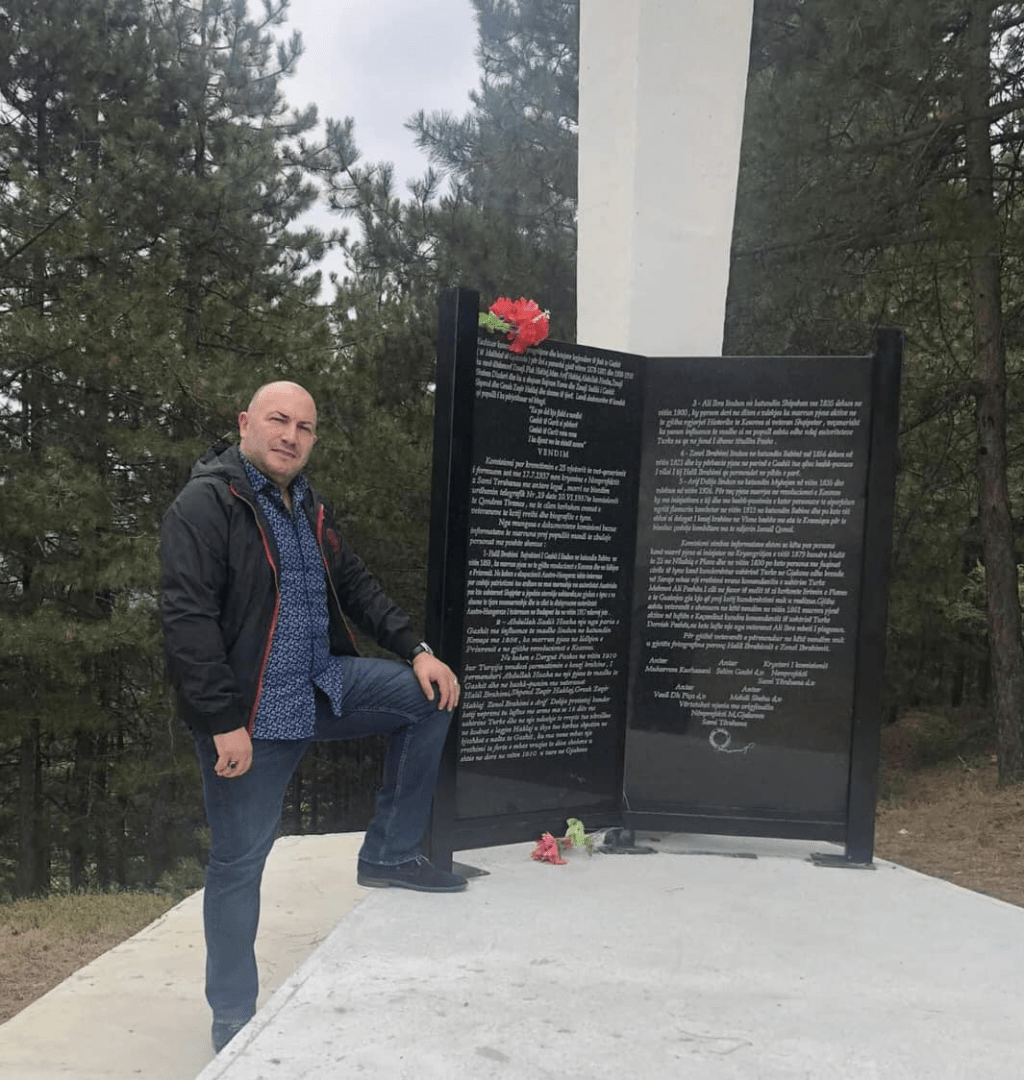

by Azgan Haklaj Haklaj. Translation Petrit Latifi
Summary
The Gashi tribe, one of the oldest clans in the Tropoja region, has a rich history dating back to the Illyrian and Dardanian civilizations. Situated between Albania, Kosovo, and Montenegro, the tribe has resisted numerous invaders, including the Ottomans, Montenegrins, and Austro-Hungarians. Known for their bravery, Gashi played a key role in the Albanian uprisings and wars of independence, including the League of Lezhë in 1444 and the Kosovo Liberation War in the 1990s. The clan’s legacy continues as a symbol of Albanian resilience, courage, and loyalty to their ancestral land and nation.
Gashi in the Pantheon of the Nation!
From small places come great histories!
The history of my nation begins from the yard of my house!
The Gashi clan from the highlands of Gjakova is perhaps a unique case in the entire space of Albanian ethnic lands, where legends, myths, and history intertwine as an unsolvable Gordian knot.
They have come hand in hand from the Albanian Middle Ages to the present day, as a shining symbol of the resistance of the Illyro-Dardanian-Arberian lineage, facing the waves and storms of many historical challenges, bloody battles with kings, sultans, who, with their bloodthirsty legions, power-hungry soldiers, and lust for glory, attacked the Albanian lands.
Gashi is one of the oldest clans in the Tropoja region and has a wide spread not only in Albania but also in Kosovo and Montenegro.
The surname Gashi is well known from Triesh, Montenegro, all the way to Nish and Kamenica.
It has a very favorable geographical position.
Its territory, as the sun rises, is covered with the first rays of the morning.
Today, Gashi extends between the rivers of Tropoja in the northeast and Mullareka in the southwest.
In the north, it has the Gash valley, which is now recognized by UNESCO.
Gashi is the oldest inhabited region of Tropoja (Malësia e Gjakovës).
In Tropoja, the clash of Illyro-Dardanian civilizations took place, which have lived there since 2000 BC. Four centuries before that, they had formed their kingdoms.
The castle of Rosuja served as a border between the Labeatae and the Dardanians.
Four centuries before Christ, the Illyrians and Dardanians established their own kingdoms.
The inhabitants of this region were called Dardanmalas (the Dardanians of the mountains).
Gashi was also inhabited by the Illyrian tribe of the Skirtones, as noted by scholar Xheladin Gosturani.
It is located on the slopes of the majestic Shkelzen Mountain, which, like a colossal pyramid, watches over the central position of the ethnic lands, equidistant from the Danube and Preveza.
In this sacred mountain rest two Dardanian brothers, the Epos of the Heroic Tales, the ballads of Gjergj Elez Alia, myths, songs, and legends.
At its base stretches the village of Mejdan, where Gjergj Elez Alia fought the sea bandits, and Muji and Halili fought the Serbian kings.
In the Gash Valley, artisans work, dancers perform the “shtojzovallet,” and eagles soar.
These precious treasures of national history are protected by the iron guardians, the divine figures who are now the Honor of the Nation, Dervish Luzha and Rexhep Beli.
In the centuries-old history of Tropoja, Gashi in the Gorge has been the first barricade in clashes with numerous invaders, including Serbs, Turks, Austro-Hungarians, Montenegrins, etc.
Throughout its history, Gashi in the Gorge never bent the knee nor compromised with the invader.
According to Ottoman registers from 1485, the early stretch of Gashi was not only where it is today, between the two rivers, like a small Mesopotamia, but also included the villages of Tropoja, Luzha, Gri, Geghysen, Rajë, Tpla (Vulpiana, the main center of the Dukagjin region), Dushaj, Degë, Curraj i Poshtëm, and Botushë from Gjakova.
The area that would later be settled by the White Clan was inhabited by Illyrian tribes.
The register of the Sanjak of Shkodra shows that the villages of Gosturan, Babinë, Shumicë, Kovaç, and Berbat were inhabited by Illyrians in 1485.
So, where does Gashi of the Gorge originate?
In the writing “The Highlanders of the Alps,” Austrian Ernest Von Hesse Wartegg emphasizes that the Gashi clan forms two banners, Shipshan and Bardhaj.
Kahraman Ulqini, in his writing “The Tribes of the Highlands,” confirms that the tribes of the Great Highlands and those of Gjakova share a common origin.
Hoti, Shkreli, Krasniqi, Palabardhi, etc.
According to the legends collected by the famous ethnographer Rrok Zojsi, the White Clan of Gashi originates from Kuçi, Montenegro.
Kuçi was populated by Albanians.
In 1856, Montenegrins entered Lower Kuçi.
Mirko, the brother of the Prince, decapitated children in cradles, the sick, and the elderly with Orthodox scythes.
In the years 1877-1878, the Montenegrins invaded the Rodaja region, several villages of Kuçi, and Zeta, forcefully expelling Albanians from their land.
Those who did not leave were converted to Orthodoxy.
Kalli Kamberi’s journey with his beautiful wife Hana from Kuçi to Kolç’s Neck, and then to the Whites of Gashi, resembles Adam and Eve’s journey.
Hana died, and Kalli, with his daughter, settled in the village of Kuçanë, Shipshan.
From Toplana to Curraj i Poshtëm, Botushë, and Luzha, there was another migration of the population.
Edit Durhami in “The Grief of the Balkans” points out that in Toplana, Shkodra region, the Gashi clan was present, and from there, due to conflicts, they moved to Botushë.
To face invaders, the tribes united. Thus, around 1600-1650, the Bardhaj, Shipshan, and Luzha tribes united and formed the Gashi clan, according to researcher Xheladin Gosturani.
The famous general of Montenegro, Mark Milani, who knew well the bravery of the men of this clan, praises their courage and virtues in his book “The Life and Customs of the Albanians.”
The general highlights that Gashi is one of the most well-known, oldest, and bravest clans in Albania, and their early origins are from the White Clan of the ancient Dukagjin Principality.
In the Middle Ages, Gashi, at that time Catholic, was led by the famous prince Pjetër Shpani.
The ancient inhabitants of this region were among the first to respond to Gjergj Kastrioti’s call for rebellion against the Ottomans, sending their prince Pjetër Shpani, along with his sons, to the League of Lezhë on March 2, 1444, alongside the Dukagjin princes Nikollë and Pal Dukagjini, who distinguished themselves in battles by Gjergj Kastrioti’s side.
Pal Dukagjini is the father of Leka Dukagjini.
The Dukagjin center was in Vulpiana (modern-day Tplani), with 15,000 inhabitants.
This is confirmed by the testimonies of Frang Bardhi and Pjetër Bogdani.
Fan Noli, in his work, emphasizes: “In Vulpiana, in the middle of the mountains.”
Even after the death of Gjergj Kastrioti (Skanderbeg) and Leka Dukagjini, Gashi always kept the flame of freedom alive and recognized the authority of its prince, never acknowledging the Ottoman Porte and Turkish pashas.
Frang Bardhi proves this through his letters sent to the Vatican at the beginning of the 16th century, where he describes the situation of the Albanian people, whom he calls “the people of Arbëri” in the papal documents.
Bardhi describes the dire situation of the population after the burning and looting of the land by the Pashas’ armies, including the killing of four Catholic priests.
He writes that the region is devastated, the Gashi clan was looted, and many families were severely harmed.
On a beautiful hill over Babinë, Bardhi writes, the son of Prince Pjetër Shpani (Pjetër II) is building his palace.
On February 15, 1602, in the church of Saint Alexander in the village of Dukagjin near Mat, where the Dukagjin Assembly was held, the bishop of Sopa, Nikollë Bardhi from the Bardhaj clan, participated.
In 1614, the famous leader Lala Drakala organized the Assembly of Kuçi, the First Balkan Assembly, in the heart of Albanian mountains, with 44 representatives from Albania, Montenegro, Serbia, Bosnia, Herzegovina, and Macedonia for the liberation of the Balkans from the Turks.
Out of the 44 representatives, a quarter were from the Albanian resistance centers.
This assembly, after the great battle of Kosovo in 1389, was the first major coalition where Albanians played a leading role.
Lala Drakala and other fighters not only had the courage and bravery but also the extraordinary vision that without a common alliance of the Balkan nations and the support of great powers, the liberation and unification of Albanian lands was impossible.
In May 1688, the leaders of Gashi sent a letter to the Pope in Rome, written in Albanian. In this letter, they addressed the Holy See, asking for diplomatic and logistical assistance for the liberation of the
Albanian people and their lands, following the Bogdanite Uprising of 1683. This was the first large-scale rebellion against the Ottomans after the defeat of the Ottoman army in Vienna.
During the wars of 1877-78, Gashi participated in defense battles against the Montenegrins, especially in the defense of Plavë and Gucia, and in the battles to preserve Albanian lands.
Gashi’s role in the War of National Liberation is crucial.
They supported the Kosovo Liberation Army (KLA), fighting for the liberation of Kosovo and its eventual independence.
As the famous German diplomat Hans-Dietrich Genscher once said: “From small places come great histories.”
The history of the Gashi clan, and its epic struggle for Albanian freedom, began in the small but legendary lands of their ancestors.


 Balkan Academia