
Summary
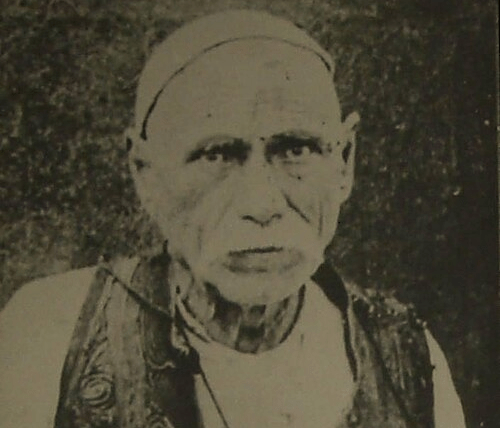
Halil Brahim Bajraktari (b. 1838) was a leading figure of the Gjakova Highlands and a delegate to the Prizren League, representing the Gashi tribe in battles and assemblies. He and his family, prominent local bajraktars, played key roles in resisting Ottoman, Serbian, and Montenegrin forces during the 19th century. Halil commanded forces in major uprisings, defended Albanian lands, and participated in the 1911 Provisional Government of Albania. Renowned for his leadership, courage, and refusal to compromise with foreign powers, he embodied the martial and political spirit of the Gjakova Highlands. His legacy is celebrated in folk songs and historical memory.
Halil Brahim Bajraktari (b. 1838) was one of the most important figures in the Gjakova highlands , and one of the seven delegates from Tropoja to the Prizren League : Halil Brahimi, Binak Alia , Ali Ibra , Mal Dula , Ahmet Sadria, Qerim Delia, Mic Sokoli .[1]
Halil Brahim Bajraktari is the Bajraktari of Gashi i Guri in the Gjakova Highlands and has represented the Gashi tribe in the battles of that time and in the highland assemblies. He was born in 1838 in the village of Babine and together with his three brothers, Haxhi Brahim Bajraktari, Bicak Brahim Bajraktari and Zenel Brahim Bajraktari are the descendants of Jakup Jakupi.
The Bajraktari family is among the honorable and important families of the Gjakova Highlands and the chimney for many important assemblies where the leaders of that time have fought wars against the invaders.
The Bardh tribe was a bajrak. The Bardh tribe included the villages of Kovac, Gosturan, Myhejan, Kerrnaje, Babine, Begaj, Shumice and Mejdan. (Luzha at this time, tribally depended on Botusha and had no connection with the Bardh).
Since Luzha was a minority in the Tropoja region and could not defend itself in the conflicts that erupted between the tribes at that time, the Aga of Botusha came to the Bajraktari of the Bardh in Babine and made a bilateral agreement for the transfer of Luzha under the bajrak of the Bardh. Initially, the bajrak was in Celaj, the first of the house of Rrustem Groshi, then it passed to Gosturan of Uke Elezi and finally it was placed in Babine in the house of Jakup Jakupi.
Halil Brahimi, Mal Dula, Ahmet Sadria are at the head of the forces of Gashi , Bytyci and Berisha in the attack against the forces of Prince Nikola of Montenegro.
In May 1845, about 8,000 fighters from the Gjakova Highlands and Reka , led by Binak Alia and Sokol Rama, Haxhi Brahim Bajraktari, Sulejman Abaz Lushaj and Tahir Bek Bajraktari, Mul Deli Bajraktari and other leaders, defeated the Turkish forces at the Morina and Prushi Passes , entered the city of Gjakova and forced the Turkish garrison, of 35,000 forces, to leave.
During the years 1867 – 1870, we had battles fought against Turkish forces in Gjakova and its surroundings, in Deçan and up to Peja , where the forces of the Gjakova Highlands were led by Haxhi Brahim Bajraktari, Ali Ibër Neza , Binak Alia, Shaqir Curri, Man Avdia, Mal Dul Bajraktari, etc.
In the battles for the defense of Albanian lands in Plavë and Guci , in the years 1872 and 1875, about 3,000 warriors from the Gjakova Highlands participated. In these fierce battles, many of the tribes of the Gjakova Highlands were killed, including the bajraktari of Gashi, Haxhi Brahim Bajraktari.
The Gjakova Highlands made a notable contribution to the developments of the Prizren Assembly, on June 10, 1878, and to all the battles waged by the forces of this League against the Ottoman and Serbian-Montenegrin powers, which aimed at the fragmentation of Albanian lands. Halil Brahim Bajraktari and Shaban Binaku were the right wing of Haxhi Zek Byberi , in the Peja Assembly (January 23-29, 1899), as well as in the implementation of the decisions of this assembly, which constitutes one of the culminations of the Albanian National Movement.
From archival documents it results that, as a result of the movement led by Trenc Toçi, in Mirdita, on April 28, 1911, the Provisional Government of Albania was established, which was supported by Mirdita in Mitrovica.
In the calculation made for the forces supporting the Provisional Government, in a total of 16,500 fighters, Sulejman ag Batusha , 4,000 people; Isa Boletini , 2,000 people; Osman ag Berisha, 1,000 people; Zeqir Halili of Krasniqa, 1,000 people; Halil Brahimi, the bajraktari of Gashi, 1,000 people; Prel Tuli, from Mërturi, 1,000 people. [2]
On one occasion, King Nikola of Montenegro had received all the leaders of the Albanian tribes in Montenegro for talks, giving them an extraordinary reception, which was welcome because they were all tired and malnourished from the incessant wars.
After a few days of rest, King Nikola called them to a meeting and began the conversation that they were threatened by a great Empire, that of Austria-Hungary, and salvation would be if Albania were to join Montenegro and they could be saved.
The leaders of the Albanian Tribes became a little tense and someone started to say something and someone to mumble something, while Halil Brahim Bajraktari remained silent and lost in thought.
Since King Nikola knew that the words of Bajraktar of Gashi enjoyed the respect of the others, he asked him: Bajraktar, why did you fall into thoughts? Say something, and Halil Brahimi replies: For this welcome you have given us, we are very grateful, that’s why I was trying to remember where I have the deeds of the tower and the land that I have, given to you as a sign of gratitude and compensation.
Kralj Nikolla returned it to him, maybe you didn’t understand me, but Halil Brahimi replied, no, I understood well, but I only have the deeds for these and I don’t have them for Albania.
In the framework of the celebration of the 25th anniversary, the commissions established in the Gjakova Highlands identified and sent to the “Commission for the Celebration of the 25th Anniversary of Self-Government” their proposals for the veterans of the province. The Tropoja Commission, through Decision No. 2, dated July 17, 1937, sent the names of the veterans of the district and the relevant biographies.
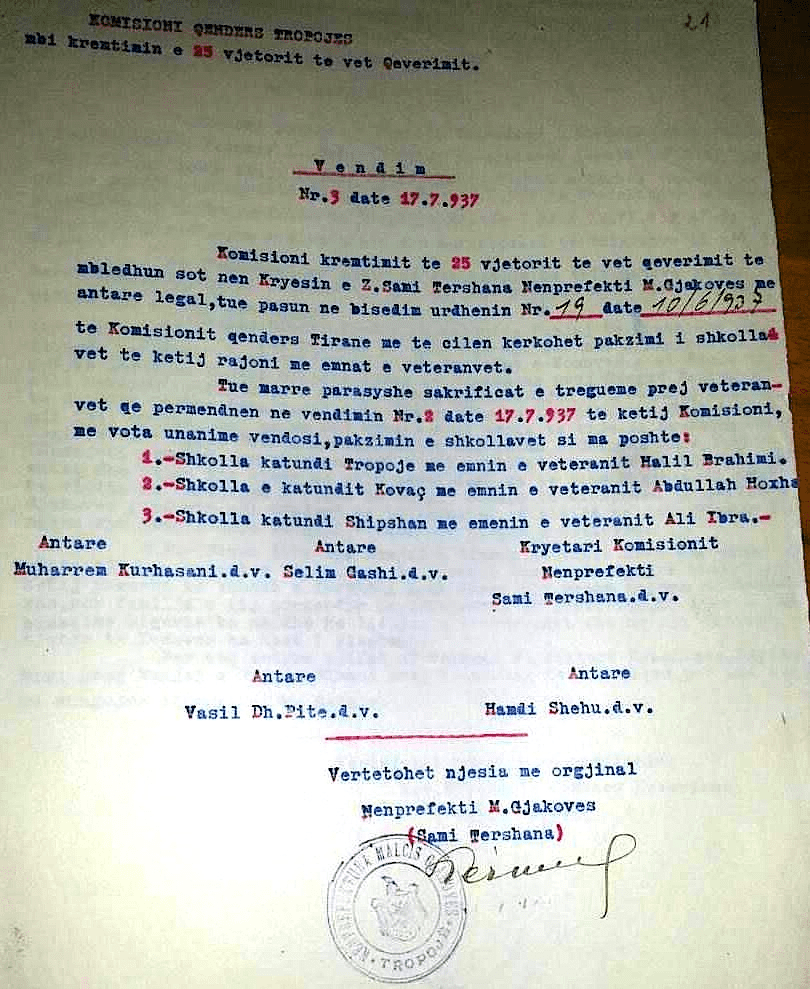
Decision No. 3, date 17. 7. 1937
Among them are:
- Halil Brahimi, the Bannerman of Gashi
2. Abdullah Sadik Hoxha, from Gashi Parish
3. Ali Ibra and Shipshanit
4. Zenel Brahimi of Babina , the Bajraktari of Gashi
5. Arif Delija of Myhejan
The decision bears the signatures of the members of the commission, the chairman and the sub-prefect Sami Tërshana. [3] In the 1910s, the Homeric battle took place in Qafë i Morina, relocated to the Haklaj hills for several days, where the martyr of the Fatherland, Man Arif Haklaj, remained on the battlefield. The Haklaj brotherhood was distinguished for its Spartan resistance. The Gashians were led by Halil Brahimi, Abdullah Hoxha, Shpend e Grosh Zeqiri (Haklaj), Arif Delia.
The folk song truly brings to us the harshness of war.
Where is this yellow flame coming out , Gashi of the stone as always , Gashi of the stone is heavy , He has sons (Bajram Rama) with seven hearts , Brahim Bardhi the great shouted , But where are you Halil Brahimi, Lesho Kushtrimin to Shpend Zeqiri.
The Gashians did not accept the compromise with the Turkish Pasha, as the memorial verses prove.
The Pasha has come to Morina’s house , He has sent a message to the Bajrakis , Are you coming to be roasted with me , If you give them the seals, they will be comfortable , He has called Gashi, but he has not gone.
In Tropoja, at a meeting organized by the Austrian commander in Bujan, to force the people to respond to the invaders with taxes and soldiers, the bajraktar of Gashi, brother of Haxhi Brahimi, Halil Brahimi, stood up and poured these words into the chest of the Austrian officer: “You came to me with difficulty, stay here as long as you can because I will not give you either taxes or soldiers”.
From that moment Halil Brahimi went on the run. The invader followed him with an extraordinary surveillance until he caught him and migrated to Budapest. There, with his hands tied in front of him, he threw himself at the interrogator, grabbed his father’s body and thus, holding each other throat to throat, the floor of the room sank and they fell from a height of three or four meters and both remained dead. [4]
References
Telegraf, Gazeta. “Nikaj-Mërturi and the Gjakova Highlands in the Battle of Maraça in 1871”. Gazeta Telegraf.
“History of the League of Prizren”. Prizren Post.
“Gashi i Gurit in the Pantheon of the Nation”. Bota Sot.
“VOAL – Online Zëri i Shqiptarëve – THE GJAKOVA HIGHLANDS IN THE ALBANIAN NATIONAL MOVEMENTBy VELI HAKLAJ, researcher”. voal-online.ch.
limit (2018-07-19). “Plava, Gucia and the Gjakova Highlands during the 19th century”. Limit.al (in American English)
“Ai që flijohet për atdhe, e ka emrin dëshmor”. 2019.
Veprimtarë të lëvizjes kombëtare shqiptare të Malësisë së Gjakovës në 25 vjetorin e kremtimit të pavarësisë nga Ylli Prebibaj. 2018.


 Balkan Academia