
by Arbend Kondi. Translation Petrit Latifi
Summary
Arben Kondi’s speech at a conference in Preševo honors Abedin Pasha Dino, a distinguished figure in Chamëria and Albania’s history. Born in 1843, Dino was a key figure in the Albanian National Renaissance, known for his roles as a diplomat, economist, and patriot. He actively defended Albanian lands against foreign encroachments, particularly Greece, and played a crucial role in the Berlin Congress. Dino was also a writer and intellectual, contributing to Albanian literature and culture. Despite being marginalized by the communist regime, his legacy endures, celebrated for his defense of Albanian territorial integrity and cultural identity.
Notable Scientific and Cultural Figures of the Albanians from the Preshevë Valley and other Albanian regions
“My Friends!
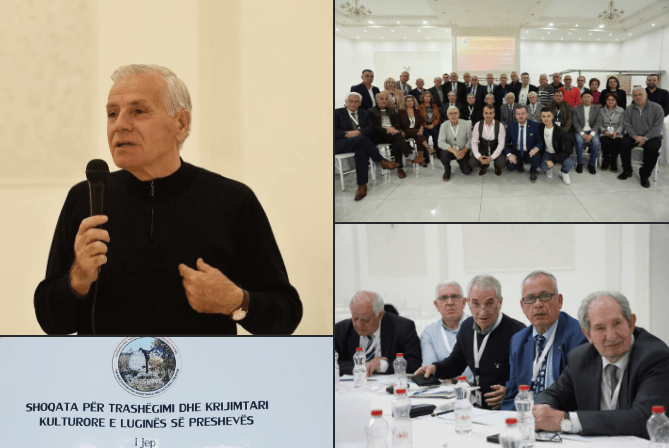
On the dates 24, 25, and 26 of October in Preshevo, where the Albanian spirit thrives, I was invited to participate in the scientific conference on the theme: “Notable Scientific and Cultural Figures of the Albanians from the Preshevo Valley and other Albanian regions.”
At this conference, I presented a paper titled “Abedin Pasha Dino: A Distinguished Figure of Chamëria and the Albanian Nation.”
Congratulations to the municipalities of Preshevo and Bujanovac, as well as Mr. Xhemaledin Saliu, for organizing this conference with a high intellectual level, where representatives from all Albanian territories gathered.
Respectfully,
Arben Kondi
Below, I am sharing the full paper presented in Preshevo:
ABEDIN PASHA DINO: A DISTINGUISHED FIGURE, NOT ONLY OF CHAMËRIA BUT OF THE ENTIRE ALBANIAN NATION
Ladies and gentlemen, I greet you brotherly. For me personally, it is a special pleasure to be here in the Preshevo Valley, in this highly sensitive and patriotic space of Albanianism. This emotional fact naturally brings us closer to Toplica, along with the unforgettable toponym (at the Red Apple). And it is precisely this feeling that brings us closer to my homeland, mythical Chamëria.
But can we connect Chamëria with Preshevo and even with all of Toplica? I believe we can. This is because the history of our people, both in the south and in the north, is the same; it is a wound that is still open and bleeding. Some might think that Chamëria has been assimilated and that the Albanian element there no longer exists. But no, this idea is wrong.
The difference between Toplica and today’s Chamëria is that my homeland is not emptied of its indigenous Albanian element. From Filati down to Preveza, it is dominated by Orthodox Chams, our brothers who speak the same language and share the same blood. Because of religion, they did not suffer the genocide from official Athens, led by the sibling of Slobodan Milošević, General Napoleon Zerva. I emphasize again that Orthodox Chams, from Filati to Preveza, speak only the Albanian language within their families and tribes. Outside, in official environments, the mother tongue cannot be used. This is because the chauvinistic and dictatorial Greek state would strike them with the force of a pneumatic hammer.
I do not want to dwell further on the inferiority of our state regarding this issue, but I cannot stay here without mentioning the Arvanites, led by the distinguished lawyer Arestidh Kola, who stood so close to Kosovo in 1999.
But let us remain faithful to the main subject of our paper and turn our eyes to the bloody history of Chamëria, starting with ancient Epirus.
Here, one recalls the great figure of Pyrrhus of Epirus, known worldwide as one of the seven most famous generals before Christ. His birthplace is the village of Ledhës in Grikohori, near the present-day Gumenicë.
Let us not forget that the mother of Alexander the Great, Queen Olympias, was an Epirus native from the area of Konispol.
Can we leave out the bright name of Gjin Bue Shpata, the great prince of the southern city of Arta, who, in the fourteenth century, heroically fought against the Serbian despot Thomas Preljubović to take the city of Janina?
To remind of the antiquity of Chamëria, it would not be enough to just mention the name of Dodona, the ancient Pelasgian site, but I would like to refer to a very interesting detail involving the name of Bekim Fehmiu, the great Albanian actor with worldwide fame. We all know the film Ulysses, where Bekim plays the role of Homer’s Odysseus. However, let us not forget that when Odysseus enters the world of Hadès, the world of the dead, where he meets his mother, he does nothing other than enter the ancient marshes of the Frar River, near Paramithia, geographically in the heart of Chamëria.
This river, the Acheron, is still called the “Acheron River” by us Chams, and it flows from the famous mountains of Suli.
But let us now turn to the main figure of our discussion, the distinguished Albanian Renaissance personality, Abedin Pasha Dino.
Friends!
Without a doubt, one of the most important and greatest figures in the history of Chamëria, and one of the most distinguished personalities of our nation, is Abedin Pasha Dino. He was born on April 5, 1843, in the city of Preveza. His father was Ahmet Bey Dino, an officer from Lopëzi in Filati, who participated in the rebellion against the Tanzimat reforms in 1847. Due to his patriotic activity, he was imprisoned in Konya, Anatolia, where he later died. His mother, Saliha Çapari, came from another distinguished family of Chamëria, the Çaparis from the Luarat region.
Abedin completed his schooling excellently in his hometown and then attended the “Zosimea” gymnasium in Ioannina, where other prominent figures of our National Renaissance, such as Sami and Naim Frashëri, also studied.
After finishing his secondary education, he went on to study law and economics in Athens and Istanbul. After completing his higher studies, he moved to Izmir, where he worked as vice-president of the Court of Appeals. Due to his excellent economic expertise, in 1871, he was appointed as the imperial commissioner to the Bursa Stock Exchange, where he worked for five years.
Meanwhile, his patriotic activity was growing stronger. In 1876, as a member of the Ottoman Assembly, he raised his voice against Serbian and Montenegrin demands, stating: “Not a single palm of Albanian land should be given to foreigners.” In 1877, he became a member of the Central Committee for the Protection of Albanian Lands, which was formed in secret in Istanbul.
On the eve of the Berlin Congress, he settled in Ioannina to resist Greece’s claims over Chamëria, claims that, unfortunately, were also supported by the great European powers.
Conclusion
Abedin Pasha Dino played a significant role in the defense of Albanian territorial integrity and the national identity. He was also a man of high culture, fluent in many foreign languages and a contributor to Albanian literature. His contributions earned him numerous honors, including the “Golden Palm” from the French Academy of Arts in 1895.
Despite his tremendous contributions, Abedin Dino was silenced by the communist regime in Albania. His legacy was overshadowed, and he was unfairly portrayed by communist historians as a wealthy landowner whose interests were only for his estates. However, his work and legacy in defending Albania and its culture remain pivotal, and he is remembered as one of the most prominent figures in the history of the Albanian National Movement.
Thank you for your attention. It was a pleasure to be here.
Arben Kondi


 Balkan Academia