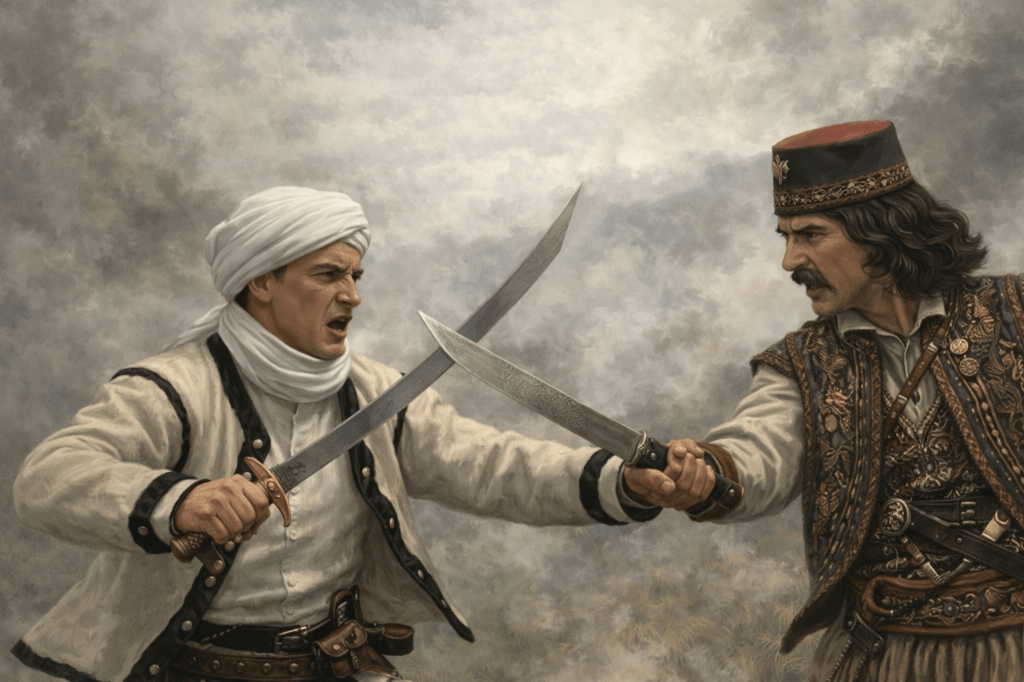

Hysen Bajri was an Albanian Flagbearer (“Bajraktar”) born in 1848 in Koshutan, Rugova. He was the younger brother of Kadri Bajri. As a young man, he joined the warriors of Rugova and his older brother Kadri Bajri, to defend the Albanian lands from the Ottoman and Serbian advances in Montenegro. In all the wars he participated, he held the flag in his hand. During a duel, he cut the head of Miter Milani, the brother of Montenegrin commander Marko Miljanov. He fell heroically at the Battle of Shekullar in 1875 resisting Montenegrin attacks.
Hysen Bajri proved to be a capable leader and strategist fighting together with Rexhë Avdia, Qelë Shabani, Tafil Ahmeti, Balë Ali, Hajdar Feka, Isuf Mujani, Halil Turkun, Sokol Qelë, Istref Salihi and Rrustem Ademi.
Hysen Bajri, wounded in the neck, defeated Miter Milan and knocked him down, picked up a large stone on the ground and hit him until he died and then cut off his head and bringing it to Rugova.

Serbs burying the head of Miter Milani killed in 1875.
Albanian folklore say that the Yataghan (sword) of the enemy had caught Hysen Bajri in the upper part of his arm and throat. When they held his head straight, he spoke as if he were not wounded at all, when they let go of his head, it fell to the side because they had cut the muscle in his neck and his head fell to the side and he could not speak.
Montenegrin betrayal
They had arranged a meeting in the past to sign a truce. However the Montenegrins had betrayed the leadership of Rugova and had come out in greater numbers from behind and had treacherously attacked them.
Albanian toponyms
According to Albanian folklore, Montenegros border in 1875 was at the region of “Kalludra” (near modern day Berane, also an Albanian town before 1878) which to this day has the Albanian toponym “Gurra e Dashit” meaning “the Ram’s rock”.
References
Gjurmime albanologjike Folklor dhe etnologji. Volumes 8–9. 1979
Folklor kosovar Volume 1. Qemal Haxhihasani, Agron Xhagolli, Instituti i Kulturës Popullore (Akademia e Shkencave e RPS të Shqipërisë). 1985


 Balkan Academia