
Qazim Namani Dr. Archaeology & Cultural Heritage. Translation Petrit Latifi
Summary
This paper analyzes the establishment and activities of the Coordinating Center of Serbia and Montenegro for Kosovo and Metohija, founded in Gračanica in 2003, and its role in politicizing cultural heritage in post-war Kosovo. Focusing on official reports, maps, tables, and correspondence sent to UNMIK and international institutions, the study demonstrates systematic manipulation and falsification of data concerning damaged cultural monuments. Serbian reports presented Orthodox heritage as the primary victim of the 1998–1999 conflict, while minimizing or ignoring the destruction of Albanian, Ottoman, and pre-modern archaeological heritage. The paper argues that these documents functioned as propaganda tools aimed at influencing international decision-makers. It further highlights the absence of coordinated Albanian scholarly responses and critiques Kosovo’s institutional failures, lack of strategy, and exclusion of qualified experts in heritage governance. The study concludes that both external manipulation and internal mismanagement severely undermined the protection of Kosovo’s cultural heritage and its national historical narrative.
Coordination Center of the Republic of Serbia and Montenegro for Kosovo and Metohija.
Following reports drafted in Belgrade during 2002 and 2003, Serbia establishes in Gracanica“Coordination Center of the Republic of Serbia and Montenegro for Kosovo and Metohija”, with the aim of protecting the interests of the Serbian population and Orthodox churches and monasteries in Kosovo.
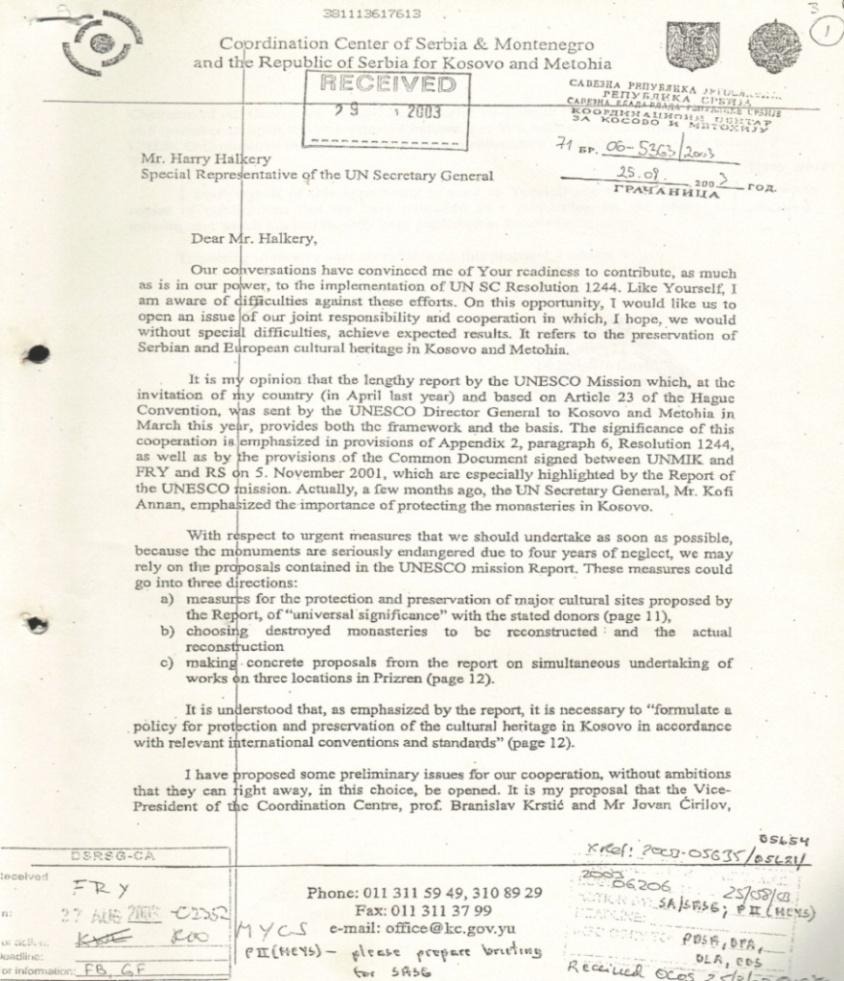
– Document drafted by the “Coordination Center of the Republic of Serbia and Montenegro for Kosovo and Metohija”, in Gracanica
Based on document no. 06-5363/2003 dated 25.08.2003 issued by“Coordination Center of the Republic of Serbia and Montenegro for Kosovo and Metohija”, in Gracanica and signed by its president, Nebojša Ćović, addressed to the Special Representative of the United Nations Secretary-General in Kosovo (UNMIK), Harry Halkery, among other things, requests:“that the Vice President of the Coordination Center, Prof. Branislav Krstic, and Mr. Jovan Cirilov, Chairman of the UNESCO Committee of this center, visit Pristina in early September 2003, to begin cooperation”Nebojša Čović wrote at the end of the letter:“took this opportunity to send you and Mr. Brayshaw a copy of our publication, which has recently been published by our UNESCO mission.”.Below we present the document drafted by Nebojsh Ćović, sent to Mr. Harry Holkery.
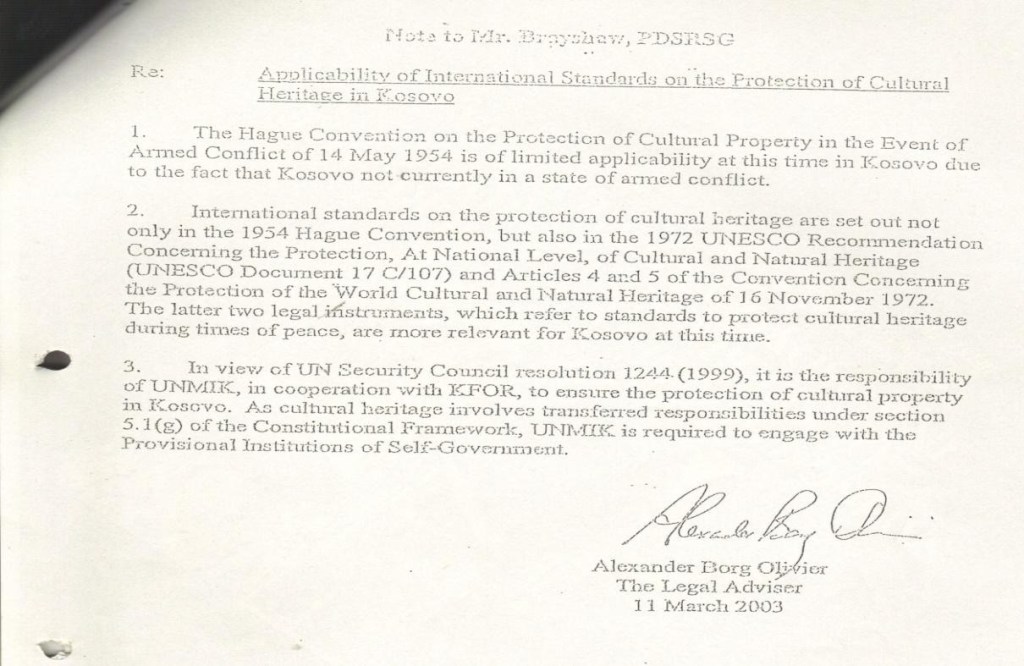
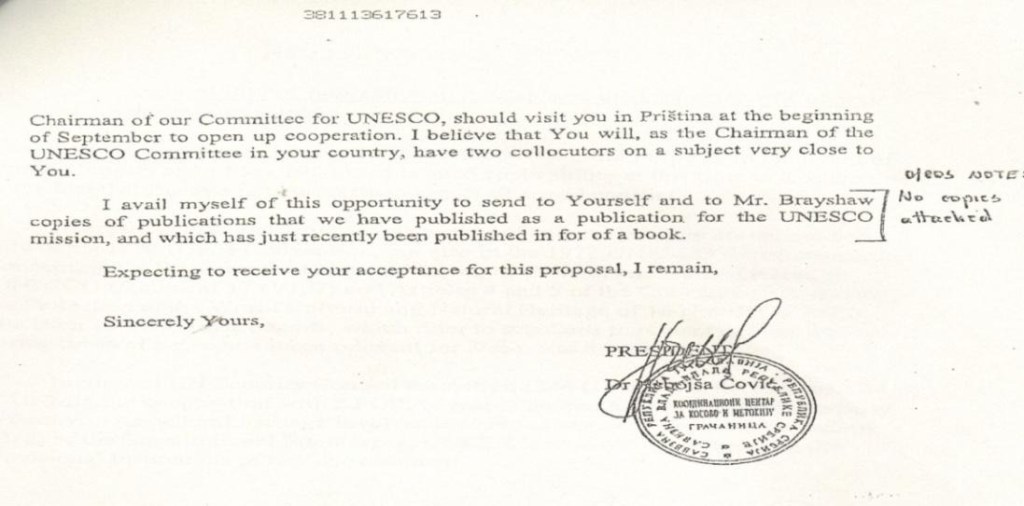
7- Document drafted by Nebojsh Ćović, sent to Mr. Harry Holkery.
We are providing some data from this publication, this document states:“NATO’s bombing campaign against Yugoslavia and local governance by the KLA” have endangered Serbia’s cultural heritage in Kosovo and Metohija”.During the military fighting between the Yugoslav Army and the KLA, 3 mosques and 14 towers of Albanians registered as cultural monuments were damaged, as well as a number of minarets of mosques not registered as cultural monuments, which were demolished. However, in the period from the intervention of NATO troops on 10 June 1999 to August 2001, these cultural heritage monuments were damaged, which are classified into 4 categories: category I: 18 monuments, category II: 30, category III: 55 objects registered as cultural monuments, all of which were Orthodox, and category IV: 107 other religious buildings.
According to this document, it is further stated that in the post-war period in Kosovo, two parallel non-civilizing processes occurred: the destruction of Christian cultural heritage and the authentic settlements of Serbs, Montenegrins and Croats, who have mainly left Kosovo.. This propaganda data in this publication is also presented illustrated on maps. The document also describes the cultural monuments in Kosovo registered in 1986, 1994 and their condition after the war of 1998 and 1999.
Below we provide the state of monuments in Kosovo in 1994, published in the 2003 report by the Coordination Center of the Republic of Serbia and Montenegro for Kosovo in Gracanica, sent to the Special Representative of the Permanent Secretary to the United Nations.
Table – Cultural monuments damaged and destroyed during and after the 1998/99 war.
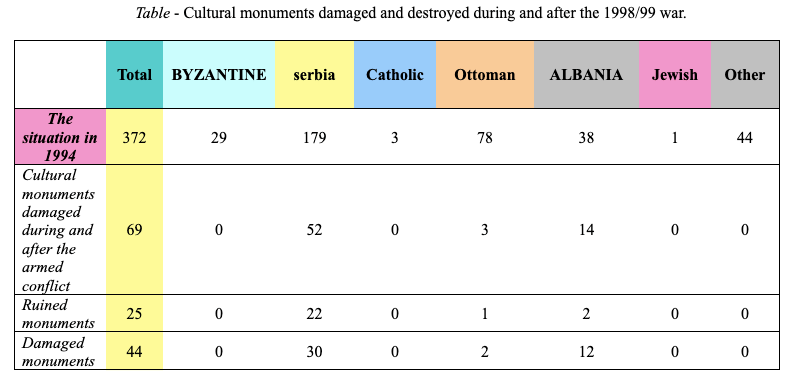
Such documents, accompanied by falsified data, containing numerous maps and photographs, were distributed by Serbs to international staff employed in Kosovo and to the embassies of many Western countries in Pristina. In addition to these Serbian documents, Albanian scholars had not prepared any general report or publication on the damage to cultural monuments by Serbian military and police forces in Kosovo during the 1998 and 1999 war. After the end of the war, the Islamic Community in Kosovo (BIK) had published a compilation of data on burned mosques, while Fejaz Drançolli had published in 2001 a publication on the burning of Albanian towers in the Dukagjin Plain.
Below we provide the table described by“Coordination Center of the Republic of Serbia and Montenegro for Kosovo and Metohija”regarding the condition of cultural monuments before the war of 1998 and 1999.
The table clearly shows the “scientific” approach they have taken to the protection of monuments: the falsification of historical facts, the appropriation of Byzantine, Arbëro, Ottoman and other period monuments, the deliberate destruction of prehistoric, Dardanian-Illyrian, Roman, Byzantine, Illyrian-Arbëro heritage and, in particular, the heritage of folk architecture of the 18th-20th centuries.
In order to illustrate what was said above, we are giving in percentage terms what the treatment of cultural monuments looked like during the time of Serbian administration in Kosovo until 1999.
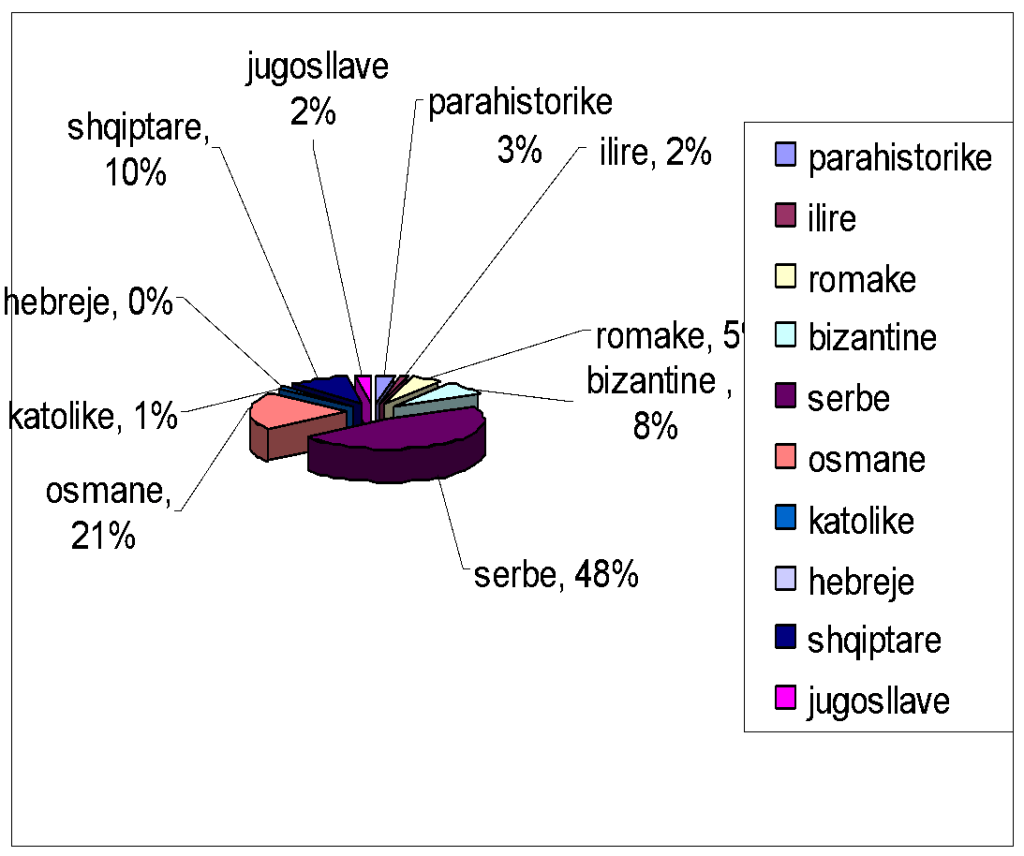
– Percentage of monuments by nationality, according to the document drafted by Nebojsh Ćović
Considering the Serbian manipulation and propaganda for the politicization of cultural heritage after the war, I think that this field should have been dealt with by the highest scientific and political institutions of Kosovo and the Division of Cultural Heritage should have been close to or in close cooperation with the Government of Kosovo, permanent cooperation with the Kosovo Academy of Sciences and Arts, the Institute of Albanology, the Institute of History and the University of Pristina, and especially with the Department of History.
The circumstances created as a result of the falsification, mismanagement and politicization of the cultural and historical heritage in the country, make it necessary to urgently take the necessary measures to regulate the situation in this area that is so important and sensitive for our national identity.
Practices so far have shown that the cultural heritage of Kosovo has been brought to this state not only by international interventions, but also by negligence and inefficient management by Kosovo institutions.
Respectively, the lack of an adequate strategy in the field of cultural heritage, the lack of vision and organizational structure. The fate of cultural monuments cannot remain in the will of the Minister, the Permanent Secretary, the Director of Administration and the Head of the Department of Cultural Heritage, high political and scientific institutions, bypassing the professional and scientific staff in cultural heritage institutions.
This area can be successfully managed by the Department of Cultural Heritage, by cooperating with experts in this field and by prioritizing the promotion of the genuine values of cultural heritage through scientific publications.
During the violent measures in Kosovo from 1990 to 1999, among the buildings that were declared monuments was the Hotel“Union”in Pristina for which a conservation and restoration plan was drafted in 2003.
This object was privatized in 2006, and in 2011 it burned down, to be renovated again in 2013, being declared a cultural monument and thus becoming the topic of discussions and the center of attention for a decade. This proves that in Kosovo not only are cultural policies lacking, but all local and international legal procedures for the protection of cultural monuments are also violated.
From what was said above, we can conclude that a priority in the field of cultural heritage is the employment of professional scientific staff to prevent the drafting of documents and the description of the history of cultural monuments by professional technical staff.
This propaganda data is also presented in this publication illustrated on maps. In addition, cultural monuments in Kosovo registered in 1986, 1994 and their condition after the 1998/99 war are described.
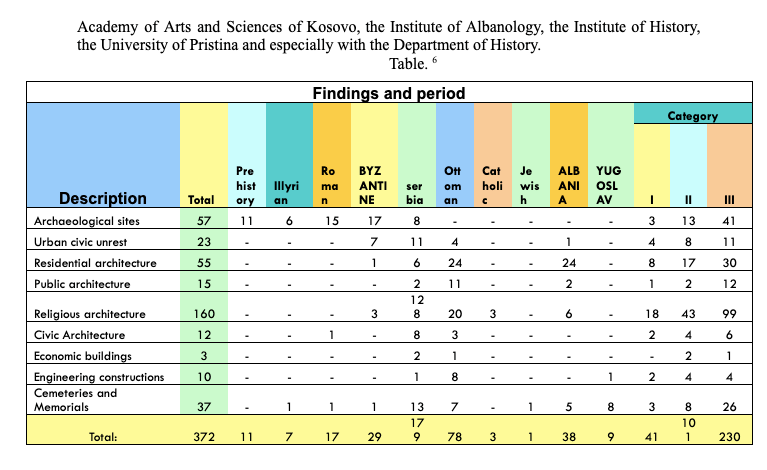
The data that we will provide in the following table is presented according to this publication regarding the condition and treatment of cultural heritage before the war. This includes findings from different periods and types of monuments.
From this table it is clear what scientific approach they have taken to the protection of monuments: Falsification of historical facts; appropriation of Byzantine, Arbëro, Ottoman and other period monuments; deliberate destruction of prehistoric, Dardano-Illyrian, Roman, Byzantine, Illyrian-Arbëro heritage and in particular the heritage of folk architecture of the 18th-20th centuries.
Considering the Serbian manipulation and propaganda for the politicization of cultural heritage after the war, I think that this field should have been dealt with by the highest scientific and political institutions of Kosovo. I think that the Cultural Heritage Division should have been close to or in close cooperation with the Government of Kosovo, permanent cooperation with the Academy of Arts and Sciences of Kosovo, the Institute of Albanology, the Institute of History, the University of Pristina and especially with the Department of History.
Table.
I think that urgent intervention is needed in the management of this important area of our national identity. Practice so far has shown that Kosovo’s cultural heritage has been brought to this state not only by international intervention, but also by our own institutions that worked without an organizational chart, strategy, and vision.
It must be understood that the fate of cultural monuments cannot remain at the will of the Minister, the Permanent Secretary, the Director of Administration and the Head of the Heritage Division, manipulating high political and scientific institutions and on the other hand bypassing the professional staff in the Heritage Division and institutions that deal with the protection of cultural values.
Our political structures should consider that this field can be led by the Cultural Heritage Division only by cooperating with the highest scientific institutions of the country. Scientific institutions should prioritize the promotion of the genuine values of cultural heritage through scientific publications in order to prevent the high level that Serbian propaganda has reached in international institutions.
Below we provide a table with percentage data on the treatment of cultural monuments during the Serbian administration.

In this table we are providing data from the 2003 publication by the Serbia & Montenegro Coordination Center for Kosovo in Gracanica, sent to the Special Representative of the Permanent Secretary to the United Nations, which presents the cultural and historical monuments damaged during the war, divided according to ethnic division, where Serbs are presented as victims with allegedly 179 damaged monuments.
Their manipulations are clearly visible when we consider that according to the Serbian publication, data on cultural monuments damaged and destroyed during and after the 1998/99 war is presented here.
The Cultural Heritage Division in the Program Policy for 2007 had foreseen the financial support to hold a Scientific Session on the Dardanian Issue. Considering the importance of this scientific session, it was foreseen that the Academy of Arts and Sciences of Kosovo would lead and plan it, while the MCYS would finance it, request no. 424/2007 dated 28.02.2007 addressed to the Academy was recorded in the Ministry’s archive.
The Social Sciences Session of ASHAK, in the meeting held on 15/03/07, had concluded that the topic proposed by D.T. is complex, serious and requires extensive multidimensional preparations, thus not accepting the suggestion in question. ASHAK’s letter no. 31/07 dated 19.03.2007 was signed by Ekrem Murtezaj, Academician, and received in the Ministry’s archive with no. 690/2007, dated 20.03.2007.
In conclusion, we can say that: Viewed from a scientific and logical perspective, the responsibility for the created situation and the weaknesses in the field of national identity must be borne by the political parties, which appointed ministers with shallow knowledge of national identity, brought in uneducated and politicized staff, who from the minister’s cabinet directed the work and projects in the field of cultural heritage, also engaging irresponsible professors from universities and political parties.
During this period, I was working on my first master’s thesis in the field of Cultural Heritage in Kosovo, at the proposal of Professor Masar Rizvanolli, but I was completely overlooked and had no influence to help improve the situation.
Even though later, under the leadership of Academician Emin Riza, we were the first three doctors in this field, according to the Bologna program, at the Department of Archaeology and Cultural Heritage at the Public University of Tirana, we were overlooked, not consulted, even I, who was an internal staff member, and employed in the ministry since 2002, was completely overlooked, even though since 2012, I was the only scientific employee, from the staff in the ministry, who had completed the doctoral exam: Conservation and Restoration of Cultural Monuments. Even when I received my doctorate, the Ministry of Culture organized two scientific conferences on cultural heritage, overlooking me and my two colleagues.
We, the first three doctors of Archaeology and Cultural Heritage, doctored at a public university, with leaders and committee members including the most renowned Albanian experts, were prevented from working at universities, we were despised and belittled, remaining completely outside the processes developed in this field.
It was also meaningless to issue a statement in the media stating that the program for cultural heritage and tourism at the public University “Ukshin Hoti” in the city of Prizren was being closed, due to the lack of professors with scientific degrees, when we had diplomas recognized by the Ministry of Education of Kosovo.
Cultural heritage in Kosovo, since the war until today, continues to be managed by uneducated technical staff, without basic knowledge of history and national identity, and by corrupt, servile professors without evidence that they have sufficient knowledge to contribute to improving the situation, therefore both successes and failures are their responsibility.


 Balkan Academia