
by Qazim Namani: Dr. Archaeology & Cultural Heritage
Translated and edited by Petrit Latifi on Balkanacademia.com
Summary
This study examines the origins, content, and political implications of the Ahtisaari Plan in relation to earlier Serbian strategic documents concerning Kosovo, particularly the 1997 project developed by the Institute for Geopolitical Studies in Belgrade. It argues that key elements of the Ahtisaari Package—such as decentralization, the creation of Serb-majority municipalities, and extensive protective zones for Serbian Orthodox religious and cultural heritage—were strongly influenced by pre-war Serbian proposals. The paper analyzes how these mechanisms affected Kosovo’s territorial integrity, institutional sovereignty, and governance after independence. Special attention is given to the legal status of Serbian Orthodox Church property, extraterritorial arrangements, and their long-term political consequences. The study also highlights weaknesses in the Kosovar negotiating position and the asymmetry of expertise during international negotiations. Ultimately, the paper situates the Ahtisaari Plan as a necessary but costly compromise that enabled Kosovo’s independence while embedding structural challenges that continue to shape state functionality and interethnic relations.
- Project – proposal for protecting the interests of the Serbian population in Kosovo
In order to draft a draft proposal for preserving the interests of the Serbian population in Kosovo, in 1997, the Institute for Geopolitical Studies “Kosovo and Metohija” was founded in Belgrade, challenges and responsibilities, by a group of authors for talks with the international factor on the Kosovo issue.
This project was based on several documents from the time of the Kingdom of Serbs, Croats and Slovenes, which relate to agrarian reform, Orthodox monasteries, and the population structure in Kosovo.
The document states that, as the crisis and ethnic problems in Kosovo deepen, it is proposed“Proposal for a solution to protect the interests of the Serbian people in Kosovo and Metohija”, to prepare the delegation of the Republic of Serbia for the difficult talks that will follow with the internationals.
This project was sent on November 19, 1998:
- Serbian Patriarch, Mr. Pavle
- President of the Federal Republic of Yugoslavia
- President of the Republic of Serbia
- President of the Republic of Montenegro.
The proposed solution for the protection of the interests of the Serbian people in Kosovo and Metohija contains
six points as follows:
- Formation of Cantons
- Special status for Serbs in cities where the majority population is Albanian
- New territorial regulation and the formation of bodies for the protection of the Serbian population
- Regulating relations between provincial institutions and Serbian bodies
- The ethnic structure of the population
- Cantons with a majority Serbian population, and monastery properties.
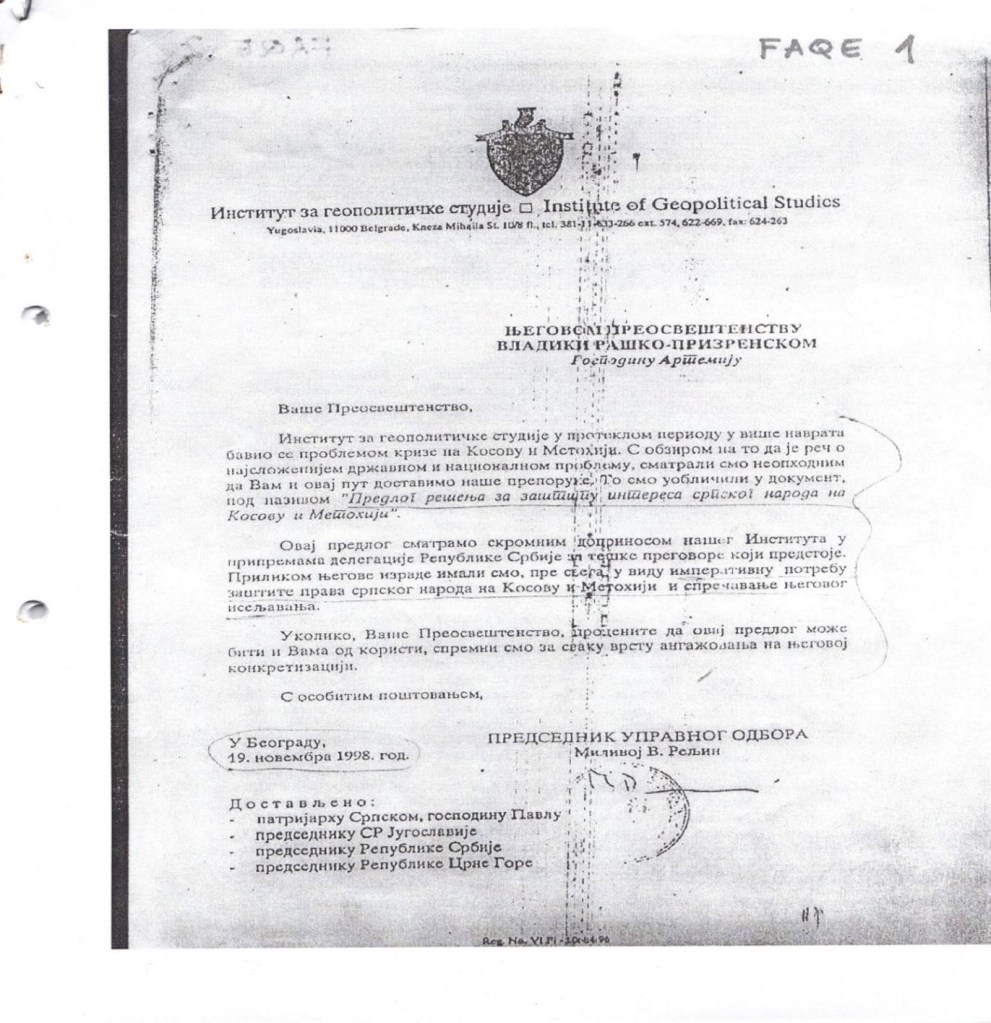
– Draft proposal for protecting the interests of the Serbian population in Kosovo
This document states that it is necessary to add measures to the agreement on Kosovo and Metohija that ensure full physical and property protection, demanding full ethnic, religious and cultural rights for the Serbian population in Kosovo. In the Serbian cantons, it was required that Serbs constitute the majority in the administrative, judicial and police structures.
This project is based on the United Nations Charter, the Helsinki Final Act, the OSCE Declaration and other international documents dealing with the protection of human rights, the rights of minorities and ethnic and religious communities. As a model, the formation of regions and the protection of national minorities is proposed, as in European countries: Spain, Italy, Switzerland, etc.
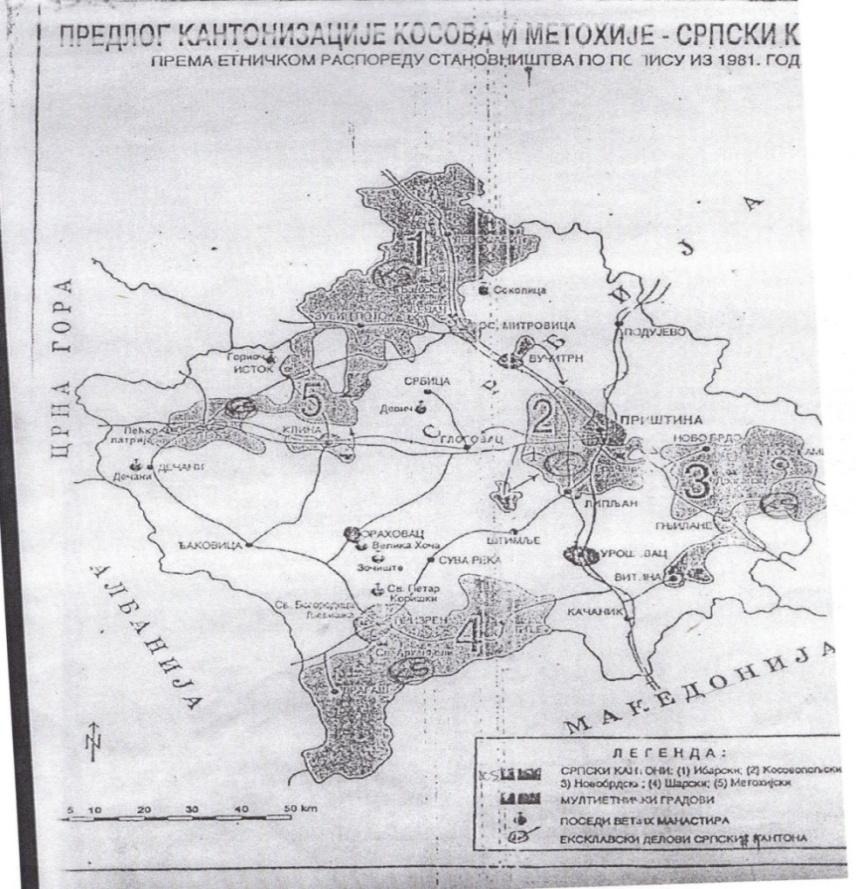
– Appearance of Slavic enclaves according to the 1981 population census
The Dayton Peace Agreement for the protection of the cultural, religious and political rights of the peoples of Bosnia and Herzegovina is also considered a positive experience. With the creation of cantons, a territorial change of the borders in the municipalities is required, including as much agricultural land as possible in the small municipalities that would be established to be included in the Serbian cantons.
The Serbian cantons were to be annexed to their monasteries and properties. It was also required that the monasteries be returned all the properties they had taken before World War II. With these measures, it is envisaged that the Serbs will have ownership and control over 30% of the territory of Kosovo.
The project for the protection of the interests of the Serbian population planned to form the following cantons:
- Ibar Canton
- Canton of Kosovo
- Novo Brdo Canton
- Sharr Canton
- Canton of Metohija
This draft proposal envisages that cantons with a Serb majority population will have their own local administration, judiciary and police.
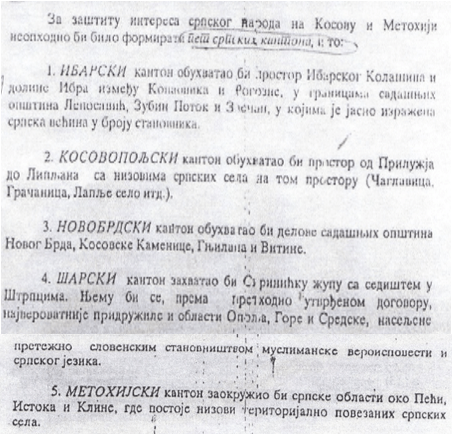
– The five cantons envisaged in the 1998 project proposal, for the protection of Serbian interests in Kosovo.
In large urban areas, mixed Serb-Albanian governance is envisaged. In large multi-ethnic cities, local assemblies are required to have two chambers: a lower chamber, which would express the will of the citizens, and an upper chamber, which would consist of half Serbs and half Albanians with equal veto rights.
The provincial assemblies would be formed by representatives of all cantons and would also have two chambers. The guarantor of the cantonal agreement would be the Serbian Parliament, while the external guarantor would be the international community.
The document states that the regulation of cantons in the southern Serbian province would be carried out by a special law of the Assembly of the Republic of Serbia. This issue is expected to be regulated within a time frame of 15 to 20 years.
The drafting of this document was based on the population structure in Kosovo according to the 1981 census.
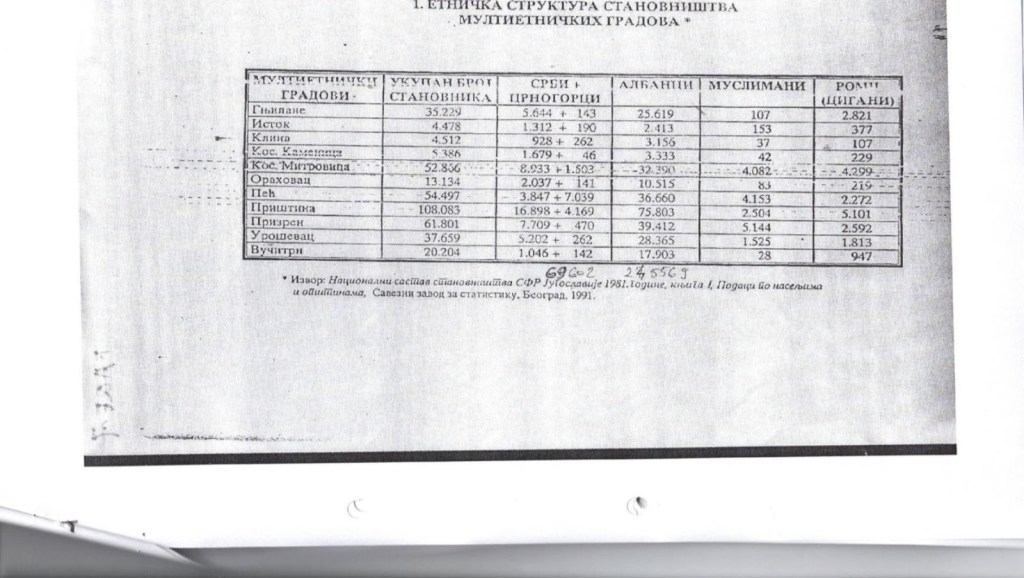
–Ethnic structure of the population in multiethnic cities based on the 1981 census
After the war in Kosovo, based on this study of more than 500 pages, which addresses the formation of Serbian cantons in Kosovo, the community of Serbian municipalities, decentralization, and many reports published in Serbia on the state of cultural heritage in Kosovo, and other documents and reports drafted by internationals, the Ahtisaari Package was drafted.
Ahtisaari, in this political dialogue, was forced to include in this package for implementation the six points of Ban Ki-moon, which in fact would foresee the creation of the Union of Serbian Municipalities in Kosovo, therefore this package can be considered a painful compromise for Kosovo, but it was achieved through many meetings and negotiations conducted by internationals.
Below we offer some of the points related to cultural and historical heritage included in the Ahtisaari Package.
- Ahtisaari Package
Serbia’s plan for the division of Kosovo is a plan designed by the Serbian Academy of Sciences, which appeared as a political platform in certain periods during the 20th century, so if we carefully analyze the Ahtisaari Package, we find many modified elements, which clearly demonstrate the intentions for the division of power and part of the territory of Kosovo.
According to Serbian academics, their project aimed to divide Kosovo into two ethnicities: Albanian and Serbian, where the northeastern part of Kosovo, divided by the Sitnica River that runs through the Kosovo Plain, would become the division of Kosovo between Albanians and Serbs, where the mineral-rich territories would belong to Serbia.
This Serbian project was used as a backup plan for the realization of Serbian goals during Milosevic’s rule.
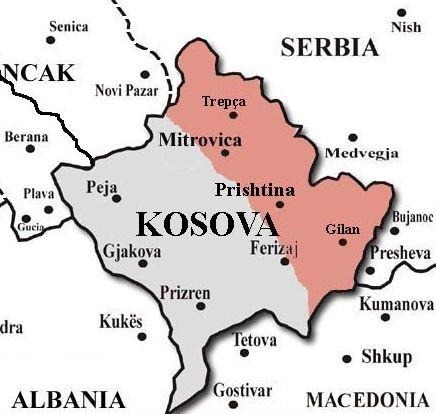
– The division of Kosovo into two ethnicities according to Dobrica Qosiq’s project
The Ahtisaari Package was preceded by many documents, reports and negotiation processes on the final status of Kosovo from 1997 until the declaration of independence in 2008.
Project of the Geopolitical Institute founded in Belgrade in 1997
UN Security Council Resolution 1244 (New York, 10 June 1999)
Constitutional Framework of Kosovo (Pristina, 15 May 2001)
Pre-Status Standards Implementation Plan for Kosovo (New York, December 2003)
Several reports published by Serbia and internationals on the state of cultural heritage in Kosovo 1999-2008
Kai Aides’ Kosovo Report (New York, June 13, 2005)
Six Principles of the Contact Group for the Settlement of the Status of Kosovo (New York, 9 November 2005)
Ban Ki Moon’s Six Points (UN – New York)
After the end of the 1999 war, the plan to divide Kosovo emerged, following the model of the division of Bosnia, in this case through the creation of Serbian enclaves, and the complete secession of the northern part of Kosovo (Leposaviç, Zubin Potok and Zveçan) and the north in the city of Mitrovica up to the bridge over the Ibar River.
This topic has been politicized, opposing the exercise of power by Kosovo institutions, according to UNMIK resolution 1244.
The Ahtisaari Package became the main topic of the Unity Negotiating Group during 2006, as a result of talks between Pristina and Belgrade.
As can be seen, the Ahtisaari Package is a comprehensive document Proposal for an Agreement on the Status of Kosovo, February 2, 2007.
On February 2, 2007, the special envoy for the statusof Kosovo, Martti Ahtisaari, submitted the proposalandin Pristina and Belgrade, for independenceandconditional onKOSOVO, a step that led to the creation of an independent state. After several rounds of talks, Kosovo declared independence on February 17, 2008.
The Ahtisaari Package was adopted as a result of talks between Pristina and Belgrade, which took place during 2006-2007.
The meetings for Albanian-Serbian talks on decentralization and the issue of “Serbian Cultural and Religious Heritage”, which took place during 2006, resulted in the establishment of several new ethnic Serbian municipalities, as well as the creation of dozens of (extraterritorial) protected areas with special status for Orthodox monasteries and churches, which, without any scientific basis, are being called Serbian Orthodox churches. From the Ahtisaari Package, we are highlighting issues related to the cultural and historical heritage of Kosovo.
Annex III and Annex V of the Ahtisaari Package provide several maps, which clearly show, through decentralization and extraterritoriality for “Serbian churches and monasteries”, the territorial compactness of the Serbian enclaves, the special protective status for “churches and monasteries” and their functional cooperation with the Republic of Serbia.
Article 10 of Annex III, on decentralization, defines the cooperation of municipalities and the Serbian Orthodox Church (SOC) with the Institutions of the Republic of Serbia, where in the following 10.1 of this annex it is stated:
““Municipalities shall have the right to cooperate with municipalities and institutions of the Republic of Serbia. Cooperation shall consist in providing financial and technical assistance by the Institutions of Serbia in the implementation of municipal competencies.”
Regarding the establishment of new municipalities, which the Unity Group has also agreed to, this issue is regulated by Article 12 of Annex III on Decentralization. Paragraph 12.1 of Article 12 of this Annex states:
“The new municipalities to be established, whose borders will be determined by the new law on municipal borders”
To argue this issue we are referring to“Appendix to Annex III for “determining the boundaries of new municipalities”according to the Ahtisaari Package.
Annex V of the Ahtisaari Package deals with“Serbian cultural and religious heritage”
In paragraph 1.1 of Article 1 of Annex V, it is stated:
“The Serbian Orthodox Church (SOC) of Kosovo shall enjoy the protection of its rights, privileges and immunities, as provided for in this Annex.”
While paragraph 1.5 of this article states:
“The Serbian Orthodox Church in Kosovo shall have full discretion in the management of its property and access to its premises. Kosovo authorities shall have access to the premises of the Serbian Orthodox Church (SOC) of the Republic of Serbia only with the consent of the church, in cases of a court order issued in connection with illegal activities, or in case of direct danger to life and health.”
In paragraph 4.1 of Article 4 of this Annex (V) which stipulates“protected areas”it is said:
“A selected number of monasteries of the Serbian Orthodox Church, as well as churches, other religious buildings, and historical and cultural sites of particular importance to the Kosovo Serb community, will enjoy special protection through the designation of “protected areas.”
The objectives of protected areas are: to ensure the peaceful existence and functioning of the objects to be protected; to preserve the historical, cultural and natural environment, including the way of life of the monastery and the clergy; and to prevent negative developments around them, ensuring the best possible conditions for the harmonious and sustainable development of the communities that inhabit the areas surrounding these objects. The enjoyment of property rights in protected areas may be limited in the following manner:
In Article 4, paragraph 4.1.1, any new activity in the following areas will be prohibited:
a) Industrial construction or development, such as: exploitation of mineral resources; construction of power plants or electricity networks, furnaces and factories.
b) Construction or development of facilities, such as: structures or buildings taller than the monastery/church/cultural monument under protection; use of hazardous materials in any new construction (including residential buildings): on roads, petrol stations and vehicle repair centres; supermarkets; nightclubs.
In the following 4.1.2 of Article 4 it is stated:
4.1.2 When circumstances require, any activity in these areas may be restricted. Before carrying out activities in the following areas, the relevant municipality must consult with the SOC or the Serbian community:
a) Commercial construction or development, such as: road construction, construction of warehouses, workshops, shops, restaurants, nightclubs, cafes, kiosks and food stands, and any larger construction in rural areas;
b) Public, recreational and entertainment gatherings;
c) Urbanization of agricultural land.
Based on these paragraphs and articles detached from the Ahtisaari package, it is understood that these measures will render the territorial, political and institutional integrity of the state of Kosovo non-functional.
These churches and monasteries, which have been designated as areas with special protective status, have historically been protected by the Albanians themselves.
In the successor 4.1.4 of Article 4 of Annex V of the Ahtisaari Package, the following are defined as protected areas:
- Deçan Monastery, Decan
- Patriarchate of Peja, Peja
- Gracanica Monastery, Gracanica
- Church of the Annunciation of the Virgin, Lipjan
- Devič Monastery, Skenderaj
- Gorioçit Monastery, Same
- Budisavc Monastery, Klina
- Sokolica Monastery, Zvecan
- Monasteries and Draganacit, Gjilan
- Monastery of the Holy Archangel, Prizren
- Banjska Monastery, Zvecan
- Zoçishta Monastery, Zoqishte, Rahovec
- The village of Hoqë e Madhe, Rahovec
- Duboki Potok Monastery, Zubin Potok
- Church of Saint George, Gornjaselle, Prizren
- Sočanica Monastery, Leposavic
- Church of the Hermits, Uljarica, Klina
- Gazimestan Memorial Monument, Obiliq
- Medieval Castle of Zvecan, Zvecan
- The Medieval City of Novo Brdo, Novo Brdo
- Medieval Bridge of Vojnović, Vushtrri
- The Hermitage of Saint Peter, Korisha, Prizren
4.1.5 The protected area for the following facilities will be defined as a 100-meter area around their perimeter:
- Holy Friday Monastery, Leposavic
- Monastery of the Holy Healers, Leposavic
- Monastery of the Holy Virgin of Hvosno, Skenderaj
- Monastery of Saint Mark, Korisha, Prizren
- Holy Trinity Monastery, Mushtisht, Suhareka
- Church of the Holy Virgin, Sredska, Prizren
- Monastery of Holy Uros, Nerodime, Ferizaj
- Monasteries of Binacit, Buzovik, Viti.
4.1.6 The protected area for the following facilities will be defined as a 50-meter area around their perimeter:
- Monasteries and Dollacit, Klina
- Church of Saint Nicholas, Gjurakoc, Istok
- Church of the Holy Virgin Hodegetria, Mushtisht, Suhareka
- Church of Saint Nicholas, Štrpce
- Church of Saint Theodore, Lower Bit, Shtërpcë
- Church of Saint Nicholas, Gotovushë, Shtërpcë.
If we analyze the Ahtisaari Package, we can affirm that this important document, which was drafted by the International Community, is based mainly on the data contained in the document compiled by Institutefor geopolitical studiesBelgrade 1997,KOSOVO AND METOHIJA Challenges and Answers, group of authors, Belgrade 1977, established on November 19, 1997, to prepare the Serbian delegation for the talks that were expected to take place after the war with the Albanian delegation and internationals on Kosovo.
The drafting of this document was influenced by the great influence of international institutions, the Government of Serbia, the Serbian Orthodox Church, and the developed propaganda of the Serbian population.
In these talks, the Serbs were also supported by several European diplomats. They had managed to present dozens of reports at the negotiating table on the alleged damage done to monuments of Serbian heritage and culture in Kosovo. They had offered their political concept for the formation of cantons and the decentralization of municipalities with a Serbian majority. They were researching and proposing the model of Swiss cantons and decentralization.
Seeing the Serbian side’s lack of interest in agreeing with the proposals of the internationals and the Albanian side, Albert Rohan, Ahtisaari’s deputy, also reacted to this topic, stating that time should not be wasted on Serbian proposals because Kosovo was not and cannot be compared to Switzerland.
Kosovo’s post-war institutions and political leaders proved to be unorganized and unprepared to properly put the issue of the Albanian problem on the table, in meetings with both the international community and the Serbian side.
The Albanian participants did not have at least a report or even a national project to offer to the internationals. Our team, as usual, was preceded by party leaders and elected officials based on leadership positions or even scientific degrees. In the negotiating team, there were very few professionals in the fields that conditioned the conversation on the final status of Kosovo.
In the field of cultural heritage, which was one of the most sensitive points after the events of March 17, 2004, at the Vienna 2006 meeting, Jahja Drançolli, Kemal Luci, Gjejlane Hoxha, Baki Svirca participated as experts, none of whom had any analysis, project on how to protect the cultural and historical heritage of Kosovo, but they went before internationals and Serbian experts led by Dusan T. Batakovici with a team of professors proven as experts and lecturers in many prestigious universities in Europe and other continents.
Jusuf Buxhovi writes that the group of local experts from various fields who participated in the Vienna meeting, highlighting: Blerim Shala, Ylber Hysa, Edi Shukriu, Jahja Drancolli, Arsim Bajrami, Edita Tahiri, Enver Hoxhaj, Lutfi Haziri, Hajredin Kuci.
The team of experts on our cultural heritage that represented us at the Vienna meeting had gone without any written concept and platform for the protection of Christian cultural heritage in Kosovo. They made a mistake because they accepted the Serbian hegemonic version of the appropriation of Orthodox Christianity, treating it as Serbian church heritage in Kosovo.
The Serbian side was not committed and serious about continuing the talks with the Albanian side. The Serbian delegation always invoked conventions and international law to prevent Kosovo’s independence, even though it had confirmed its participation in the talks.
The Serbs sought to exclude the Albanian side, claiming that Kosovo had no international legal personality and demanded that this agreement be signed between the UN and Serbia. The Albanian delegation from Kosovo was advised by internationals and Americans to be careful and generous in the talks in order to achieve the goals and aspirations of the Albanians for the status of Kosovo as an independent state.
During this period, the Albanian side had shown itself to be very humane and unprepared, and often in negotiations the Albanians offered privileges to the Serbs living in Kosovo, without anyone from the international side asking for them in the negotiations.
In the successor 4.1.4 of Article 4 of Annex V of the Ahtisaari Package, the following are defined as protected areas: An area of several hectares, 22 monuments of cultural heritage, 8 Orthodox monasteries have been proposed as a protective zone, and a monastery and five Orthodox churches have been proposed as a protective zone of 50 meters.
Below we offer some of the maps for protected areas according to the Ahtisaari Package:
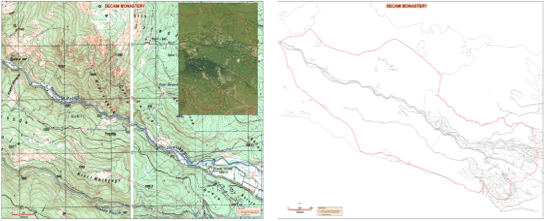
– Deçan Monastery
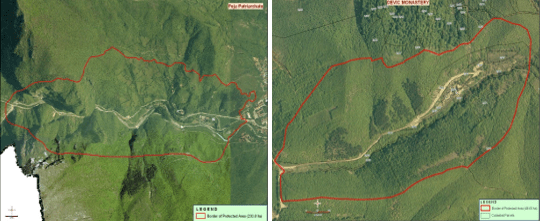
– Patriarchate of Peja, and – Devici Monastery
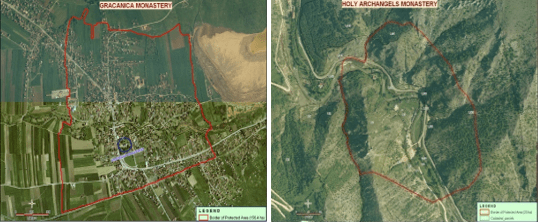
– Gracani Monastery and – Monastery of Saint Archangel in Prizren
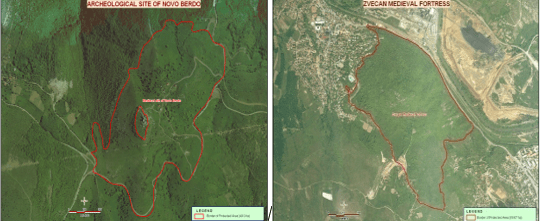
– The archaeological city of Artana, and – The Sokolica Monastery in Buletin
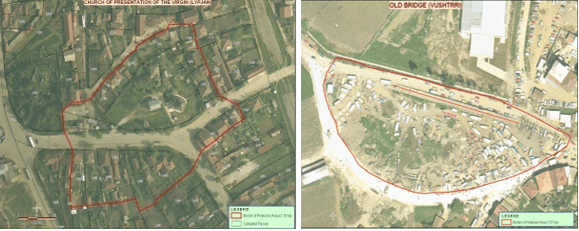
– The Church of Saint Florin in Lipjan and – The Stone Bridge in Vushtrri
Kosovo, after many negotiations with Belgrade and international mediation, declared independence on February 17, 2008. After the declaration of independence, the first international recognitions began.The Constitution of Republic of Kosovo, came into force on June 15 2008.Previously Chuang was governed by a Constitutional Framework based on Resolution 1244.
All the proposals presented by the Kosovo delegation in these negotiations were based on the assumption that the future status would be independence. This was done without considering the consequences that decentralization and the creation of new municipalities without any criteria would bring in the future.
Even Ahtisaari’s deputy Albert Rohan himself had stated that it was not good to form many new municipalities with a Serb majority because such a thing could be dysfunctional, this had to be financially sustainable as well..
There were recommendations from the International Crisis Group for Albanian political parties and our institutions to favor open lists in elections, to create a space for the development of democracy within, and to prevent the deepening of kleptocracy.(governance oriented towards the enrichment of the political elite through the mechanisms of power),within our parties, young people should be encouraged in politics.
Professionals should be given more space in strengthening institutions and more thought should be given to how, after the internationals leave, the transition (transitional phase) would be made easier within the institutions of Kosovo.
The biggest disaster, even though we were in very difficult negotiations in Vienna in 2006, was with the underground and intelligence structures of our two main parties after the war, LDK and PDK, their underground services were waging a fierce war over who would control the institutions of Kosovo, and not the main focus of the negotiation agenda and the strengthening of institutions during the transition..
If we analyze the political circumstances, both international and domestic, when this plan was prepared, it can be stated that it was the best possible solution for subsequent developments for Kosovo on its path towards independence. Article 1 stated that:
“Kosovo will be a multi-ethnic society, governed democratically and with full respect for the rule of law, through its own legitimate, executive and judicial institutions. “.
According to this plan, in Article 1, point 1.11, it was clearly defined that Kosovo had to respect the definitions of Annexes IX, X, XI, which regulated the civil and military presence of the international community in Kosovo and had to successfully fulfill its obligations. So it was clear that in addition to the provisions that enabled the democratic functioning of the state, there would be restrictions on certain issues by the institutions of Kosovo, also a very sensitive point of the provisions of the comprehensive Ahtisaari report would be Annex V, in this annex the Orthodox religious and cultural heritage in Kosovo was regulated.
Some of the articles of this annex will be quite problematic for the institutions of Kosovo in the future. I think that with the provisions within this plan in the fifth annex, many concessions were made regarding the status of Serbian cultural and religious heritage within Kosovo. In point 1.2. of annex V where it is written that;
“Kosovo will recognize the Serbian Orthodox Church in Kosovo, including monasteries, churches and other facilities used for religious purposes, as an integral part of the Serbian Orthodox Church headquartered in Belgrade.”.
This point will continue to pose a problem for Kosovo institutions in the implementation of the Ahtisaari plan on the ground, and problems will arise especially in the subsequent negotiations that will begin between Kosovo and Serbia for the normalization of relations in the future. Also, another point of Annex V of the Ahtisaari comprehensive plan that I think was very lenient regarding the Serbian Orthodox Church in Kosovo was point 1.5.1. of Article 1, where it says;
“Kosovo authorities will have access to facilities that constitute the property of the Serbian Orthodox Church only with the consent given by the Church or in cases where a court order is issued in connection with illegal activities, or in case of direct danger to life and health.”
The US, immediately seeing the maneuvers coming from Russia and Serbia, had openly supported Ahtisaari’s comprehensive project proposal.. The Special Representative of the UN Secretary-General, before making the plan public, had held a meeting with members of the Contact Group and NATO representatives in Brussels to consult on the initial publication of this plan.
According to the Ahtisaari plan, general provisions for a functioning democratic state were included. But with the comprehensive proposal, President Ahtisaari had made permanent some of the provisions that had previously been in the Constitutional Framework, these provisions were set for the period of international administration.and not that they should have continued even after the country’s independence, this was a mistake that will cost the country’s institutions after.
It was interesting that although Kosovo had made many concessions with the Ahtisaari plan, the Contact Group had still demanded even greater concessions. This had caused Kosovo to feel disappointed while Belgrade officials rewarded themselves by demanding the maximum, especially regarding the provisions related to the Orthodox Church and decentralization.
But it was important that the US, through State Department spokesman Sean McComb, had supported the comprehensive proposal, stating that this was a good project, and aimed at a peaceful Kosovo without ethnic problems and would also affect regional stability, it was also emphasized that this plan should be acceptable to the people of Kosovo..
While Russia on the other hand was playing its game that they would only accept a plan that would be acceptable to both sides, Pristina and Belgrade, this would mean an official no from Moscow.
Unfortunately, diplomats until the end had thought and hoped that Russia would support this plan in the Security Council, while Vitaly Churkin had stated that this draft was filled with the concept of Kosovo’s independence, implying that the chances were zero for such a plan to be adopted in the Security Council..
Seeing that Belgrade had rejected the Ahtisaari plan and Russia had blocked all efforts to get the plan through the Security Council, the US administration of President Bush began to seek other solutions by working with European allies to convince them to support it on the issue of Kosovo’s future status, but not through the Security Council..
American diplomat James Pardew writes in his book “Peacemakers” that his former Russian friend from the Contact Group, Sasha Bocan-Kharchenko, seeing American actions regarding Kosovo, had called him and declared that you know that we are against Kosovo’s independence, we will not be able to stop it, but the price you will pay for this was in Georgia.
Attention
The names of the churches and monasteries are written in the original as they are translated intothe proposal document thatspecial envoy for the statusof Kosovo, Martti Ahtisaari, On February 2, 2007, he submitted the proposalandhis in Pristina and Belgrade, for independenceandconditional onKosovo, the document translated into Albanian, which was submitted to us at the Department of Culture, at MCYS.


 Balkan Academia