
by Qazim Namani Dr. Archaeology & Cultural Heritage. Translation and edit by Petrit Latifi
Summary
This paper critically evaluates the International Donors’ Conference on the Protection and Conservation of Cultural Heritage in Kosovo (2004), organized by UNESCO in cooperation with UNMIK, the Council of Europe, and the European Commission. It argues that the official heritage documentation prepared for the conference relied predominantly on Serbian literature and reports, resulting in systematic historical bias. Many monuments were presented as exclusively Serbian medieval heritage, disregarding earlier archaeological layers and the multicultural character of Kosovo’s past. Through specific examples, such as the Lower Town of Prizren and the Fortress of Zvečan, the study demonstrates how these representations distorted historical realities. The paper further links this documentation to later political negotiations, showing how cultural heritage narratives were instrumentalized in the Ahtisaari process and Kosovo’s status talks.
International Donor Conference, organized by UNESCO, in cooperation with the United Nations, the UNMIK Administrative Mission in Kosovo, the Council of Europe and the European Commission, for the preservation and conservation of cultural heritage monuments in Kosovo, organized in 2004, and published in a book in 2005.
Next, let’s see how the monuments of cultural and historical heritage in Kosovo are described. If we analyze this publication, we notice that the history of the description of the monuments is made entirely based on Serbian literature and reports. In this case, we offer some examples to see the serious omissions, with consequences for our history and national identity.
To attract donors to the conference, a list of cultural heritage monuments and sites was compiled, based on two reports from the UNESCO Mission from 2003 and April 2004, and four reports from the Council of Europe.
The data for all these monuments were compiled in a document by international and local experts, such as: from CHwB, Sweden: Francisco Mondanes, Alex Mills and Ms. Susanne Wik, UNESCO experts: Alessandro Bianchi, and Horst Godicke, from the Council of Europe and the European Commission experts: Alkiviades Nicolaos Prepis and David Johnson, from the Ministry of Culture of the Republic of Serbia: Borislav Surdić, and from the Ministry of Culture, Youth and Sports Ms. Gjejlane Hoxha.
The documents compiled by these experts were published in a book that was published in Paris in 2005, in several languages of the world. Below we offer some of the published documents for some of the cultural monuments in Kosovo.
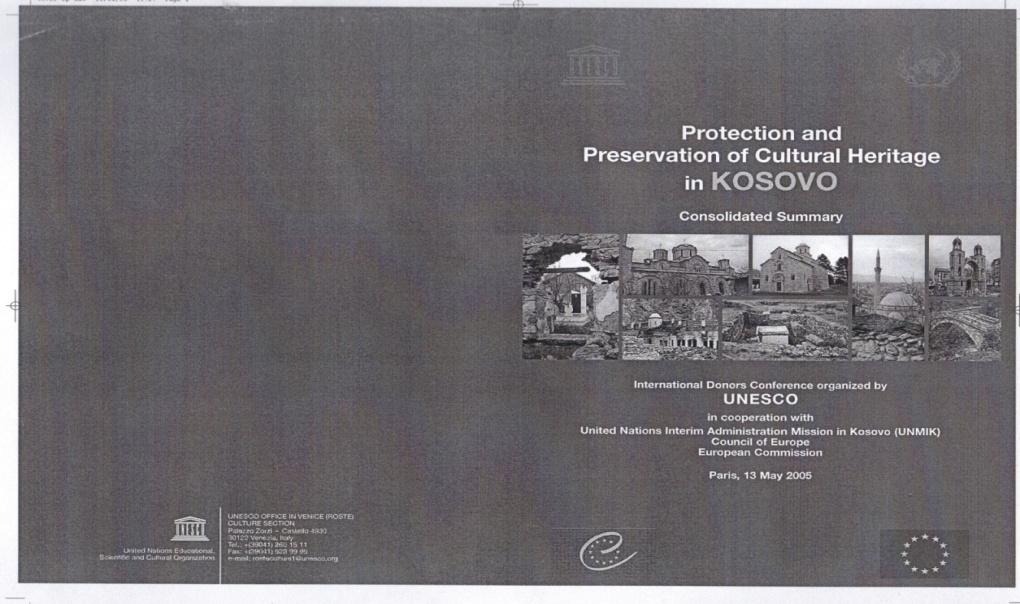
– Description of the cultural monuments selected for the donors’ conference
From the analysis of this document, it is understood that the historical data for all the monuments described in the list were taken from Serbian reports and publications. Almost all the cultural monuments are described as Serbian monuments built in the 11th-14th centuries.
We are highlighting two examples from the description of the monuments on this list:
– The Prizren Under-Castle, although published in English, is described with the Serbian word “SUBCALATION“, while this neighborhood is said in this report to be very important for the identity of the Serbian population in Prizren.
I think these documents should be analyzed to understand the difficult process of the subsequent negotiations for the country’s independence, where the cultural heritage and the community of Serbian municipalities in Kosovo were very sensitive topics during the talks.
Based on several reports published in Belgrade, in the report of the UNESCO Coordinating Centre established injarin 2003, and in the publication of the Geopolitical Institute founded in Belgrade in 1997, where in order to preserve the interests of the Serbian population in Kosovo during negotiations with internationals, two main pillars were envisaged: Serbian cultural and historical heritage and the Community of Serbian municipalities in Kosovo.
This publication was made public on November 29, 1998, and was also sent to the Presidents of Montenegro and Macedonia. Based on these reports and publications, the Ahtisaari Package was drafted.
Until this period, Albanians had not managed to come up with a scientific report on the cultural and historical heritage monuments of Kosovo.
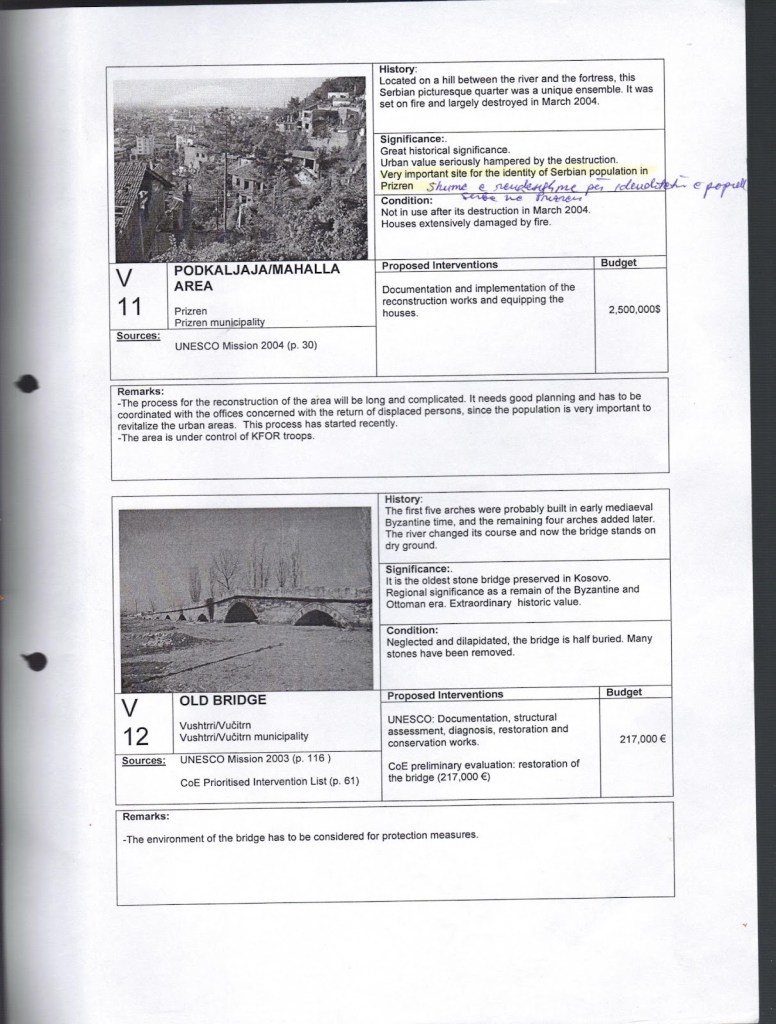
– Description of “Under the Castle” in the city of Prizren
– The Zvečan Castle, which is said to have been built between the 11th and 14th centuries, is very important for the medieval Serbian state and the Nemanjadi dynasty.
These publications are very harmful and inaccurate, it is enough to emphasize that the castle in the city of Mitrovica, and the city itself, have traces of civilization thousands of years before the medieval Nemanjide dynasty.
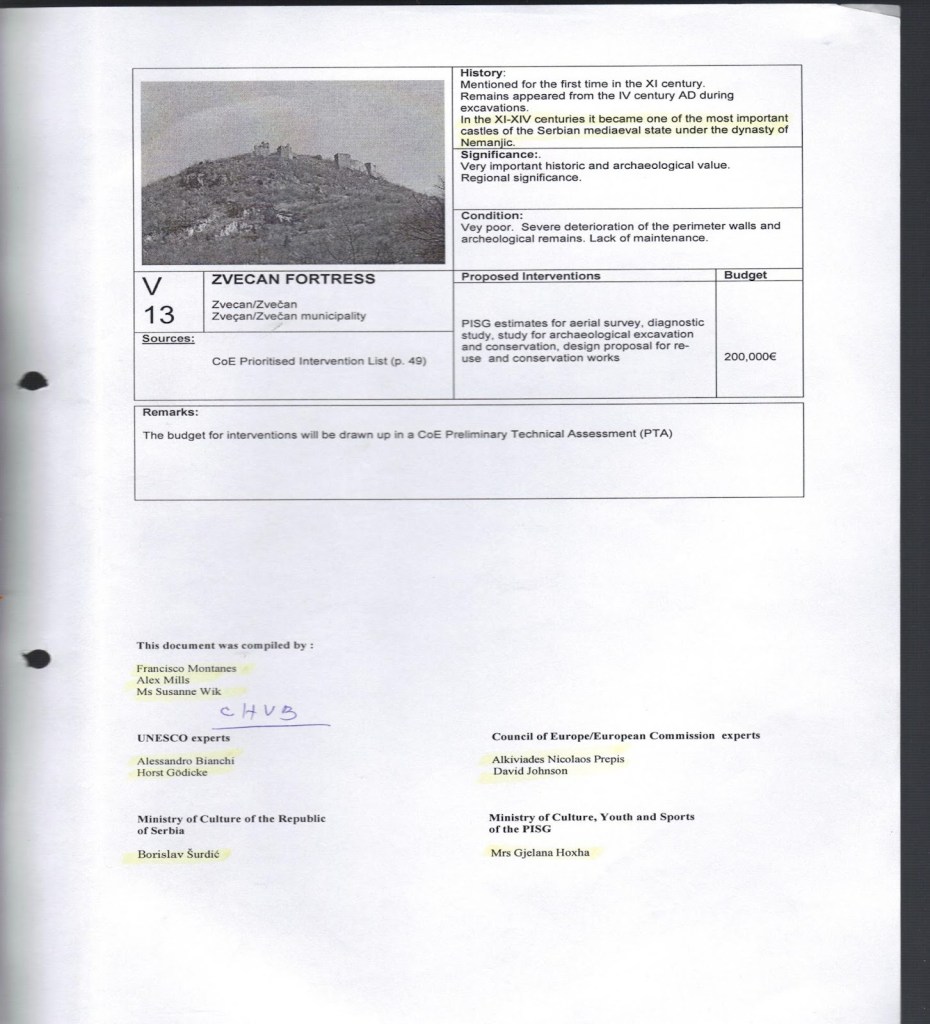
– Documents drafted by international and local experts


 Balkan Academia