
by Qazim Namani. Translation Petrit Latifi
Summary
This paper critically examines the implementation of the Regional Programme for Cultural and Natural Heritage in South-East Europe (2003–2005) with a focus on Kosovo. Through detailed case studies—including the Great Hammam of Prishtina, the Fortress and medieval city of Artana, and the Catholic Church of St. Peter in Stantërg—the study reveals serious professional, historical, and methodological flaws in heritage documentation prepared for international institutions such as UNESCO and the Council of Europe. It argues that the exclusion of local academic experts and reliance on inaccurate or politically influenced narratives resulted in historical distortions that undermine Kosovo’s cultural identity. The paper highlights institutional responsibility, mismanagement of heritage governance, and the long-term risks posed by falsified documentation for Kosovo’s cultural and historical legacy.
The Regional Program for Cultural and Natural Heritage in Southeast Europe 2003-2005, which should have drafted important documents for cultural and historical heritage monuments in Kosovo.
The list of experts for drafting the PTAs included the most renowned experts in the field of heritage, but, as it turned out later, they were more interested in their daily income than in the fate of Kosovo and its cultural monuments.
During the phase of compiling these documents, we are providing some of the documents prepared for several objects:
1. The Great Hamam of Pristina
At the meeting held on December 8 and 9, 2008, where the documentation for the ancient city of Ulpiana, the Pristina City Bathhouse and the Atelier of the sculptor Agim Qavdarbasha was reviewed, the participants made remarks about the documentation prepared regarding the Pristina City Bathhouse.
The documentation was prepared by Gjejlane Hoxha, architect, then head of the Cultural Heritage Division at the MCYS, and Valbona Saliuka, architect at the Institute for the Protection of Monuments and the Regional Museum of Pristina.
The document is titled The Great Turkish Hamam (Prishtina).
In addition to the title, there are many other omissions in its description, such as: instead of writing the former Danube Street, it says “Dunavska”, when it comes to the building, it says that most of the building is not used, the other spaces are occupied by illegal shops and the Kosovo Academy of Sciences and Arts. (see the document!).
The drafting of such documents for the Council of Europe by professional technical staff without consulting with professional scientific staff has consequences for the future, therefore it is a priority task to employ as many cadres of various scientific profiles as possible in institutions for the protection of cultural heritage that deal with the history, identity, art and material and spiritual culture of the people of Kosovo.
The description of these documents with major linguistic, professional, scientific and logical content errors, drafted mainly by architects who held important positions in the organizational and leadership structures of Kosovo’s institutions, will have long-term consequences for the history of Kosovo.
The drafting of the documentation that had begun in 2003 was sent to UNESCO and the Council of Europe without being verified by academic and scientific staff.
At the next meeting on 2 and 3 April 2009, the material prepared by Mr. David Johnson, expert of the Council of Europe, for this facility with the following title: Draft Feasibility Study for the Great Turkish Baths Pristina – Kosovo was distributed.
After the reactions of local experts regarding the history and naming of this object, he responded that you yourself have described the history of every monument, so let’s not waste time dwelling on this issue.
Throughout history, damage and falsification of documents for cultural monuments of one people against another are known, but there are rare cases when a “cultural heritage expert” destroys their own cultural values, and this passes in silence before scientific institutions, and is even supported by state institutions. How can it be written that the Academy of Sciences and Arts of Kosovo occupied a Turkish Hamam!
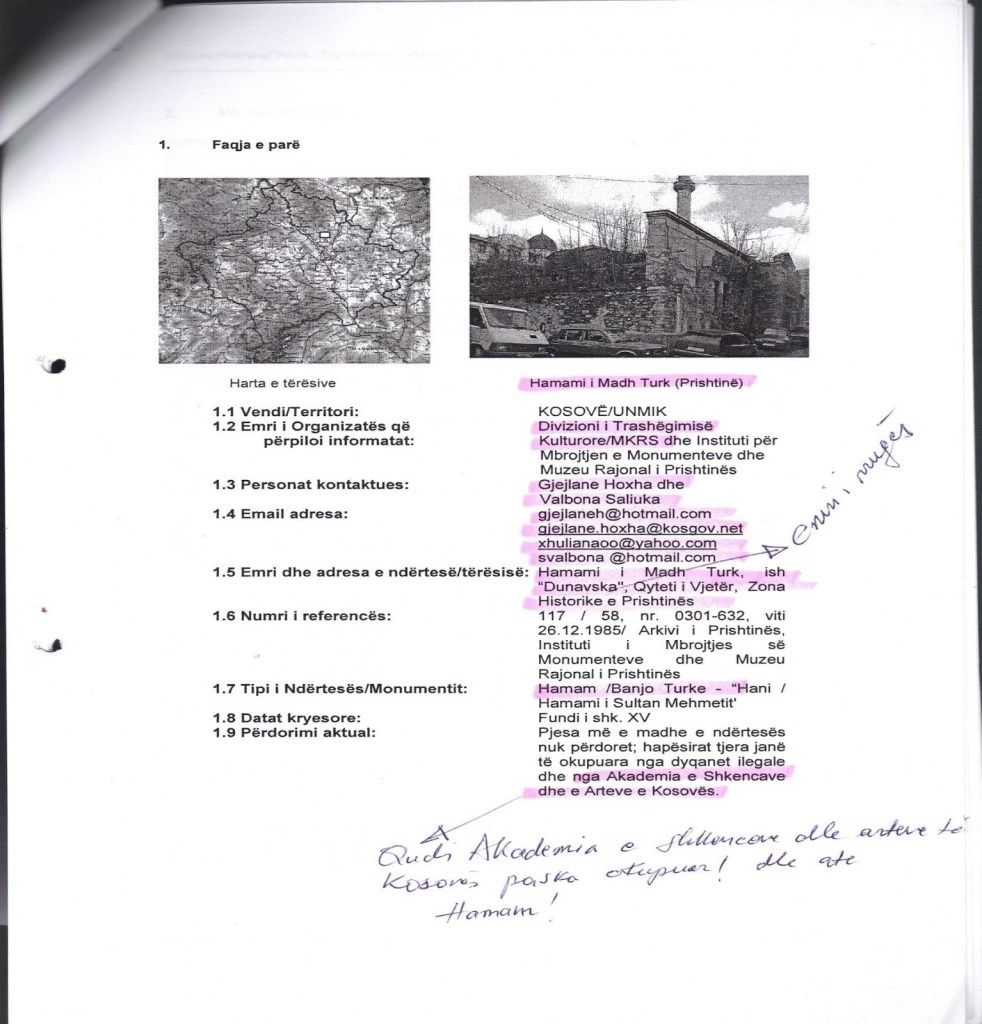
– Documents with the title The Great Turkish Bath in Pristina, described in 2005.
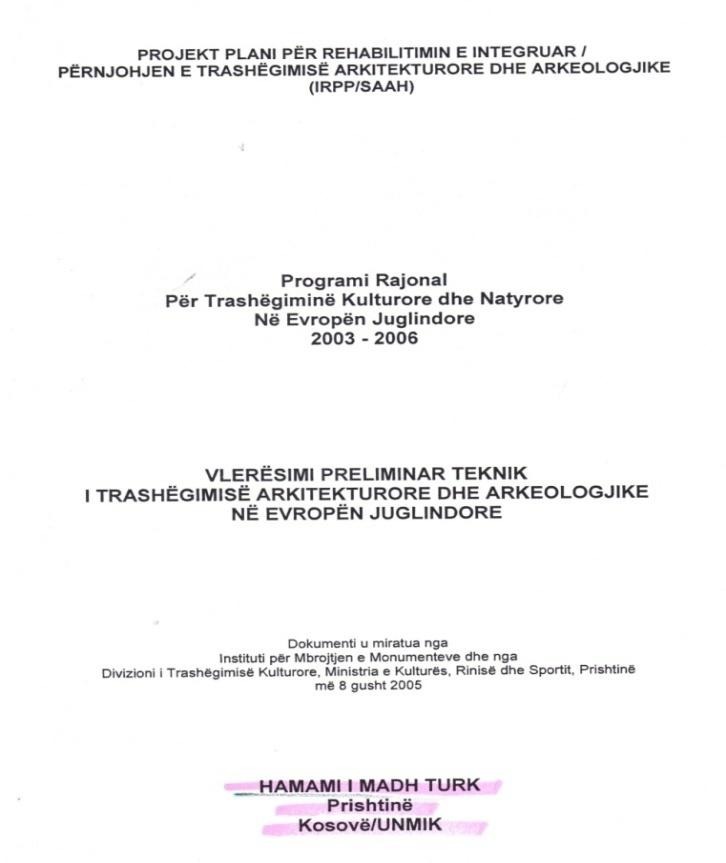
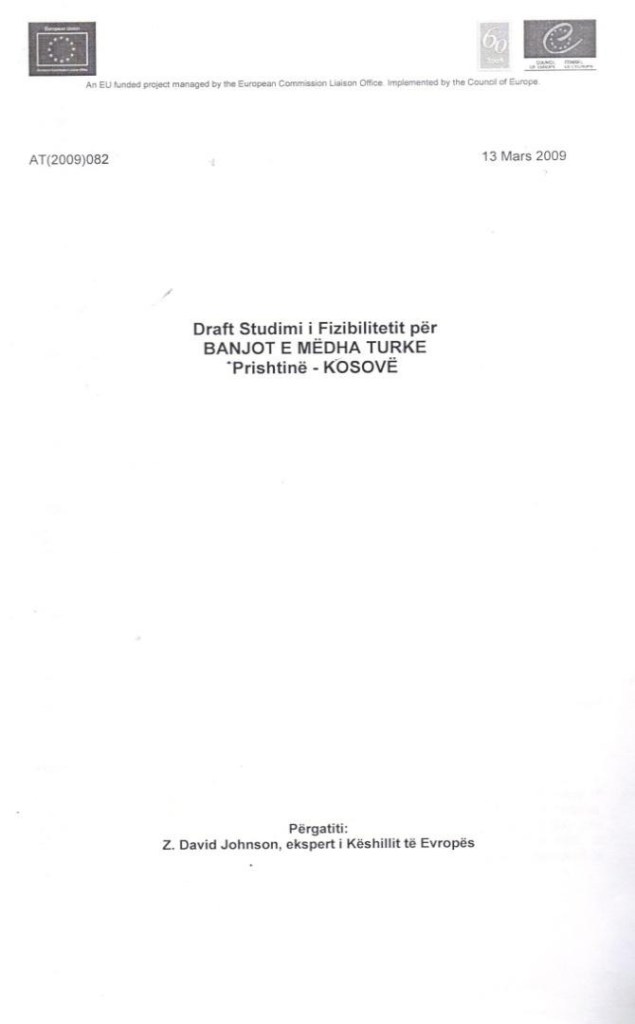
– Documents titled The Great Turkish Bath in Pristina, described in 2009 by international expert Mr. David Johnson
On April 2 and 3, 2009, the next meeting was held to review the project plans arising from the task of the regional program for the integrated rehabilitation of cultural and natural heritage in Southeast Europe 2003-2006.
Preliminary technical assessment for the Artana Castle, the Jashar Pasha Mosque in Pristina and the Catholic Church in Stan Tërg.
The working groups noted several omissions that emerged during the drafting of these projects, which had to do with the description of their history.
2. Artana Castle
The document related to the Artana Castle was prepared by the same experts, which begins with the name Gumnishte Castle – Novo Brdo, and this document was also approved by the MCYS on January 25, 2007.
The document prepared with this title does not stand, when it is known that Gumnishta is a small hill about 3 km east of the Artana castle with large land slopes. The Artana castle, in all world literature is known by different names, such as: in Latin Novus Mons, Nouaabre, in Italian Noua Monte or Monte Nova, the Saxons according to B. Brokier called it Nyeuberghe, the Byzantines are known as Nobapurion and Nobaprodon, the Ottomans Novabri, Yenidag, Novabride and Novayerde, the Slavs call it Novobrdo. The locals knew these mountains as the silver mountains, and the locality as Artana. It is first mentioned in documents in 1326, under the name Nouvo Monte.
This document contains numerous other omissions about the history of this very important site. Among other things, I would like to highlight the sentence that states that due to the importance of this castle, experts from the Institute of Monuments and the Regional Museum of Pristina have listed it as a first-category monument protected by law. From this sentence we understand a lot about the irregularities in the management of cultural heritage in Kosovo, for which the MCYS is responsible.
The city of Artana has entered into legal protection with the decision no. E.K. 266/48 of the Institute for the Protection of Cultural Monuments in Belgrade. This site of special cultural and historical importance has been protected and managed since the establishment of the Institute for the Protection of Cultural Monuments in Kosovo, which began its work in 1954, therefore, being of special importance even today, it should be managed by the Central Institute for the Protection of Monuments of Kosovo. The document was drafted by Haxhi Mehmetaj, archaeologist and prof. Alkiviades Prepis, architect, expert of the Council of Europe in Greece.
The city is said to have been developed by Saxons and merchants from Dubrovnik, then several other nationalities are mentioned.
It should be noted that, when it comes to Artana, we must bear in mind that this settlement is located in the central part of the Galab highlands, surrounded by dozens of castles and other cities that have left traces since the ancient period.
In addition, the exploitation of ores in these parts dates back much earlier than the Middle Ages. As evidence today, the metal slag that is found in almost every river in these villages.
As for the population, it is very difficult to deny the autochthonous population, but from medieval sources it is known that merchants and miners from Dubrovnik, Geneva and other places lived and worked in this city and its surroundings. Without a doubt, at that time the majority of autochthonous Albanians lived here. As evidence today, the Albanian population in these regions continuously preserves the early traces of civilization for several cities and castles in the vicinity of Artana.
The population of these villages was mostly of the Catholic faith of the Western rite and thus Artana survived as a Catholic municipality until the 18th century. As evidence is the Cathedral of St. Kolli and several other Catholic churches in the villages around Artana.
The Cathedral of St. Kolli in this document is presented to us as the Cathedral of Sta Paraskevi, which I think should not have been listed under this name or is unknown to me, because I have not encountered it under this name in the literature before..
3. St. Peter’s Catholic Church in Stanterg
In this document approved by the Ministry of Culture, Youth and Sports on November 24, 2005 and prepared by Haxhi Mehmetaj and Valbona Saliuka led by Bujar Demjaha, project coordinator, and 7 international experts, it is written that the St. Basilica of Stan Tërg was built in the 13th century and is known as the Latin church or the Saxon church, which is first mentioned in the 14th century.
Regardless of its historical and artistic values, the church also has a favorable geographical position and a beautiful environment with picturesque views of the forests. It is planned to be included as an Eco-Museum in a wider complex, which would include the Trepça Mine, the Archaeological Site“The old ladder”, Sokolica Monastery and the Tower-Museum of Isa Boletini in Boletini.
Among other things, as a factor for increasing the value of this church, the temporary and historical content where the two Christian religions, Eastern Orthodox and Western Catholic, met is described, illustrated by the medieval Orthodox monastery near Sokolica in Boletini. At the end it is written that the PTA for this project was made by Bektesh Vidishiqi, IMM-Mitrovicë, Haxhi Mehmetaj, IMM-Prishtinë and Andreas Heymoski, CoE expert, signed and dated 25.9.2005.
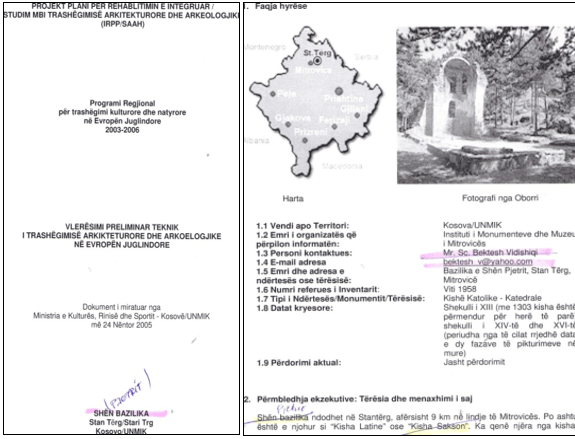
Fig. 75 and 76- Description of the church of Saint Peter in Stantërg
Based on the data contained in this document mentioned above, it is noted that the neglect of local professionals and experts working in the Institute and the Department of History has led to the drafting of many documents with falsified historical data that are detrimental to the history of the Albanian population of Kosovo, using Serbian propaganda data and writings to draft documents and publications, which were folded into archives and international institutions dealing with cultural heritage.
I am quoting the omissions in this document: It does not mention the Saint Basilica in Stan Tërg, but it mentions the Basilica of Saint Peter in Stanterg. It cannot be said that it was built in the 13th century and is known as a Latin or Saxon church because the first data known so far for this locality is in 1303, that is, in the 14th century, while the Saxons as miners are first encountered in written sources in Brskovë in the last decade of the 13th century, in Trepça sometime around the middle of the 14th century.
This leads us to think that we are dealing with a much earlier Catholic church because in 1303, two old Catholic churches are mentioned in this locality. In addition, no parallel can be drawn between this Basilica and the present-day Sokolica Monastery. For these reasons, this document mentions the alleged existence of the medieval Orthodox Monastery of Sokolica, while this monastery was founded as a women’s monastery in 1956.
Below we are providing some data from the document about the Sokolica Monastery and a brief overview of the professional and scientific omissions related to this document. Look at their professional and intellectual level, so don’t be surprised why our cultural and historical heritage is in this state!
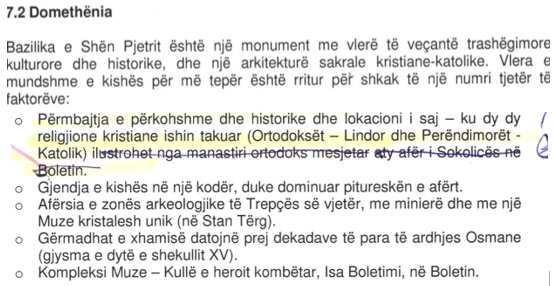
– Description of the document about the Catholic church and cultural monuments in Stantërg
This is also evidenced by literature and sources that mention a small church that was supposedly built by an unknown Serb in the 14th century. The reality and data about this church speak quite differently, when it is known that this church was a small shrine without its owner until 1954. During this period, the properties of the Boletini family were confiscated and donated to this shrine in 1956, when it was declared an Orthodox Women’s Monastery, interfering with the construction of other buildings.
The legal dispute between the Boletini family and the Monastery for these properties is still not closed. Data from the field suggest that this shrine was a small church of the Boletini family or a small shrine for the Jewish community that the Boletini family had brought to their village to help run the well-known business that the Boletini family had at that time.
As evidence, we can take the Jewish cemetery in Zhazha and the very name of a Serbized Jew named Avram, who had a house next to this shrine and very close to the Bulletin Tower, more specifically at“The Tupan Stone”This is a place where the Buletini family used to signal the surrounding residents with a trumpet on occasions of holidays or other gatherings.
The authors who drafted this document also write that in this location the Christian religions, Orthodox and Catholic, meet. This information is very harmful for the history of the indigenous Albanian population, when now we have abundant data and it has been documented with numerous historical sources the presence of the Albanian Catholic community in the easternmost cities of Dardania, such as: in Nish, in Prokuplje, in Vrajë, in Leskoc etc, but also the presence of churches and this very powerful community in the area of Artana, Trepça and other medieval cities that at that time also had Catholic communes established in these cities.
Material data and historical sources for the present-day territory of Kosovo and beyond, where the indigenous Albanian population lived, convincingly prove that the Albanian population, since the separation of the church, more specifically from 1054, had embraced both denominations, the Orthodox and Catholic, and had coexisted with them until the 19th-20th centuries, when believers of the Orthodox faith, under the influence of the propaganda of the Patriarchate of Istanbul, the Serbian, Greek and Russian churches, were assimilated.


 Balkan Academia