
Qazim Namani Dr. Archaeology & Cultural Heritage. Translation and edit by Petrit Latifi
Abstract
This paper provides a comprehensive analysis of the condition of cultural heritage in Kosovo from 1999 to 2012, with particular emphasis on the system of permanent monument protection. It examines post-war damage, illegal excavations, unplanned urban and industrial development, and the prolonged absence of effective heritage legislation. The study highlights serious institutional and administrative failures, including the removal of heritage documentation to Serbia, politicization of heritage management, and the manipulation of monument lists without scientific criteria. By analyzing statistical data, legal frameworks, and institutional practices, the paper demonstrates how cultural heritage protection was weakened by political interference, lack of professional expertise, and financial misuse. It argues that these shortcomings endangered Kosovo’s archaeological, religious, and vernacular heritage and undermined the credibility of national heritage governance.
State of Cultural Heritage 1999-2012 and Lists of Monuments Under Permanent Protection
Cultural heritage in Kosovo represents a complex and intricate system of values, activities and social relations, historically formed and developed in close connection with the life of one or more cultural, ethnic and religious communities in a specific historical-geographical territory.
The situation in cultural heritage after the war was alarming, where in addition to the damage suffered by cultural monuments during the 1998/99 war, many monuments and sites of particular cultural importance were endangered in recent years, as a result of rapid industrial development and unplanned urban construction.
The lack of proper institutional organization and administrative irregularities created confusion and an indifferent attitude towards cultural sites and monuments, which resulted in illegal actions on the ground, endangering the values of cultural heritage in Kosovo.
Based on information received to date, clandestine excavations have been carried out in mineral-rich regions that have left traces of ancient mines such as: Artanë, Dardana, Gjilan, Viti, Lipjan, Prishtina, Ferizaj, Mitrovica and the regions of ancient Dardania outside the borders of present-day Kosovo in the Medveđa, Bujanovac, Preševo, and Kumanovo lines. In this case, illegal actions have been carried out on the ground, risking the disappearance of the most important cultural values in Kosovo.
The lack of a law on the preservation of cultural heritage for six years after the war, and the failure to respect international conventions, has made it difficult to prevent these negative phenomena.
The deployment of KFOR in certain locations as archaeological zones immediately after the war, the politicization of culture and the delay in the procedure for the expropriation of protected areas, do not enable access of the relevant institutions to the monuments.
Attention should also be paid to strengthening institutions, training officials, experts in various fields, especially those for the restoration and conservation of monuments. Setting priorities without going through a professional commission that would guide the preparation of an action plan in accordance with legal provisions and financial assessment.
The treatment of cultural heritage values is done through identification, study, valorization, conservation, restoration and promotion. All of this is done by having staff from different fields available. Therefore, a multi-professional and interdisciplinary approach is required.
Cultural Heritage values, according to the international framework, are preserved, cultivated and promoted by the state itself.
As a socio-cultural category, cultural heritage is presented to us; in terms of tangible and intangible form; in terms of movable and immovable character; and in terms of use: sacred, profane and utilitarian.
In the following, we will present the existing situation by identifying the potential of cultural heritage (monuments and inventory list), the legal framework, the institutional and professional potential, and the education system.
Cultural heritage monuments until 2012
In Kosovo, the first attempt to protect monuments dates back to 1947, and was enriched by other announcements in previous years. Since then, a list of monuments has been created, which has reached the number 426.
According to the type of monuments in this list we have:
- Archaeological sites – 96
- Cemetery – 16
- monuments of Christian worship – 142
- Orthodox Church – 63
- Orthodox church ruins – 43
- Orthodox monasteries – 16
- Orthodox monastery ruins – 7
- Catholic Church – 3
- Icon, iconostasis Orthodox – 7
- Muslim religious monuments 32
- Mosque (1 ruin) – 22
- Tekke, turbe – 10
- Popular residential monuments – 71
- Lock – 28
- Apartment – 43
Public social building – 25
- Bazaars (markets) – 3
- Water – 7
- Water supply, tap – 4
- Hammam – 6
- Mills – 2
- Clock tower – 1
- Ensembles – 1.
- Historical monuments – 21
- Clothing, books, objects – 19
- Miscellaneous – 4
From this list, there are four objects that have been included in the World Heritage List. They are placed on this list with the designation“Mediavel Monuments in Kosovo”– Medieval Monuments in Kosovo. Under this heading are placed:
Deçan Monastery – Year 2004
Patriarchate of Peja – Year 2006
St. Friday Church – Year 2006
Gracanica Monastery – Year 2006
It should be emphasized that the proposal to include it in this list was made by the Republic of Serbia and that there are many ambiguities and inaccuracies in the files of these objects, which best reflects the extreme politicization of the Cultural Heritage of Kosovo.
From the list of protected monuments, we have ascertained that the files of 410 monuments were taken and transferred to Serbia; based on a decision number 140, dated 09.06.1999.
It is worth highlighting the fact that in each file there was the original decision of the monument that the object with cultural value was under state protection.
The files had index cards (positive photos) of 1 or more photographs.
According to the evidence we possess in the documentation files, there were 16,434 positive photographs. Furthermore, from the above, we assume that 16,434 negatives were also taken from the photo library.
A considerable number of first-category objects had in their files materials from field research, archaeological research materials, various reports and correspondence, as well as several projects for capital objects.
Also taken from the documentation were field reconnaissance diaries, starting from 1957 until 1991; this material had approximately 300 typewritten pages.
According to evidence, copies of the projects of these monuments have remained in the Institute’s documentation:
- The Bazaar Mosque (Bajrakli) Mosque in Peja
- Bajraktar Mosque with cemetery in Junik
- Jashar Pasha Mosque in Pristina
- Sheh Emin’s Tekke in Gjakova
- Church of Our Lady in Lipjan
- Church of the Transfiguration in Budisalc
- The Old Hamam in Vushtrri (partially)
- The Great Hamam in Pristina
- The Small Pasha Hamam in Pristina
- Hammam in Mitrovica
- Theresa Bridge in Gjakova
- Haxhi Zeka’s Mill in Peja
- Qamilovic House in Vushtrri
- The House of the “Protiqs” in Peja
- The building of the Institute of Monuments in Pristina
- Dul Shabani Tower in Carrabreg
- The Tower of the Ibërhysajs in Deçan
- The Gjikokaj Tower in Deçan
- The Mushkolaj Tower in Deçan
- The Arifaj Tower in Nivokaz
- Musa Ali’s Tower in Nivokaz
- Pepsh Tower in Junik
Also taken from the documentation were the field reconnaissance diaries of the municipalities of Kosovo starting from 1957, namely from the travel notes of Nedelko Virievic to the notes of the Municipality of Deçan from 1991.
The reconnaissance materials must have been approximately 300 typewritten pages.
In 2002, the process of identifying and inventorying objects that were considered to have value to be classified, after proper scientific studies, as monuments that should be protected by law, began.
After 2010, a project began to reassess the list of cultural monuments that had been protected before the war. Teams were formed to visit cultural monuments in the field. We who worked in the field noticed many Serbian houses and some of the objects put under protection by the former Provincial Authority, those in the field did not appear or did not meet any criteria to be kept on the list as cultural monuments.
We requested that the list of 426 monuments be cleaned up, removing those objects that the Serbs had put on the previous list, after we had visited them in the field. This did not happen, but surprisingly, all the monuments registered by the Serbs remain on the list.
The list was inflated by field data that had also come from other centers, a list of 2847 objects was compiled, without registering in some Serbian municipalities, when the recognition had not yet been done in the north-eastern strip of Kosovo.
We are providing data from the final report on the creation of a new list of objects to be taken under state protection.
The path of Serbian academics in the appropriation of cultural heritage was also followed by neighboring countries. In 2009, four books written about the cultural heritage of Macedonia were promoted. The books were promoted under the patronage of the Ministry of Culture of this country, where the regional director of UNESCO, Mr. Engelbert Ruos, was also invited. These books were also supported for publication by UNESCO.
The authors of these four books are researchers, archaeologists, art historians, such as: Aneta Serafimova, Viktoria Popovska, Julia Trickovska, Mirjana Mashnič, Zoran Pavlov, Radmila Petkova, Pasko Kuzman, Dragan Mitrevski, Dragisha Zdravkovski, Kiro Ristov, Kiril Trajkovski and Lenče Jovanova.As can be seen, Julia Tričkovska is a co-author of the publications of these books.
In the Monastery of Saint Birgur, now Jovan Bigorski, the liturgy was performed in Albanian until 1945. This monastery was burned several times to lose all traces of Albanian.
The government and the Serbian Orthodox Church pushed Julia Trickovska to obtain a doctorate for this monastery in order to falsify historical facts and, through the Council of Europe, brought her to Kosovo in 2009 to direct cultural heritage. Julia is a collaborator with archaeologist Pasko Kuzman, who was entrusted with many works and publications on the appropriation of Albanian material culture in Macedonia.
During this period, the Minister of Culture in Kosovo, Julia Trickovska, had surrounded herself with a group of Albanian party serviles, employed in our institutions, and some dishonest professors, who were happy to participate in any work meeting for a living.
This was the darkest period in cultural heritage, where everything went against historical sources and scientific theories regarding interventions in cultural monuments. Although we have reacted several times with official letters, we were completely ignored and isolated from these activities, unable to influence this harmful process to stop.
According to a planned dynamic, earlier in the process of identifying the objects, the Kosovo Institute for the Protection of Monuments and its four branches, in Prizren, Peja, Gjakova and Prishtina, were included. From all this, a list of 2847 objects was compiled. The list is not complete due to the lack of identification of objects in four municipalities and in some enclaves with a Serbian population.
Also, other objects may be added to this list since in the future objects may appear that for one reason or another may have fallen out of the attention of experts.
The project for compiling this list of monuments in 2012 was entrusted to the Archaeological Institute of Kosovo.
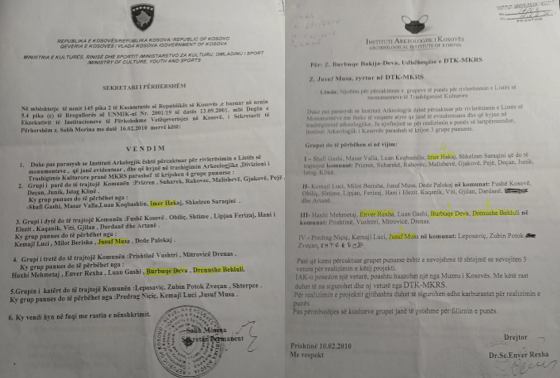
Regarding the drafting of this list, I reacted in writing, but the remarks were not taken into consideration, See document 4.
Below we present the structure of the objects by category. The objects placed on the list by gender are divided into objects; sacred, profane and utilitarian.
The religious objects placed on the list are divided into;
- Muslim religious objects:
Mosque – 317 objects
Mejtepe -15 objects
Mejjite – 14 objects
Tekke – 35 objects
Tombs – 67 objects
Madrasah – 8 buildings
Mole – 2
- Christian religious objects
- Orthodox Church – 65 objects
- Catholic Church – 55 objects
- Monasteries – 6 objects
- Residential buildings
- Gold – 916 items
- Houses – 587 objects
- Other residential buildings – 100 buildings
- Public facilities
- This category includes shopping complexes, public service facilities, etc.
- 140 objects
- Cemetery
- Illyrian Cemetery – Arbërore – 29
- Christian – Catholic Cemetery – 11
- Christian – Orthodox Cemetery – 3
- Archaeological sites
- 175 locations
- Other objects
- FARM
- Bubble – 111 – objects
- Tribe – 3
- Hives – 1
- Barns – 76
- Basket – 54
- Animal shelter – 1
- Flanik – Qilare – 4
- Supporting objects
- Storage – 1
- Traditional costumes – 34
- Stone troughs – 1
- Well box – 2
- Summer Kitchen – Kitchen – 1
- Fence – 1
- Water-powered wood saw – 1
- Wells – 5
- Special
- Different – 3
- Cave – 2
- Lis – 1
This category includes many archaeological sites that have not been protected by law.
Below we present in tabular form the number of monuments that have been protected from 1947 to 1990, and their number in municipalities by region.
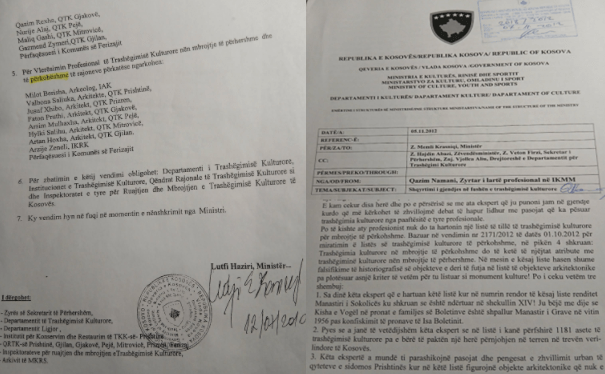
The list of monuments under protection was added outside of any scientific criteria. This list was added every year without taking into account the monumental values of the monument. The list was approved every year by the minister and made public, and even the list contained ridiculous proposals that had nothing to do with cultural monuments, nor with the logic and common sense of man.
Proposals were included in the list for temporary protection, according to the wishes of the working committees, without thinking that they were seriously offending the people and state of Kosovo. We are mentioning just some of the proposals that were included in the list of monuments under temporary protection, such as: Corn Bread, Mrume Bread, with pearls in their hands, the PIT Pidak game and many other proposals that were made public, can serve as humor or can even be used by our neighbors to make fun of us and our experts.
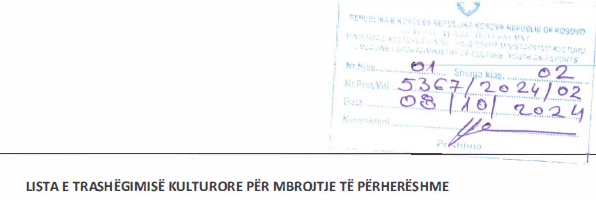
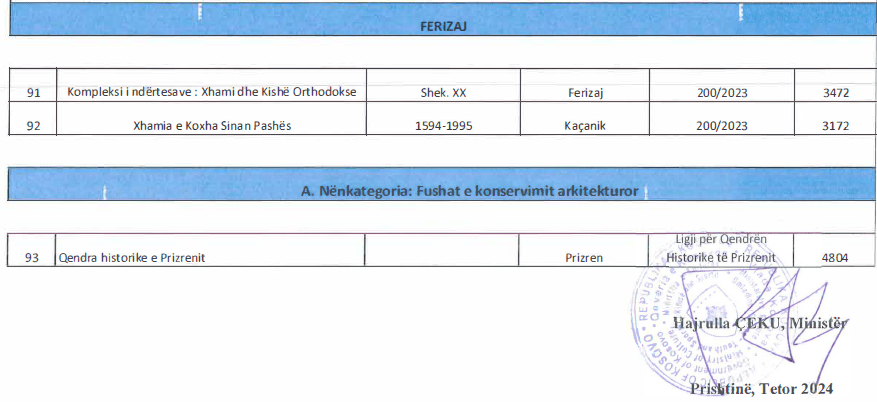
As can be seen in the decision signed by the Minister of Culture in 2024, the list of the Ministry’s Database, with ridiculous proposals, had reached the figure of 4804 as monuments under temporary protection.
But how can Corn Bread be included as a proposal for a cultural monument, to be protected by law in Kosovo, when historically it is known that corn as a plant culture comes to Europe, after the discovery of America, while in Albanian lands, it was possible that it was brought somewhere in the 16th century, or to include in the list as proposals, some of the games that have been played, since the Olympic Games in antiquity.
There have been cases when many objects have been selected as a priority for investment from the temporary list, even though they did not meet any criteria to be assessed as cultural monuments, or to be taken under state protection.
From the list of monuments under permanent protection 1947-1990, all monuments that had been assessed as cultural monuments by the former Provincial Office for the Protection of Monuments were removed.
Regarding the inclusion of monuments on the permanent list, you had entrusted this work to the Kosovo Council for Cultural Heritage.
Starting from scratch to make a list of cultural monuments, the members of this council and working committees were well-suited to gain time, and to profit from the large salaries they received for each working meeting.
The Department of Cultural Heritage, along with all its subordinate institutions, became commission institutions that were paid with daily wages, and rewarded with lunches and working meetings, often abroad, but also in luxury hotels in the country, supposedly doing important work to save cultural monuments in Kosovo.
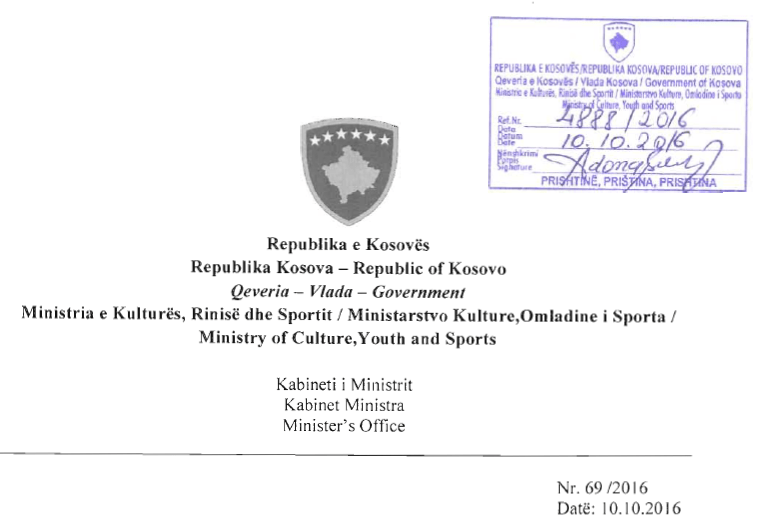
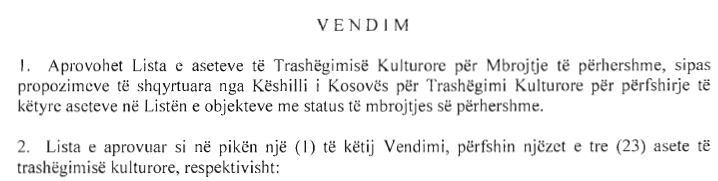
Based on the decision issued by the Ministry of Culture, until 2016, a total of only 23 cultural monuments were included in the permanent list, while based on the decision of 2004, we note that a total of 93 cultural monuments were included in the list of permanent monuments.
Despite these professional omissions, our reactions were futile, against an uneducated staff employed in politicized institutions and a political cabinet of ministers, and a secretary, ignorant, irresponsible, and directed by daily politics, who did not respect the professional hierarchy with specializations and scientific degrees of staff in institutions.
List of monuments under permanent protection for 2016, signed by the minister
List of monuments under permanent protection for 2024, signed by the minister
Below we offer the list of Cultural Monuments 1947-1990, according to the years they were placed under protection and the municipalities.
Table – Number of Monuments in Kosovo during the years 1947 to 1990
| No. | Years of placing monuments under protection | Number of monuments |
| 1 | 1947 | 4 |
| 2 | 1948 | 13 |
| 3 | 1949 | 6 |
| 4 | 1950 | 7 |
| 5 | 1952 | 1 |
| 6 | 1953 | 2 |
| 7 | 1954 | 3 |
| 8 | 1955 | 43 |
| 9 | 1956 | 8 |
| 10 | 1957 | 6 |
| 11 | 1958 | 34 |
| 12 | 1959 | 1 |
| 13 | 1961 | 6 |
| 14 | 1962 | 8 |
| 15 | 1963 | 12 |
| 16 | 1964 | 11 |
| 17 | 1965 | 12 |
| 18 | 1966 | 45 |
| 19 | 1967 | 47 |
| 20 | 1968 | 12 |
| 21 | 1969 | 1 |
| 22 | 1970 | 10 |
| 23 | 1971 | 16 |
| 24 | 1972 | 3 |
| 25 | 1973 | 1 |
| 26 | 1974 | 6 |
| 27 | 1977 | 10 |
| 28 | 1978 | 4 |
| 29 | 1980 | 31 |
| 30 | 1981 | 3 |
| 31 | 1982 | 9 |
| 32 | 1983 | 14 |
| 33 | 1984 | 8 |
| 34 | 1985 | 6 |
| 35 | 1986 | 8 |
| 36 | 1987 | 3 |
| 37 | 1988 | 8 |
| 38 | 1989 | 1 |
| 39 | 1990 | 2 |
| Total | 39 Quickly | 425 |
Note:
a.) First list since 1947 with 4 monuments;
b.) The list was expanded in 1967 with 47 new monuments;
c.) Lists with the smallest number of monuments accepted
in the years 1952, 1959, 1969, 1973, 1989 with 1 monument each.
Table no. 5 – Monuments in Kosovo – Accrediting Municipalities
| No. | municipalities | Number of monuments | |
| 1 | Peja | 57 | |
| 2 | Gjakova | 28 | |
| 3 | Decan | 16 | |
| 4 | Kline | 13 | |
| 5 | The same | 14 | |
| Total in the Peja Region | 128 | ||
| No. | municipalities | Number of monuments | |
| 1 | Prizren | 82 | |
| 2 | Orahovac | 17 | |
| 3 | Suva Reka | 8 | |
| 4 | dredger | 3 | |
| Total in the Prizren Region | 110 | ||
| No. | municipalities | Number of monuments | |
| 1 | Mitrivice | 9 | |
| 2 | ethnology | 18 | |
| 3 | Skenderaj | 8 | |
| 4 | Zvecan | 5 | |
| 5 | Zubin Potok | 6 | |
| 6 | Leposavic | 11 | |
| Total in the Mitrovica Region | 57 | ||
| No. | municipalities | Number of monuments | |
| 1 | Gjilan | 11 | |
| 2 | year | 11 | |
| 3 | Novo Brdo | 2 | |
| 4 | Kamenica | 8 | |
| Total in the Anamorava Region | 32 | ||
| No. | municipalities | Number of monuments | |
| 1 | Lipljan | 15 | |
| 2 | Pristina | 33 | |
| 3 | Ferizaj | 14 | |
| 4 | rounds | 7 | |
| 5 | Strpce | 5 | |
| 6 | Podujevo | 11 | |
| 7 | Kaēanik | 4 | |
| 8 | Kosovo Field | 3 | |
| 9 | Glogovac | 5 | |
| 10 | Obilic | 1 | |
| Total in the Pristina Region | 98 | ||
Table 6. Number of protected monuments by region | |||
| Regions | Number of monuments | ||
| Total in the Peja region | 128 | ||
| Total in the Prizren region | 110 | ||
| Total in the Mitrovica region | 57 | ||
| Total in the Anamorava region | 32 | ||
| Total in the Pristina region | 98 | ||
| Total Monuments | 425 | ||
TABLES
In 2004, by decision of the Minister Mr. Behgjet Brajshori, after the reconstruction, the house of Shtjëfen Gjecov in Janjevë was placed under protection, therefore the number of monuments under protection by law is 426.
These analyses were conducted by the author of the article, so they are not allowed to be misused, but can be used for research purposes!


 Balkan Academia