
This text analyzes how Romantic-era Europeans misinterpreted modern Greece through a classical lens. Confronted with a society shaped by Byzantine and Ottoman history, they redefined Greek identity by claiming that modern Greeks were ethnically different from their ancient ancestors.
Philip Sherrard:
European Romantics created the myth of a “classical Greece” being reborn in modern Greece in 1821. But it did not take long for the truth to emerge: modern Greeks were not Greeks. Most were Slavs, or more precisely, Albanians. Attica, Megara, Euboea, Locris, Andros, Marathon, Plataea, Salamis, Mantinea, Olympia, Poros, Hydra, Spetses, etc. – practically the whole of Greece – was inhabited by Albanians. Even the so-called heroes of the Revolution were such.
Historical misunderstanding
For late-18th and early-19th century European travelers, the gap between myth and historical reality was striking. The Greece they encountered was not “classical” at all. Historically, Greece had developed through Byzantine Christianity and centuries of Ottoman rule, preserving late-Byzantine religious and cultural traits rather than ancient classical ones.
To classical humanists, Christian Byzantium represented everything that was non-classical: obscurantist, barbaric, and medieval.
Gibbon and the anti-Byzantine mindset
Edward Gibbon viewed Christianity as the cause of Rome’s fall. He famously wrote:
“I have described the triumph of barbarism and religion.”
He blamed Christian emperors and Byzantine policy, showing deep hostility toward Byzantine Greeks. In his writing, “Romans” were noble victors, while “Greeks” were treacherous losers. He often used insulting terms like “base,” “crafty,” and “weak.”
He described Byzantine history as:
“A tedious and uniform tale of weakness and misery.”
Influence on British scholarship
This attitude dominated British academia for generations:
- Gibbon was required reading at Oxford for European history students.
- No British university had a chair dedicated to Byzantine studies.
- Classical studies, by contrast, had multiple departments.
Romantic Philhellenism and the Greek War of Independence
During the Romantic era, Greece’s 1821 uprising against Ottoman rule inspired European imagination. Greece symbolized:
- Classical heritage
- Freedom
- National identity
Poets like Percy Bysshe Shelley declared:
“We are all Greeks. Our laws, literature, religion, and arts have their roots in Greece.”
In Hellas (1822), Shelley imagined a reborn Greece rising like a phoenix.
Reality on the ground
However, travelers such as Lord Byron encountered a very different reality:
- Modern Greeks often had little knowledge of ancient history
- Many belonged to tribal, rural societies
- They did not resemble the idealized classical image
This caused confusion among European admirers.
The “solution”: modern Greeks were not Greeks
The explanation became simple:
Modern Greeks were not Greeks.
Historian George Finlay wrote that most of the population was Slavic or Albanian, especially Albanians (Arvanites). Albanian settlements included:
- All of Attica and Megara
- Most of Boeotia
- Parts of Locris, Andros, and Euboea
- Marathon, Plataea, Salamis, Mantinea, Olympia
- Poros, Hydra, Spetses
- Practically all of Greece
Many “Greek” revolutionary heroes were actually Albanian.
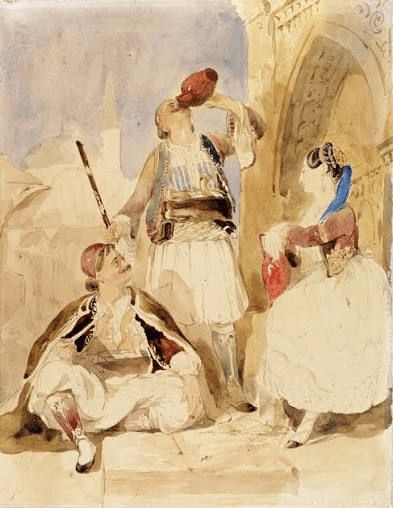
Even the fustanella, Greece’s “national costume,” was Albanian (Tosk) in origin and adopted after independence to honor Albanian military valor.
Fallmerayer and the final verdict
German scholar Jakob Philipp Fallmerayer reinforced this narrative, claiming that ancient Greeks had vanished and been replaced by Slavic and Albanian populations.
The people living under the ruins of the Parthenon were described as:
“The immoral remnants of medieval Slavic migrations, deforming their native soil with their politics and their small, dark bodies.”
Source
Sailing to Byzantium. Philip Sherrard. The Twentieth Century, Vol. 169, Issue 1007. Bloomsbury Way, London. January 1961


 Balkan Academia