
Abstract
This study examines alternative interpretations of selected ancient inscriptions from the Boeotia region in central Greece through a comparative linguistic perspective involving the Albanian language, particularly the Gheg dialect. Focusing on an inscribed vase currently held in the Louvre Museum, the paper discusses claims that its script resembles Pelasgian–Etruscan letter forms and that its phonetic segmentation may correspond to lexical structures preserved in Albanian. The analysis situates these interpretations within the broader historical and demographic context of Boeotia, a region historically characterized by population movements and linguistic diversity, including documented Albanian-speaking communities in the modern period. While acknowledging that such interpretations remain controversial and outside mainstream consensus, the study argues that Albanian may retain archaic linguistic elements worthy of further interdisciplinary investigation in the study of pre-classical Balkan history.
Reconsidering a Boeotian Inscription: Linguistic and Historical Observations
Numerous archaeological objects bearing ancient inscriptions have been discovered across the Mediterranean region. In many cases, however, these inscriptions have not been translated or systematically analyzed in relation to Modern Greek, and alternative linguistic interpretations have occasionally been proposed.
It has been suggested by some researchers that a notable proportion of lexical elements found in certain ancient inscriptions appear to correspond to forms preserved in the Albanian language, particularly in the Gheg dialect, which retains a significant number of monosyllabic words. From this perspective, Albanian has been considered by some as a potentially useful comparative language when examining pre-classical or non-Hellenic inscriptions.
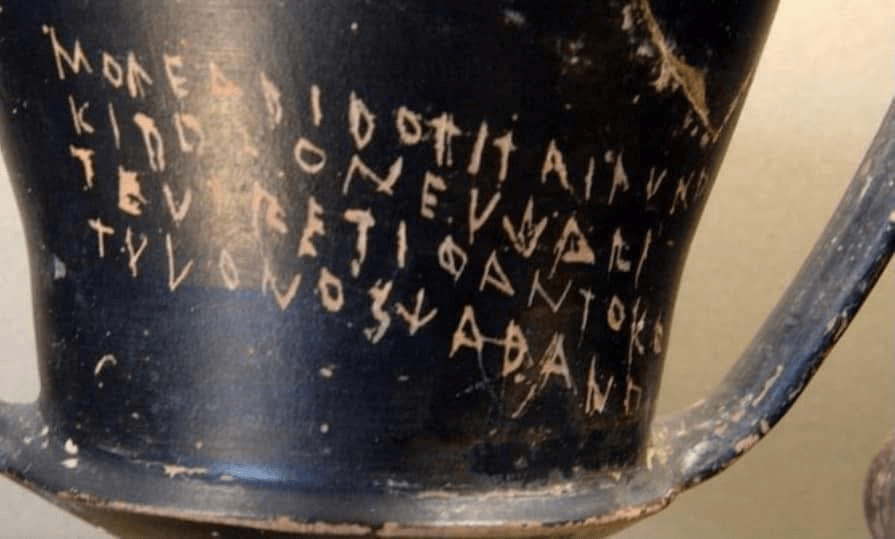
One such example frequently cited in this context is a vase currently housed in the Louvre Museum. According to these interpretations, the script used on the vase resembles what has been described as Pelasgian–Etruscan letter forms. Proponents argue that the inscription may be segmented and phonetically interpreted in a way that aligns with contemporary Gheg Albanian. The inscription is transcribed as follows:
MOPEDRIDOTITAIR
KIDORONEVARI
TETRETITHANTOKS
TYLONOZPADA
When divided into proposed phonetic units, it is interpreted as:
MO PE DRID O TIT AIR
KI DOR O NE VARI
TE TRET I THA NTOKS
TY LON OZ PA DA
The association with Albanian is further contextualized by the geographical origin attributed to the object. The vase is reported to have been found in the mountainous region of Boeotia, in central Greece. According to the Treccani Encyclopedia, Boeotia is a region that, in the early 20th century, had a substantial Albanian-speaking population. Treccani notes that the area, with an extent of approximately 2,580 square kilometers, was administratively linked with Attica and was divided into two districts centered in Livadia and Thebes, both of which had significant Albanian communities.
Some scholars and writers have argued that this demographic continuity may reflect a longer historical presence of Albanian-speaking populations in the region. Linguistic parallels are occasionally proposed between Albanian toponyms and local place names, although such connections remain the subject of debate and require careful historical and philological verification.
Classical sources, including Herodotus and later authors such as Plutarch, describe Boeotia as a region with complex population movements involving Thessalians, Mycenaeans, and other groups. The city of Thespiae, for example, was an important member of the Boeotian League and experienced multiple phases of conquest and alliance throughout antiquity. These accounts illustrate the cultural and ethnic diversity of the region rather than a single linear continuity.
The purpose of presenting these interpretations is not to diminish established historical narratives, nor to claim definitive conclusions, but rather to highlight the possibility that the Albanian language—particularly in its archaic forms—may preserve elements valuable for comparative study in the context of ancient Balkan and pre-Hellenic history. Further interdisciplinary research involving archaeology, historical linguistics, and epigraphy would be required to assess such claims rigorously.

 Balkan Academia