
by Petrit Beqiraj.
Abstract
This study explores the intersection of oral tradition and local history in the Rugova region through the figure of Syla Mustafa Sejda (Beqiraj) and related heroic narratives. Using a traditional Albanian epic song as a primary cultural source, the text analyzes representations of resistance, leadership, and communal identity during periods of armed conflict in the late Ottoman and early Balkan contexts. Particular attention is given to the ways in which oral history preserves alternative historical perspectives that remain marginal in official accounts. The inclusion of female agency, notably through the character of Bike Alija, further illustrates the social breadth of resistance narratives. The study demonstrates how oral tradition functions as a vehicle for historical memory and regional identity.
Syla Mustafa Sejda (Beqiraj), originating from Shtupeqi i Vogël in the Rugova region, is remembered in local historical and oral accounts as a figure associated with armed resistance and regional defense during periods of conflict.
Background
Mustafa Sejda Beqiraj (1864–1910) and Isuf Haxhi Kastrati (1855–1910) killed fighting the Turkish forces.
He was the son of Mustafa Sejda Beqiraj (1864–1910), who was killed in 1910 together with Isuf Haxhi Kastrati (1855–1910) during clashes at Shkallët e Vogla in Qafë e Peklenës. According to local tradition, the two men resisted attacking forces in an effort to protect their village and its inhabitants. They fought against the Turkish forces.
Mulla Jusa
Contemporary accounts suggest that Mulla Jusa, a religious and community figure of the time, addressed the warnings of imminent danger directly to Mustafa Sejda and not a formal bajraktari (flag bearer).
This has been interpreted by local historians as an indication of informal authority exercised by certain individuals who were not necessarily included within the official hierarchical structures.
Syla Mustafa Sejda
Following his father’s death, Syla Mustafa Sejda assumed responsibilities at a young age in a context marked by sustained violence and instability. The Beqiraj family was widely known in the Rugova region as a large and economically stable household, whose male members were frequently involved in armed conflicts.
Syla later lived as an armed fugitive, a status that local sources frame as a consequence of ongoing resistance rather than personal criminality. He was reportedly familiar with the mountainous terrain of Rugova, utilizing caves, mountain passes, and remote paths to evade pursuit.
According to oral tradition, his ability to avoid capture led opposing forces to attribute to him various sobriquets, reflecting his perceived elusiveness. Anecdotes recount that his name was used rhetorically in domestic contexts to evoke fear, although such claims remain within the realm of folklore.
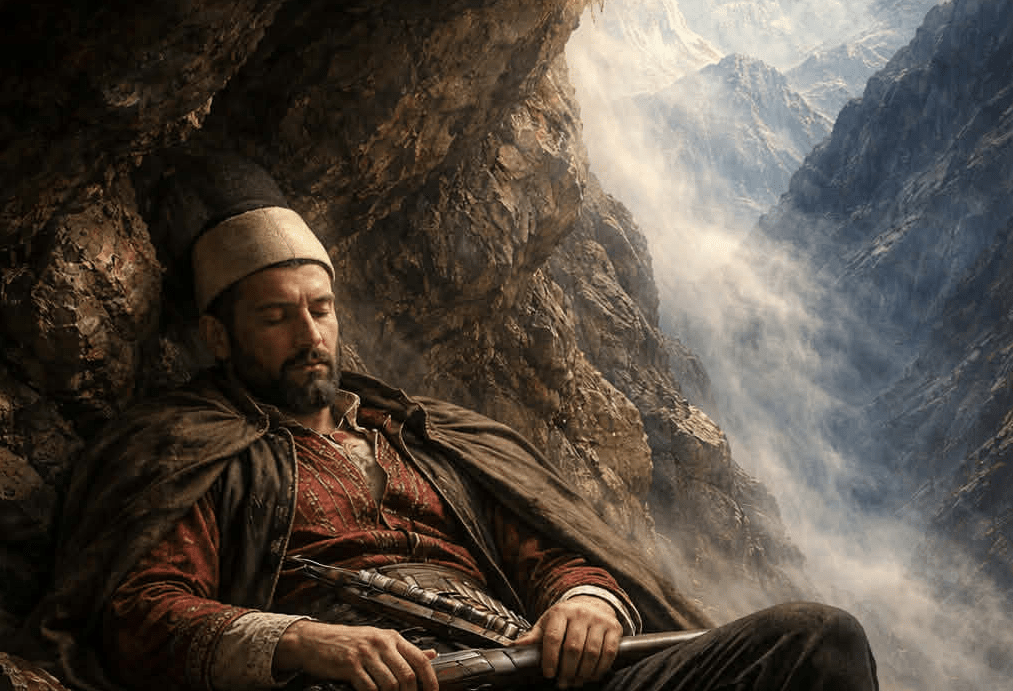
Subsequently, Syla ceased contact with his family and no longer returned to populated areas for supplies. After several days, family members and villagers organized a search and located him deceased in a mountain cave. He was found with his rifle and the quiver in his possession. According to prevailing belief, he was not killed in combat but died as a result of illness or extreme physical exhaustion, conditions consistent with prolonged exposure and isolation in the mountains.
Syla Mustafa Sejda left no direct descendants. However, within Rugova’s collective memory, he is regarded as a significant figure whose life symbolizes resistance, endurance, and the costs associated with prolonged conflict. His legacy persists primarily through oral history, where he occupies a place between documented individual and legendary representation, illustrating how local communities preserve historical experience through narrative continuity.
Poetry
Extracted text (Albanian)
“BIKE ALIJA N’STREHË TË KËRSHIT
Mulla Jusa letër shkrua:
– Bajraktarit me m’ja çua!
Bajraktarit na i vjen haber:
“Sonte natën del asqeri,
del asqeri me t’ i hipi kalit!
Mustafë Sejda n’kamë e çua:
– Isuf Haxhia a vjen me mua,
n’Shkalla t’Vogla me luftua?
Ni veçil, o aty t’ka pështua,
për haber tek paska shkrua:
– Dymbëdhjetë herë top na kanë gju!
Ç’ka Peklena qi gjëmon?
– Isuf Haxhia po lufton.
Mustafë Sejda e Isuf Haxhia,
plot me gjak na u mbush Qelia.
Ç’ka Peklena qi po dridhet?
– Mustafë Sejda nuk po lidhet.
U’ bloh asqeri ish fillua,
n’ Shtupeq t’Math tek â shkua;
i tubë rob’ i kanë hetua,
jurrish bajshin me i çnerrua.
Si sokol m’ish kanë i gra:
Bike Alija n’strehtë të kërshit:
– Largou! – i thotë zabit t’ mretit –
largou, qen i Anadollit,
se nuk jam kurva e Stambollit!
S’ish kanë gra, po ish kanë kralicë,
pesë nizam i preu sakicë.
N’ Shtupeq t’Math po bjen buria,
gjashtë sahatë po gjuajnë topxhia;
bijshin gjylet te xhamia.
Academic English Translation
Bike Alija in the Shelter of the Ravine
Mulla Jusa wrote a letter
to be sent to the standard-bearer.
News reached the standard-bearer:
“Tonight the army will advance,
the troops will mount their horses.”
Mustafa Sejda rose to his feet and said:
“Isuf Haxhia, will you come with me
to fight at Shkallët e Vogla?”
A messenger arrived there,
bringing further news:
“Twelve times the cannons have fired.”
Why does Peklena thunder?
“Isuf Haxhia is fighting.”
Mustafa Sejda and Isuf Haxhia,
the field was filled with blood.
Why does Peklena tremble?
“Mustafa Sejda will not surrender.”
The army had begun its advance
and moved toward Greater Shtupeq;
they gathered captives
and carried out violent assaults.
Like a falcon stood a woman:
Bike Alija, in the shelter of the ravine.
“Leave!” she said to the king’s officer,
“Leave, dog of Anatolia,
for I am not a prostitute of Istanbul!”
She was no ordinary woman, but a queenly figure;
with a dagger she killed five soldiers.
In Greater Shtupeq the horn sounded,
for six hours the artillery fired;
shells struck the mosque.”


 Balkan Academia