
by Muharrem Qafleshi. Translation Petrit Latifi
Abstract
The massacre of Livadh i Kasës in 1913 represents one of the gravest crimes committed against the Albanian population of Kosovo during the aftermath of the Balkan Wars. As part of a broader policy of terror, repression and ethnic cleansing carried out by Serbian military and gendarmerie forces, eighteen prominent Albanian men from the Opojë region were arbitrarily arrested, tortured and executed without trial. Targeted for their social, moral and national influence, they were eliminated to dismantle local leadership and suppress resistance. This study situates the massacre within the wider historical context of systematic violence against Albanians and examines its long-term significance for collective memory, justice and national identity.
THE MARTYRS OF OPOJE MASSACRED IN 1913. (The Massacre of Livadh i Kasës)
The year 1913 marks one of the darkest periods in the history of the Albanian lands. After the end of the Balkan Wars and the unjust division of the Albanian territories, the Serbian army and gendarmerie exercised an organized and unprecedented terror on the indigenous Albanian population. The goal was clear: the complete subjugation of the local population, the physical extermination of the most nationally conscious element and the intimidation of future generations.
The region of Opojë, known for its resistance, unity and preservation of Albanian identity, became a direct target of this oppressive policy. The massacre of 1913, which culminated in the cruel murder of 18 Opoja men from the village of Bresane, must also be seen in this historical context.
Rounding up and arresting the victims.
Under fabricated pretexts and false accusations of rebellion and disobedience, Serbian military forces rounded up 18 Albanian men, mainly from the villages of Bresane and Kuklibeg, but a large number of the masked martyrs were also from the villages of Bellobradi, Pllava and Brruti.
They were well-known and authoritative men in their families and communities, people of social, moral and national influence. It was precisely for this reason that they were selected for elimination.
Their arrest was accompanied by physical violence, insults and humiliations, making it clear that their fate was predetermined.
Torture and massacre
In September 1913, the arrested were taken to a place called Livadhi i Kasës, between the villages of Bresane and Blaq. There they were subjected to inhuman torture: they were beaten, humiliated and mistreated in a barbaric manner. Then, they were executed with firearms and bayonets, without trial, without guilt and without mercy. Their bodies were thrown into a mass grave, with the aim of covering the crime not only with soil, but also with silence.
The surviving witness
One of the massacred, although seriously wounded by gunfire and stabbed with bayonets, managed to survive. Covered in blood and left for dead, he escaped the eyes of the executioners. Later, he confessed the event, remaining the only eyewitness to this massacre. Thanks to this confession, the historical truth did not disappear completely.
The first memory and the early tombstone
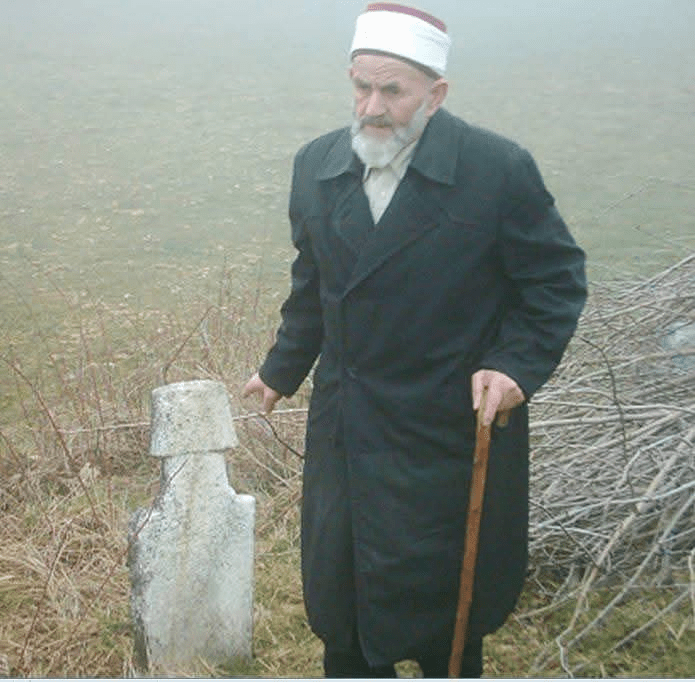
Around 1930, in extremely difficult political and social circumstances, the widow of Avdi Beg, one of the martyrs, undertook a courageous act of remembrance. She erected a modest monument at the site of the massacre and placed a stone plaque with the names of the murdered.
This action had an extraordinary symbolic significance, because it represented the resistance of memory to imposed oblivion.
However, the monument was built with weak materials and, over time, was severely damaged. Initially, it was just a stone slab, a lonely testimony to a collective crime.
Institutional memory after liberation
After the liberation of Kosovo and the establishment of local institutions, the memory of the martyrs of Livadh i Kasës no longer remained on the margins of oblivion. A serious institutional initiative was undertaken to erect a dignified monument, which honors their sacrifice and speaks to generations about the past. Historical memory is not only a matter of emotion, but a moral, national and cultural obligation.
The historical significance of the massacre
The Livadhi i Kasës massacre was not an isolated act, but an integral part of a broad state policy of violence, terror and ethnic cleansing against the Albanian population in Kosovo during the years 1912–1913.
After the occupation of Kosovo by the Serbian army, violence spread to almost every Albanian province, taking on massive and systematic proportions.
In Llap, Drenica, Anamorava, Dukagjin, Prizren, Gjakova, Peja, Mitrovica and in many rural areas, collective killings, burning of villages, mass deportations, rapes, looting and destruction of Albanian religious and cultural sites were committed.
Hundreds of thousands of Albanian civilians, men, women, elderly and children were killed without trial, solely because of their ethnic and national affiliation. In this wave of violence, the main objective of the Serbian authorities was to eliminate the traditional Albanian leadership: village elders, local leaders, early intellectuals, clergy and men of moral and social authority.
This strategy aimed to eradicate organized resistance and break the Albanian social structure. The massacre of 18 men from Opoja in Livadhin i Kasës represents precisely this model of repression. They were not killed for an individual fault, but for what they represented: Albanian dignity, resistance and national consciousness.
In this sense, Opoja was hit just like many other provinces of Kosovo, becoming part of the general national tragedy of 1912–1913. These crimes, also documented by consuls, journalists and international reports of the time, constitute a dark chapter in the history of the Balkans and clear evidence of a state policy of violence and forced assimilation against Albanians.
Call for perpetuation
The erection of a dignified tombstone in Livadhi i Kasës is not only an act of commemoration, but a return of historical truth to the public space. It is a call for the past not to remain buried with its victims.
Today’s generation has the obligation to ensure that the martyrs of 1913 do not remain just names in family memory, but are an inseparable part of the historical identity of Opoja and Kosovo.


 Balkan Academia