
Written by: Dr. Behixhudin Shehapi. Translation Petrit Latifi
Abstract
This study examines a personal seal belonging to Abdurrahman Bey (later Abdurrahman Pasha), discovered in the Ottoman State Archives in Istanbul. The round seal appears on a letter dated 1823, sent to the Governor of Rumelia as a goodwill message expressing Abdurrahman Bey’s wish to succeed his father, Rexhep Pasha, as the leader of Tetovo. The seal is executed in refined taʿlīq calligraphy and represents a high-quality example of early nineteenth-century Ottoman seal art. Through stylistic, material, and textual analysis, the paper situates the seal within the broader tradition of Ottoman personal seals and interprets it as a visual and narrative expression of authority, legitimacy, and political ambition prior to Abdurrahman’s elevation to the rank of pasha.
Abdurrahman Pasha’s Seal
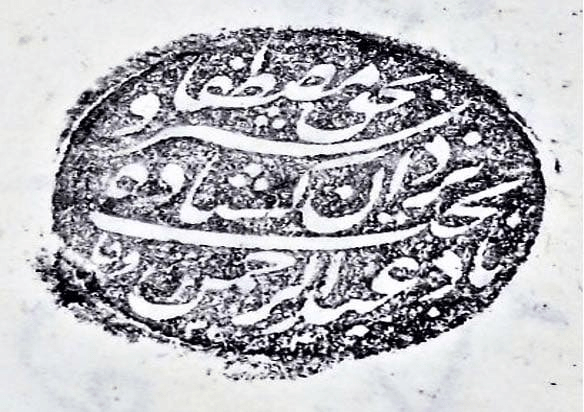
In the Ottoman State Archives in Istanbul we found the seal of Abdurrahman Pasha, with refined calligraphy and a very concise text.
The round seal was placed on a letter from 1823 when he was still bey, so he did not have the title of pasha.
The letter with his seal and signature on the back was sent to the Governor of Rumelia, as a letter of goodwill, with the desire and willingness for him to succeed his father Rexhep Pasha as the leader of Tetovo.
Ottoman seals (seals) are generally divided into three groups: official, functionary and personal seals. The seals were prepared according to their purpose and according to their owners.
The making of seals, depending on the researcher, was a special art and the 16th century is considered a flourishing time for the production of seals. After a long hiatus, interest in seals, their use and production increased again in the 19th century.
It is the seal of Abdurrahman Pasha made at the beginning of this century which, from an artistic point of view, represents a beautiful sample worked with the “talik” script, i.e. calligraphy, which represents one of the most aesthetic and refined ways of Ottoman writing.
The seals were made in special workshops and sophisticated artisanal and artistic equipment was used for their production. They were not made in series, but craftsmen made a unique seal to order, decorated with floral and geometric ornaments, in the “hataj” or “rumi” style.
At first, the Arabic letters that are read backwards were written with lead coils, and then with steel tools they were processed (cut) in depth, thus creating compositions that were the embodiment of those institutions and persons for whose use they were intended.
They were works in themselves, showing the aesthetic expression of the time and the ruler. Abdurrahman Pasha’s mural is extremely artistic and meets all the characteristics of the time and space from which he received the order. It is a personal seal. So, Abdurrahman Pasha’s mural from the content aspect, respectively narrative, or from the aesthetic and artistic aspect gives a clear message about his vision and the way of magnificent governance.
This is confirmed both by his appointment as pasha and leader of Tetovo, and by his magnificent Castle, which is the manifestation of a dominant power, first of all, for the protection of the same, also confirmed by the construction of the Colorful Mosque (Pasha).
On the seal of Abdurrahman Pasha in Arabic is the following text:
“Bi-hakki Mustafa ve bi-sırri Yezdân küşâde bi-hubbi yâd-ı Abdurrahman”, a text that loosely translates to:
“With the secret of the Almighty, with the right of the Messenger, the memory of Abdurrahman is opened.”
He used this seal as a personal seal before becoming a pasha and in the letter found in the archive there is an explanation that: After the death of Rexhep Pasha, his son Abdurrahman Bey, through this letter addressed to the Governor of Rumelia, Mehmet Pasha, is requested to be given the position. His signature is after the text, while the seal is proportionally on the back of the letter.


 Balkan Academia