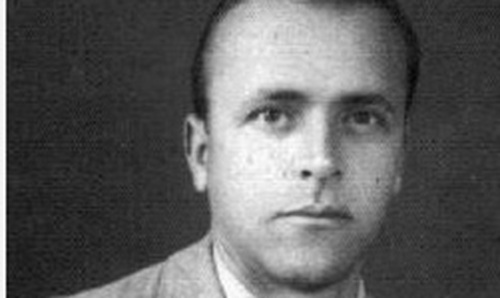

By Rafael Floqi. Taken from Gazeta Dielli – Faqja Zyrtare. Image from ZemraShqiptare.com
Abstract
This review examines Athanas Gegaj’s 1937 study on medieval Albania, focusing on his analysis of Illyrian continuity and the origin of the name Arbër. Written against a backdrop of romantic and politicized Balkan historiography, Gegaj’s work stands out for its critical method and rigorous use of Byzantine, Latin, and Slavic sources. The review highlights Gegaj’s arguments on Albanian ethnic survival during the Slavic invasions, the role of religion and Western influence in preserving identity, and his nuanced onomastic analysis of Arbëni/Arbënia and Albania. It also emphasizes his rejection of Serbian political myths regarding Northern Albania, underscoring the study’s lasting relevance as a model of sober, source-based historical scholarship.
A review of Athanas Gegaj’s study on the origin of Arbër
(based on the chapter “La situation intérieure de l’Albanie au Moyen Âge”, 1937).
In the mid-1930s, when Balkan historiography was still dominated by romantic, nationalist and often politicized readings of the past, Athanas Gegaj published his study on medieval Albania and the Ottoman conquests in French.
Already in the first chapter, where he addresses the issue of Slavic invasions and the history of the name Arbëri/Albania, his methodical lucidity and critical seriousness are clearly evident, which, for the time, was clearly ahead of many colleagues in the region.
This text, published around 1937, remains today one of the most mature treatments of the origin of Arbër, Illyrian continuity and the historical formation of the name “Arbëni / Arbënia / Shqipni”.
Gegaj’s vision of the Illyrian continuity of the Albanians
From the first pages, Gegaj establishes a clear thesis, argued on a source basis: in the Slavic invasions of the 7th century, most of the old Illyrian-Thracian populations were assimilated, but the Albanians, as descendants of the Illyrian race, preserved their identity. He writes:
“Seuls, dans toute la Péninsule, les Albanais, descendants de la race illyrienne, purent se maintenir intacts.”
At a time when part of Slavic historiography tried to minimize Illyrian continuity, Gegaj, on the basis of Byzantine, Latin and Slavic sources, clearly formulates the thesis of Albanian ethnic survival. This is not simply a patriotic declaration, but the conclusion of an analysis that combines historical geography, church documents and toponymy.
Equally lucid is the assessment of the role of religion.
Gegaj underlines that three factors preserved the Albanian element from “Serbian absorption”: the spread of Latin culture, the Catholic religion and, later, the political influence of the West. He recalls that the Byzantine court, at the time of the schism, called Albania loyal to Rome “Latinia”, indirectly acknowledging the failure of complete Greco-Byzantine penetration.
This is a very modern reading: Gegaj does not see the Albanian nation-formation as a product only of “blood”, but as the result of the interaction between ethnicity, religion, political structures and opposition to neighbours. According to him, the Albanians “acquired the consciousness of their nationality” precisely in the clash with the Orthodox Slavs and in the struggle to preserve religion and traditions.
Analysis of the name Arbëni – from Arbania to Shqipnia
The most original part of this chapter is undoubtedly the one dedicated to the naming of the country and the people. Gegaj makes an onomastic panorama, collecting the different historical forms:
“Nous rencontrons des dénominations telles que: Arbania, Arbanon, Raban, Albania, Albanum, comme aussi Albanon et Albanopolis…”
He connects these forms with Ptolemy’s testimony for Albanopolis and then follows the Byzantine (Arbanon), Serbian (Raban), Western and Papal (Arbanensis princeps, judex Albanorum) names, placing them on the concrete map: the space between Shkodra, Durrës, Ohrid and Prizren – that is, the historical core of Arbër.
Gegaj clearly states that all these names derive from the same root and from the name that the Albanians have given to the center of their country. He connects this with Kruja as the center of political life of Central Albania and with the province of Arbëri (Arbëni), from which, by extension, the name Arbëri/Arbënia for the entire country arises.
A very valuable element is the fact that he clearly distinguishes between the name “Albanie/Albanais” used by foreigners and the local name:
“La masse albanaise appelle sa patrie: Arbënia et se nomme Arbënuer ou Arbëreshë.”
So Gegaj does not mechanically submit to the terminology of Latin and Byzantine sources, but brings to the fore the self-definition of the people, the language of the Albanians themselves. He even notes the etymological explanation that connects Arbëri with “field” (arbë = field), mentioning the area between Mati and Erzeni as “the fields of Arbëri”.
Equally far-sighted is his observation of the shift towards the names “Albania” and “Albanian”, without denying the continuity of the old terms: he points out that in his time the people called the country “Albania” and themselves “Albanian”, while the name Arbëni/Arbëresh was more strongly preserved in the Italo-Albanian colonies and among the southern Slavs than in the motherland. This is a sociolinguistic observation that would still be considered careful and accurate today.
Critical clarity towards Serbian myths about “Northern Albania”
One of the most courageous – and most current – aspects of this 1937 text is Gegaj’s rejection of Serbian political theses about “secular rule” and “Slavic assimilation” in Northern Albania up to Durrës. He openly says that we should “classify among legends, born of political ambition” the claim about the long Serbian occupation of the Albanian north and the assimilation of the local population.
Instead, he brings concrete documents: the cities of Shkodra, Ulcinj, Tivar, Shas, Drishti, Shëngjin that in Latin sources are described as inhabited by “Latins” (Albanian Catholics); their occasional passage under Diocles, then under the Serbian kings, then under the Balshajs and the Venetians; the presence of Serbian yupans in Shkodra, but also the resistance of the local population that differed from the Serbs “in language, religion and Western traditions”.
Here Gegaj’s clear historical thinking is best displayed: he does not deny the Serbian conquests, but opposes the mechanical transplantation of political sovereignty into “ethnic properties” and total assimilation. He reads the sources with a critical eye and distinguishes between state control and the real ethnic and religious structure of the population.
Gegaj’s relevance: a 1937 study that still speaks today
In the light of later historical research, many of Gegaj’s conclusions seem surprisingly stable today: The Illyrian continuity of the Albanian element, clearly expressed in the phrase that “only the Albanians… managed to remain intact”, was later taken as a starting point by many foreign albanologists.
The connection between Latin-Catholic affiliation and resistance to Byzantine and Slavic assimilation has become part of the standard reading of early Albanian history. The analysis of the name Arbanon / Arbania / Arbëni and the distinction with “Albanian / Albanian” predates modern studies of onomastics and ethnogenesis.
Finally, the rejection of political theses of “North Slavic assimilation” and the insistence on the role of Albanian nobles, families like the Thopiaj, Balshaj, Dukagjin, etc., as independent actors in the Middle Ages, takes Gegaj out of the narrow nationalist framework and places him in a genuine critical tradition.
Read today, this chapter is not simply source material; it is an example of how history should be done: with broad knowledge of sources, with attention to the language of the people, with care for the religious and political context and, above all, with the courage to oppose false myths, no matter how politically powerful they may be.
In this sense, Athanas Gegaj, with his 1937 study on Arbërija, deserves to be read not only as a classic of Albanology, but also as a model of lucid historical thought: he sees Arbërija not as a myth, but as a concrete, verifiable historical reality, which emerges from old names, medieval documents and the self-definition of the people themselves – from Arbëni and Arbëreshë to Shqipni and Shqipërin.


 Balkan Academia