
by Xhelil Arifi.
Abstract
This study examines the historical presence of Arbënors (Albanians) and Vlachs in Bosnia, challenging interpretations that portray them solely as late medieval migrants introduced by Ottoman rule. Drawing on Slavic historical sources as well as classical and modern scholarship, the paper argues for a deeper continuity rooted in Illyrian antiquity. Evidence from demographic records of the 15th and 16th centuries indicates a substantial Arbënor and Vlach presence across multiple Bosnian regions. By situating these populations within broader Illyrian–Pelasgian continuity, the study questions narratives of complete early Slavization and emphasizes the shared ethnogenetic origins of Albanians and Vlachs.
Bosnia is historically known as a territory where the Illyrians lived. But also a territory where in later centuries the Arbënors lived as descendants of the Illyrians. Gradual and more complete Slavization came only in the later centuries.
In the documents that the Slavs themselves bring, it is understood with a tendency, as they may be, and with adaptations and hypotheses that suit their interpretation of the history of these areas, the large presence of the Arbënors in the 15th and 16th centuries is accepted….These, by these authors, are considered as newcomers, or brought by the Ottomans who had brought these lands under their rule, which in fact may not be the full truth, when we consider the Illyrian continuity.
Here is what Slavic authors write about the presence of the Albanians and Vlachs in the mentioned centuries in the territory of what we know today as Bosnia:
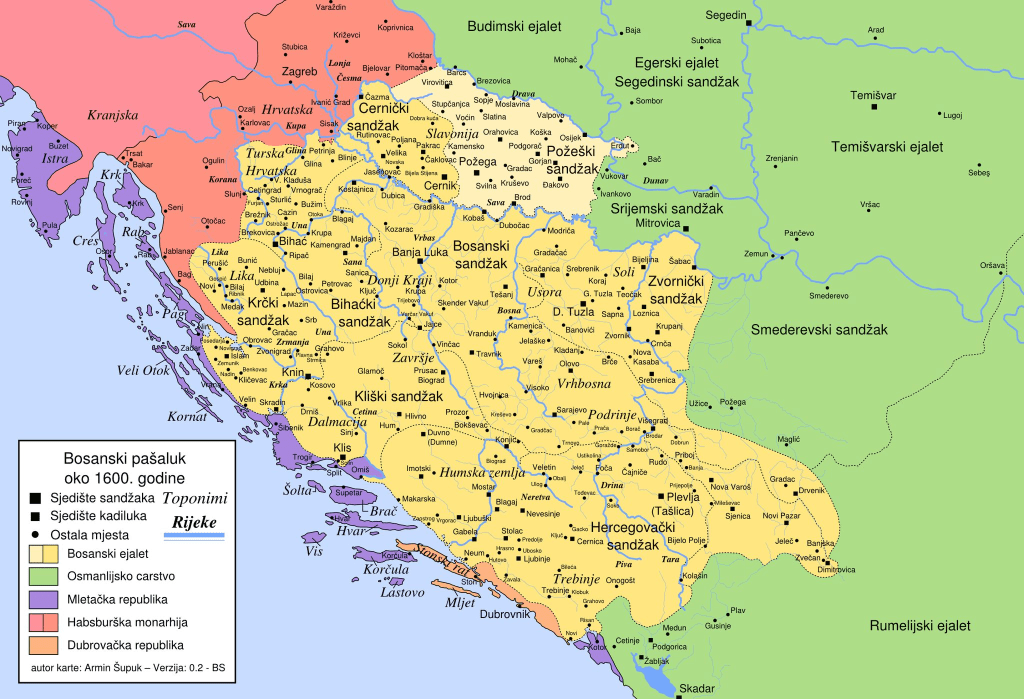
Large groups of Vlachs and Albanians were in northwestern and western Bosnia (Bosnian Sandžak), northeastern Bosnia (Sandžak of Zvornik) from 1480/1481) and southwestern Bosnia (Sandžak of Kliš from 1537) and western Bosnia (Sandžak of Bihać and Bosnia from the end of the 16th century), but now they were no longer only Vlachs from Herzegovina, but also those from other areas such as Macedonia, Kosovo, Serbia, Montenegro, Greek Vlachs from Greece and Albanians from Malaysia.
The Vlachs and Albanians then practically flooded Bosnia and all the Croatian lands occupied by the Ottomans. But when it comes to Vlachs and Albanians, you can freely think that we are dealing with an ethnic group that belongs to the same ethnic line, which is traced back to the same genesis since Illyrian antiquity.
Authors since antiquity such as: Strabo, Eugene Borene with the study “Notes on the Vlachs” in 1869, and especially the French monk, Jean-Claude Faverial, with the book “The Vlachs of Pindus” in 1864 and “History of the Vlachs” in 1891, “History of Albania” (Histoire de l’Albanie), have written that the Pelasgians and the Illyrians were homogeneous, with very close tribal origins.
In these regions called Thessaly and in particular in the territories of Pindus called Macedonia, Albanian and Vlach tribes lived. These belonged to different nuclei, but were of the same race, Illyrians. Even the name of their settlements is called “Katun” in the Albanian language, which belongs only to the Albanian lexicon.


 Balkan Academia