
Abstract
This article presents a historical reconstruction of cultural life in Rožaje from the late 1930s to the early 1970s, with particular focus on the Cultural and Educational Society and the Original Folklore Group “Daciće.” Drawing on archival texts and photographs from Muhamet Nikqi–Buxhovi’s album Grupi Folklorik Burimor “Dacaj” – Rožhajë 1947–1972, the study traces the emergence, development, interruptions, and revival of organized folklore, drama, and music activities in the region. It highlights the role of individual enthusiasts, social and political constraints, post-war modernization, and national and international festival participation. The article documents how traditional music, dance, and theatre became key vehicles for cultural preservation, social change, and regional representation within Yugoslavia, despite material shortages, political repression, and demographic shifts.
This article extracts data and photos from Muhamet Nikqi Buxhovi’s album “Grupi Folklorik Burimor “Dacaj” – Rozhajë 1947-1972″. Translated to English by Petrit Latifi.
Page 1:
“In 1937, at the initiative of Hivzija Ćatović, a Public Library with a reading room was founded in the premises of the Vakufska kafana in Gornja čaršija, which also included members of the Cultural and Artistic Society and the Football Club. The Society had a drama, music, chess and photography section.
In the absence of a business space, the Society’s sections prepared programs in private homes and kafana, mostly in the homes of Hivzija Ćatović, Mustafa Pećanin, as well as Hilmo Sutović’s kafana. The program of the Cultural and Artistic Society was strictly controlled by the then regime, namely the gendarmerie.
Members of the Society, Sadik Dacić, one of the advanced literate people, and Mustafa Čatović, a ćatip (record clerk) at Žuja Dacić’s sawmill in Ivovik, brought a gramophone to a wedding in Dacići in 1939. That was when the residents of Dacići heard the gramophone playing for the first time and saw the “old dance” performed by Sadik and Mustafa, while the gramophone was turned by Orle Dacić, later a teacher in Dacići.
The society was active until the beginning of World War II.
Immediately after the liberation of Rožaje, at the end of 1944, under the auspices of the USAOJ, later the Local Committee of the National Youth, the Cultural and Educational Society “Hivzija Čatović” was founded, with four sections: drama, folklore, music and education. At first, it had a modest program and a small number of members, and it performed before and after national assemblies, rallies, conferences and other gatherings.
The sections performed their programs on open improvised stages in the streets, Lanište, Bandžovo brdo, Šušteri, Carine and Županici, or wherever gatherings were held during national holidays. The lack of premises for the Society’s work, electricity, wardrobe, necessary instruments and aids were not the only obstacles to its work, but during the course of its activities, there was a major problem in gathering female youth in the work of the sections, because at that time girls and women were under the veil and veil.
Thanks to the great commitment of some of its members, over time the Cultural and Educational Society became more numerous and its work more meaningful. Various drama, folklore and musical performances, dances were performed, and friendly evenings and other gatherings were organized (most often on Fridays, for rural youth, and on Sundays, for working-class youth). The Society visited neighboring municipalities. For example, the Drama Section of this Society visited Peć in February 1945. Participants in the program
Footnote: Ramuš Vukelj (1034-1998), leader of the original folklore group “Daciće” from 1958-1972.
Page 2:
They walked on foot along the difficult caravan route, through heavy snow, over Kula and Žljeb to Peć, carrying food, clothing and necessary instruments. After the successful performance in Peć, the Drama Section worked intensively until 1949. It performed in Berane, Andrijevica, Plav, Gusinje, Bijelo Polje, Tutin and Novi Pazar.
The drama section of the Cultural and Educational Society was among the best sections in Montenegro in 1948, and its member Tahir Sutović was declared the best amateur actor in Montenegro, for which he received a ten-day stay in Opatija as a reward.
The society performed, among others, the following plays: “Koštana”, “Hadži Loja”, “Amanet and Emina”, “Nastradin Hodža” and “Od kad je Banja Luka postala”.
The members of the Society were: Fehmija Ćatović, Tahir Sutović, Nada Radonjić, Stana Boričić, Hajruša Kurpejović, Redža Demić, Ceca Filipović, Suljo Hajdarpašić, Asim Sutović, Milica Đuranović, Medo Rožajac, Nurka Kardović, Nafija Mandžukić, Nusret Zejnelagić, Bećo Imamović, Ljubica Fjodorović, Rusto Radončić, Husein Dervović, Ifeta Hadžialijagić, Rizo Burdžović, Ifeta Ćatović, Zada Sinanović, Fadil Zejnelagić, Bahrija Bećiragić, Gano Bećović, Faik Hajdarpašić, Veska Sutović, Ifeta Redžepagić and Isat Đečević. The solo musicians were: Ivan Radenović, Velimir Radenović, Elmaz Iković, Adem Uković and Ramadan Komanović.
Within the Cultural and Educational Society of Rožaje, the Original Folklore Group “Daciće” was formed. The group participated in the Montenegrin Folklore Festival in July 1947 in Cetinje, where it achieved notable success. The following participated in this festival: Ljano Ljaić, Tahir Ljaić (folk dance “Fight for a Girl”), Zejnel Ljaić (gudlar), Reko A. Nikč (Mališor songs), Mustafa Nikč (kaval), Avdija Ljaić (banjaktar), Elmaz Iković (goč) and Adem Uković (zurla).
Under the leadership of Ljan Ljaić, the Folklore Group “Daciće” participated in the 2nd Montenegrin Folklore Festival “Cetinje 1949”, where it was declared the best folklore ensemble in Montenegro. In August 1949, in the afternoon, we set off from Rožaje for Cetinje, on the body of a “Reno” truck, without seats and without a tarpaulin, driven by Redžep Kurtagić.
The journey was long: we traveled via Turjak, Berane, Trešnjevik, Podgorica and Rijeka Crnojevića. This journey was very tiring and difficult, and lasted about 24 hours, but the folklorists endured it well, although they were hungry and thirsty, sleepless, and barely recognizable from the dust. Everything was overcome by the desire to win.
Along the way, we talked about how to perform, how to play our roles, and also about seriousness and good behavior. The members of the Group who participated in this festival were: Ljano Ljaić and Tahir Ljaić (knightly dance “Borba za djevojku”), Reko A. Nikč (singer of Malisor songs), Ramuš Vukelj and Selman Dacić (“Dukadinska igra”), Zejnel Ljaić (gus-lar), Nifa Ljaić and Mustafa Ljaić (dance “Šota”), Mustafa Nikč (kaval), Ahmet Nikč (svi-rala), Elmaz Iković and Abaz Iković (drum and goč) and Adem Uković (zurla).
At that time, Saka Hodžić from Gusinje and his wife (they played “Gusinje games with a rifle”), as well as three Albanians from the Tuzi area (who sang with šarkija and čutelija). The whole of Rožaje rejoiced at the success of this Group, and upon its return, a festive welcome was arranged for it.
Page 3:
As the best folklore ensemble of Montenegro in 1949, the Folklore Group “Daciće” participated in the Yugoslav Folklore Festival in Opatija in 1950. The Berane District Committee and the Government of Montenegro provided assistance in the preparations of the Group and its participation in this festival. According to my recollections, the Folklore Group’s journey looked like this:
On July 19, 1950, we set off, in full force, in a truck driven by Milić Radević, the driver of the ŠIP “Gornji Ibar” in Rožaje, via Turjak to Berane. In Berane, we slept in Čakov Han, on the floor without bedding. The next day, we continued our journey in a “Dodge” truck, driven by a certain Periša, whose last name I do not remember.
The truck body had wooden benches for seating, and the body was covered with a tarpaulin, which made our journey easier. We traveled along the old macadam road through Trešnjavik, Podgorica, Crnojevića Rijeka, Cetinje, Njeguša and down the Kotor side, from where, by moonlight, we saw the sea for the first time. We arrived in Kotor after midnight and immediately continued our journey, by small boat, via Dubrovnik and Split, to Opatija, where we arrived on the evening of July 21.
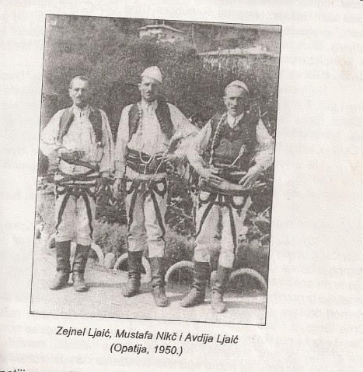
Zejnel Ljaić, Mustafa Nikč and Avdija Ljaić (Opatija, 1950)
In Opatija we were well received, checked into a hotel, got a guide and everything else we needed. We rested for two days. We walked along the beach dressed in national costumes, because we didn’t have any bathing suits, and we didn’t even know how to swim. The beach was full of domestic and foreign tourists. I don’t know who who was more surprised.
The tourists were surprised that we were dressed in trousers, miltans, scarves, our sandals with woolen socks and caps, and some had leather boots. What surprised us the most was that the women and girls were so naked, only in swimsuits. We quickly got used to each other, we started talking, hanging out, taking pictures together, going for drinks in restaurants and cafes. These two days passed quickly: the time came for the performance at the festival, and we were ready and rested, and in a good mood. Ensembles from all over Yugoslavia arrived.
The folklore festival began on July 24, 1950 at 12 noon at the “Kantrida” stadium. The patron of the festival was Moša Pijade, the president of the Yugoslav Parliament, and the welcoming speech was given by Milovan Đilas. We gave a very good program.
When the youngest participants of our Folklore Group, a girl Nifa Ljaić and an eight-year-old boy Ljaić Mustafa, performed the dance “Šota”, the audience was delighted. After the speeches and the closing ceremony, our group was invited to repeat the program. On that occasion, Moša Pijade asked: “Is this a professional ensemble or a school?”
The president of the Organizing Committee of the Yugoslav Folklore Festival replied: “This is an original folklore group from Dacić near Rožaje, People’s Republic of Montenegro”. The original folklore group “Daciće” was declared the champion of the Festival and received the first prize from the patron of the Festival, thus becoming the champion of Yugoslavia in amateur folklore. The prize was a set of musical instruments for folklore work and participation in the 1951 International Folklore Festival in London.
At the festival in Opatija, the original folklore group “Daciće” consisted of: Ljano Ljaić, Tahir Ljaić, Reko Nikč, Avdija Ljaić, Zejnel Ljaić, Mustafa Nikč, Tahir A. Dacić, Šaćir Šabović, Adem Uković, Elmaz Iković and Abaz Iković. At this festival, the original folklore group “Daciće” participated with the same program as in Cetinje, which was enriched with another act: the duet “Stara trojka”.
The “Daciće” Folklore Group did not participate in the World Folklore Festival in London, even though it registered on time, because passports were not issued to the members of the Group, for unknown reasons.
After the end of the Festival in Opatija, a film newsreel was shot with the original folklore group “Daciće”.
The construction of the Cooperative Home in Rožaje in 1947, and later the Workers’ Home at ŠIP “Gornji Ibar”, created conditions for better work of the Cultural and Educational Society. Cinema and cultural performances were organized, various ensembles, societies, actors, singers and amateur and professional entertainers from various parts of Yugoslavia were guests.
Cooperation developed between the Cultural and Educational Society in Rožaje and similar societies and cultural centers from all over Montenegro and beyond. During this period, a new era of Rožaje’s development began.
The Rožaje-Raška and Rožaje-Berane roads were completed, new companies, industrial plants were formed, new shops were opened, education, healthcare were developed, various sports associations and other organizations were founded, the zar and feredža were abolished and women were allowed to freely go out into the streets and promenades.
Later, a carpet weaving plant was opened, which employed a large number of young women. All of these were favorable conditions for the further all-round development of the Cultural and Educational Society and the ever-increasing enrichment of its programs.
Page 4:
The original folklore group “Daciće” participated in the May Day celebration in Berane in 1951, along with 43 other groups from the Berane district. They received a cash prize (3,000 dinars) on the occasion.
The Cultural Educational Society did not operate until 1958, due to the arrest of some of its leaders and members due to the Informburo Resolution.
The ŠIP “Gornji Ibar” workers’ home burned down to the ground in 1955. The fire destroyed the entire wardrobe of the “Daciće” Folklore Group, cinema equipment, musical instruments and other equipment, which led to the stagnation of the Society’s work.
In mid-1958, the Cultural and Educational Society of Rožaje was re-formed, with a drama, music and folklore section. The folklore section consisted of members of the Original Group “Dacići”: Rama Ljaić, Sulja Nikč, Mustafa Dacić, Hasima Dacić, Ahmet Nikč, Zulja Dacić, Soko Dacić, Binak Š. Ljaić, Fetija Dacić and occasionally Hajro Brđanin, Muslija Osmanović, Ramiz Hasović and Vukelj Ramuš, who was the leader of the Original Group “Dacići”.
The members of the drama section were: Arslan Alijević, Dragoje Zekić, Asim Z. Lukač, Hidajet Fetahović, Zuma Hot, Asim Hodžić, Dušanka Đurišić, Desanka Čukić, Ćazim Lukač, Zlatana and Mišo Čukić, Miroslav Fićo Magdelinić, Vučko Đurović, Drago Tomović and Poleksija Poca (whose last name we could not determine).
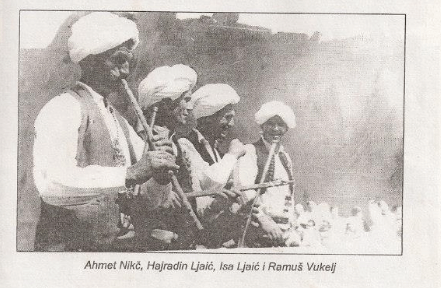
Ahmet Nikč, Hajradin Ljaić, Isa Ljaić and Ramuš Vukelj
The members of the music section were: Emin Nurković, Ivan Radenović, Abaz Iković, Ramadan Komanović, Halil Salović and Murat Agović. The head of the Society was Avdul Kurpejović.
Immediately after its establishment, the Society achieved exceptionally good results with its well-prepared programs. It performed in almost all cities of northern Montenegro, in Novi Pazar, Tutin and Sjenica with dramatic plays.
Page 5:
“Zajednički stan”, “Emina”, “Rasimov sevdah” and others. The exceptionally talented actors were Dragoje Zekić and Asim Hodžić, and the actresses were Zuma Hot and Zlatana Čukić. Of the folklore acts, the audience was most delighted by: the knightly dance “Borba za djevojku”, performed by the unsurpassed Rama Ljaić, the dance “Šota” by the eight-year-old girl Fetija Dacić and “Ibarčanske pjesme” sung by Muslija Osmanović.
Due to the emigration of a large number of members of the Society to Turkey, the Cultural and Educational Society ceased operations in 1966.
The original folklore group “Daciće” was registered in 1967 as a citizens’ association for the development of folk music and cultural activities. Under the leadership of Vukelj Ramuš, and with the help and support of the Rožaje Municipal Assembly, the People’s University in Rožaje and the Inter-Republican Community for Cultural and Educational Activities from Pljevlja, the original folklore group “Daciće” achieved extraordinary results.
The original group received special help from the “Rugovo” ensemble from Peje, in terms of purchasing clothes and instruments. In addition to cooperation with the “Rugovo” ensemble, led by Rama Nikč, cooperation was established with the “Fap” ensemble from Priboj, the “Voloda” KUD from Pljevlja and the professional “Šota” ensemble from Prishtina.
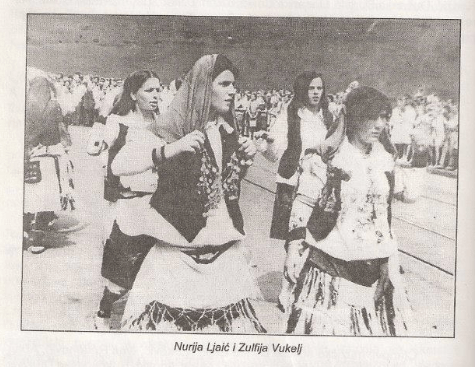
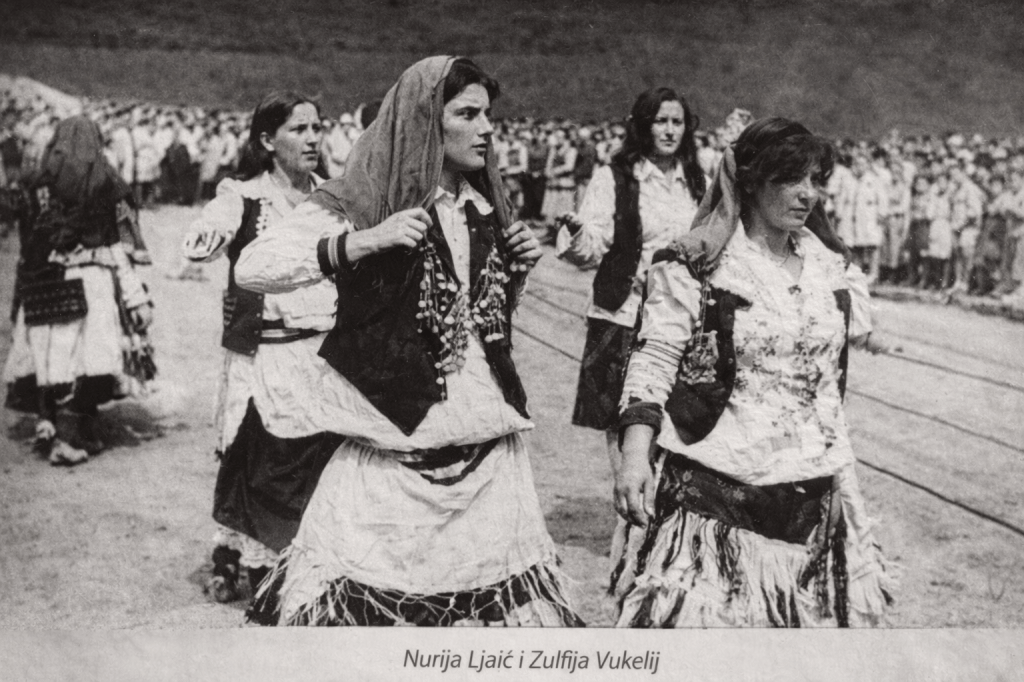
Nurija Ljaić and Zulfija Vukelj
At the International Folklore Festival in Zagreb from 25 to 31 July 1971, the Original Folklore Group “Daciće” won first prize with original songs and dances from the Rozhaje area. The group also received a special diploma for the best “Original Folklore Zagreb 1971”, a cash prize, and the members of the Group received gifts.
Page 6:
The enlarged image of the folklorist was featured in the Zagreb University Theatre, and later in the book “Zagreb Folklore Festival 1966-1976”. The following members of the Original Group “Daciće” participated in this festival: Sulja Nikč, Tahir Nikč, Soko Dacić, Iso Ibrdemaj, Hajradin Ljaić, Zeća Dacić, Zulfija Vukelj, Nurija Ljaić, Balija Dacić, Ifeta Korać, Emina Hadžić, Binak Ljaić, Ajka Rebronja, Esmana Šabović, Muslija Kajević, Zeliha Ganić, Šućro Nurković, Sadeta Zejnelagić, Ahmet Nikč, Abaz Iković, Šefko Uković and Ramuš Vukelj, the ensemble leader.
After its success in Zagreb, organized by the Inter-Republican Community for Cultural and Educational Activities from Pljevlja, the Original Folklore Group “Daciće” gave concert performances throughout Montenegro, western Serbia and eastern Bosnia, that is, throughout the territory of the Inter-Republican Community, because that year the celebration of the thirtieth anniversary of the uprising against fascism was being held.
On the occasion of the celebration of September 30, 1971, the original folklore group “Daciće”, together with the KUD “Fap” from Priboj, held a concert, which was broadcast live by Television Titograd. This performance was broadcast by Television several more times in the program “Across Montenegro”.
At the meeting of folklore ensembles in Nova Varoš in 1972, organized by the Inter-Republican Community from Pljevlja, the original folklore group “Daciće” achieved the best results, albeit with a shortened program of only 20 minutes. Some members of the folklore section of the “Mustafa Pećanin” Elementary School, led by Ibiš Kujević and Delija Kurpejović, also participated in this concert.
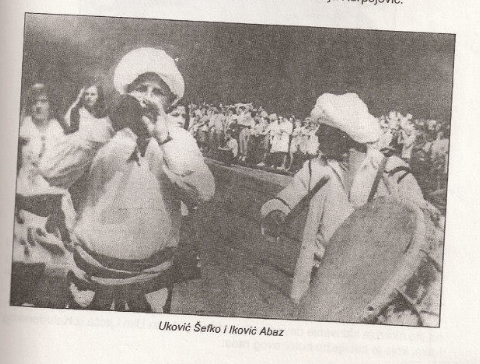
Uković Šefko and Iković Abaz
Page 7:
On January 16, 1972, the Cultural and Artistic Society “Vrelo Ibra” was formed in Rožaje, and the Original Folklore Society was merged with its folklore ensemble.
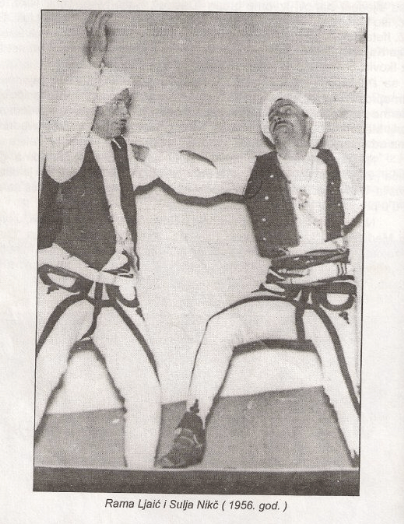
Rama Ljaić and Sulja Nikč (1956)
group “Daciće”. The cultural and artistic society “Vrelo Ibra”, and especially its folk ensemble, achieved great success and won numerous awards in Yugoslavia and the world under the leadership of Ibiš Kujević. His contribution to the preservation of the folklore of this area is invaluable. Thus, the tradition of numerous previous generations of folklorists from this area was continued.
Finally, we emphasize that the folklore of this area has very distant roots, as indicated by the saying of a ninety-year-old man named Uko Ljaić from Kaluđerski Laz, recorded by the author of this paper”.
End
Source
ROŽAJ PROCEEDINGS, YEAR VIII, NUMBER 8, 1998, Ramuš Vukelj, ORIGINAL FOLKLORE GROUP “DACIC” (1947 1972).


 Balkan Academia