
by Sylejman Morina.
Abstract
This study examines the role of Greek Orthodox ecclesiastical authorities in opposing Albanian national education in the early twentieth century, focusing on incidents in Progr, Negovan, and Tren. Drawing on contemporary Albanian newspapers such as Korça and Koha, the article highlights efforts by Greek despots and priests to suppress Albanian-language schools and literature through intimidation, religious sanctions, and book burnings. At the same time, it emphasizes the resistance of local Albanian communities, who defended their cultural and educational rights despite clerical pressure. These events illustrate the broader conflict between Albanian national awakening and Greek ecclesiastical chauvinism in the late Ottoman Balkans.
When Greek Despot shut down Albanian schools of Korça in 1911
Greek Orthodox ecclesiastical authorities played an active role in opposing the spread of Albanian national education in the early twentieth century. According to contemporary Albanian newspapers, the Greek despot of Korça ordered the closure of the Albanian-language school in the village of Progr. This directive, however, was openly resisted by the local population, whom the newspaper Korça described as “honest patriots” unwilling to submit to ecclesiastical pressure. Similarly, in Negovan, the establishment of an Albanian school provoked retaliatory measures by the despot of Kostur, who instructed Orthodox priests to withhold religious services from the local Albanian community.
Such actions were widely criticized in the Albanian press, which portrayed them as manifestations of Greek ecclesiastical chauvinism and warned of their potential consequences. The newspaper Korça likened these practices to an attempt to revive the Inquisition, cautioning that such policies would ultimately have negative repercussions.
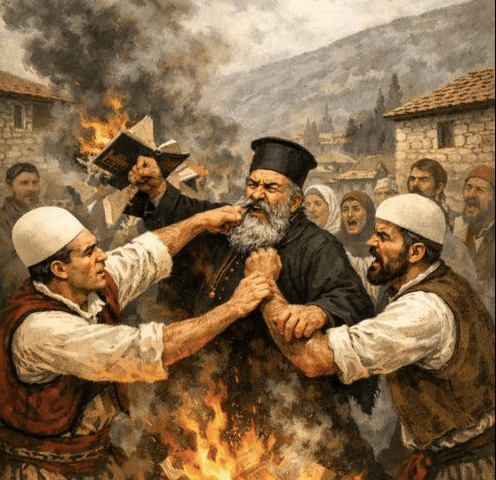
Further evidence of clerical opposition emerged in the spring of 1911 in the village of Tren, in the Devoll region, where Albanian-language books were being actively distributed. An Orthodox priest, described by the newspaper Koha as being aligned with Greek nationalist interests, convened the villagers and demanded the surrender of these books, which he subsequently burned publicly. This act was sharply condemned in the press as an assault on Albanian culture and education, underscoring the broader conflict between the Albanian national movement and Greek ecclesiastical authorities during the late Ottoman period.
Sylejman Morina writes:
“The Greek despot of Korça “had given the order to close the Albanian school” of Progr, but, as stated in the newspaper “Korça”: “The honest patriots of Progr did not even listen to your words”. Whereas since the Albanians of Negovan opened their Albanian school, the priests were ordered by the despot of Kostur not to serve religiously. “The great wonder – wrote the newspaper “Korça” – do they not want to bring the holy court (the inquisition) into existence? Let them be wise, because the end will not be good for them”.¹
In the spring of 1911, many Albanian books were sold in the village of Tren in Devoll. But the village Orthodox priest, who had been put at the service of Greek chauvinism, gathered the villagers and ordered them to bring the Albanian books, which he set on fire. “This priest – wrote the newspaper “Koha” – should have his beard pulled out by the trenarians because these urata do not deserve anything else.²”
Footnotes:
¹ Myzyri, Hysni. 1996. Arsimi Kombëtar Shqiptar, 1908-1912. Prishtina: ADEA, p. 250.
² Ibid., p. 318.


 Balkan Academia