
by Nikolle Loka
Abstract
This document provides an insight into the historical experience of Turkish populations in Yugoslavia, particularly the challenges faced due to persecution, displacement, and the imposition of foreign language policies. It discusses how local authorities systematically forced the disarming of certain communities and justified their persecution. The paper outlines the socio-political measures taken by the Yugoslav government in an effort to control ethnic minorities, including Turkish-speaking communities, while also examining the consequences of forced migration and its impact on cultural and linguistic practices. Ultimately, the document sheds light on the broader implications of these policies on identity and survival.
Diplomatic documents of the Ministry of Foreign Affairs of the Kingdom of Albania regarding the anti-Albanian Yugoslav-Turkish agreements for the expulsion of Albanians from ethnic Albanian lands in the former Yugoslavia to Turkey.
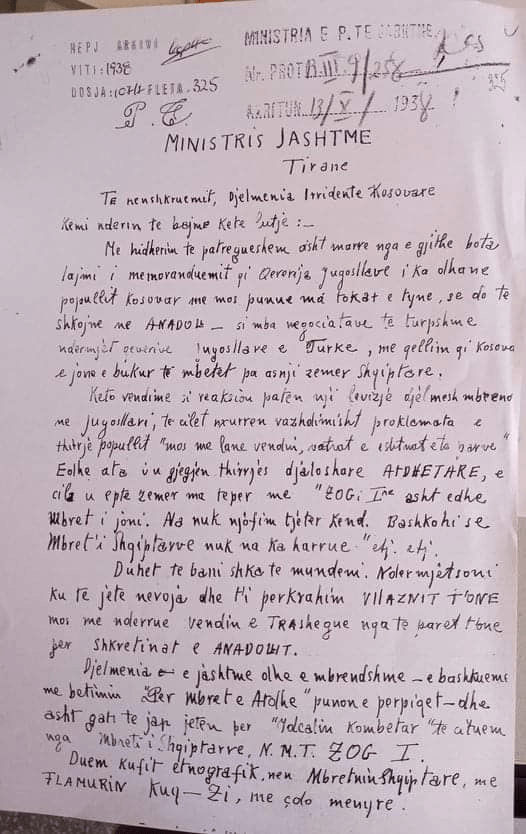
“MINISTRY OF FOREIGN AFFAIRS
To the Foreign Minister, Tirana
Date: 1936
Subject: To the undersigned, the Irredentist Youth of Kosovo
We respectfully submit the following request:
With great concern, we have learned that, according to all reports and memoranda from the Yugoslav government, the Kosovar population has been forbidden to work their lands, and they are to be sent to Anatolia—and that the Turkish authorities are negotiating with the Yugoslav authorities to ensure that Kosovo remains completely empty of Albanian land.
This decision has provoked reactions among our people, who continue to flee Yugoslavia, violating the proclamations of the authorities that “our people should not leave their lands,” and the situation is worsening day by day.
Therefore, we urgently request a declaration of sovereignty (Adethetare), which would protect our land under the Kingdom of Albania. It is our desire that no other land be informed or interfered with. At the same time, the protection of Albania should not be violated, etc., etc.
Action must be taken immediately. The necessary measures should be taken and followed with complete diligence, and the decision of the Trashëgues (heir) should be executed to defend our lands in Anatolia.
The youth—both external and internal—alongside the faithful “For the Kingdom of Albania” must work continuously, and it should be their duty to advance the national cause of Albania, under the protection of the King of Albania, N.M.T. Zog I.
We respectfully request that this ethnographic duty be carried out under the sovereignty of Albania, with the Albanian flag raised in every way possible.
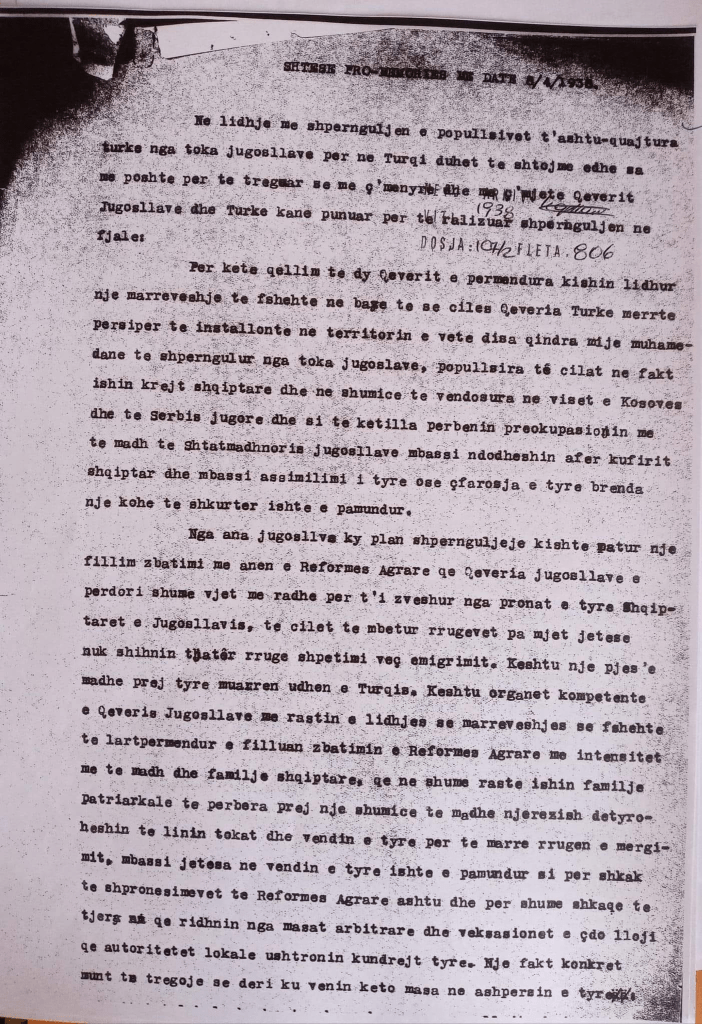
Excerpt from the report dated 3/IV/1938
In our discussions regarding the dispersal of the Albanian population from Yugoslav territory into Turkey, it was deemed necessary to add, or at least to report, the ways in which the governments of Yugoslavia and Turkey had acted to implement the dispersal of these populations.
For this purpose, the two governments had apparently reached a secret agreement according to which the Turkish government would undertake to install several hundred thousand Muslims displaced from Yugoslav territory—populations that were in fact entirely Albanian and in some areas located in the districts of Kosovo and southern Serbia. This matter constituted a major concern for the Yugoslav authorities, given the proximity of the Albanian border and the potential for their assimilation or dispersion over a short period of time.
On the Yugoslav side, this plan had been preceded by the implementation of the Agrarian Reform, which the Yugoslav government had repeatedly used to remove Albanian-owned properties in Yugoslavia, leaving the inhabitants without livelihoods or forcing them onto the roads in search of survival or emigration. This constituted a significant part of their migration to Turkey.
Here, the competent authorities of the Yugoslav government, in cases related to the secret agreement, began implementing the Agrarian Reform with greater intensity against Albanian families. In many cases, these were patriarchal families composed of several individuals who were compelled to leave their land and homes to take the route of migration, as staying in their place of residence had become impossible due to the effects of the Agrarian Reform and, in many other instances, due to arbitrary measures and local authorities’ actions against them. A concrete fact can demonstrate to what extent these measures intensified their hardship.
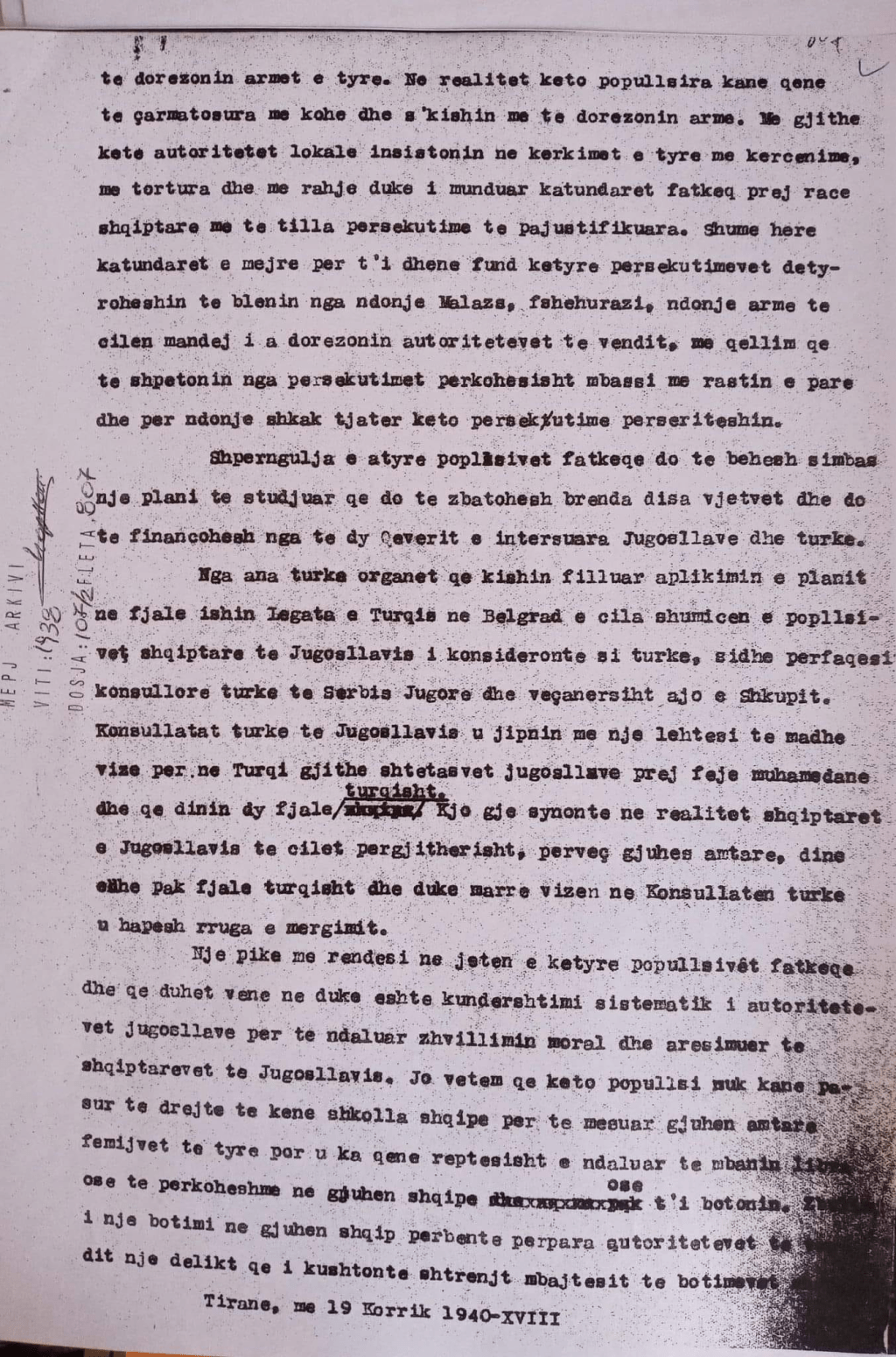
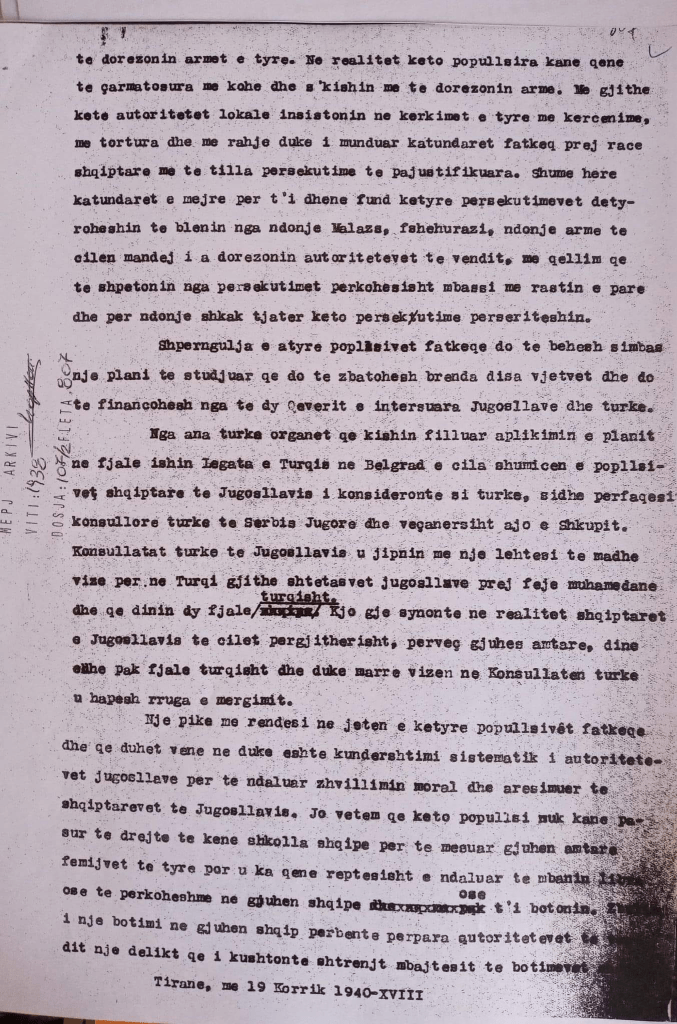
They were armed with their weapons. In reality, these populations had been armed because the authorities insisted on their arming, with intimidation, torture, and a forced change among the unfortunate peasants from other races.
They justified the persecution of the unjust. Many of them were given the excuse to justify the persecution by deciding to move away from Malaz, refugees, or armed with their rifles by the authorities of the country, with the goal of protecting them from persecution under the guise of military operations from the first case. In addition, these persecutions continued with other justifications.
The displacement of their populations, however, was in line with the plans for studying the implementation of financial assistance from the government to address Yugoslav Turks. From the Turkish side, those who were implementing the plan spoke in Turkish. The officials in Belgrade saw the economic development of Yugoslavia as having been influenced by the Turkish presence and Serbian actions in relation to the large part of the population.
Some of these authorities went to consult with the consular officials in Yugoslavia, calling it a concession of necessary action, but the problems arose with the Turkish population that needed to reach the Turkish Consulate to obtain further rights.
The key factor for the population in the implementation of development requires that they not only struggle to develop morally but also prioritize the development of linguistic practices, especially the Turkish language, across the borders and onto the other side.
The point is, the language issue affects the youth, who were supposed to be educated in Turkish, as a method of expression, and government officials had taken decisions with strict implementation.
Tirana, July 19, 1940-XVIII”.


 Balkan Academia