
Abstract
This study examines the historical development of Katundi Buzavik, a village in southeastern Kosovo with deep Albanian roots. Archival sources indicate its existence since at least 1455, contradicting claims that it was uninhabited before the arrival of Albanian muhajirs from Serbia. Buzavik historically hosted Albanian Orthodox and Catholic populations, with four churches and one monastery. Following the annexation of Kosovo in 1912, Serb, Montenegrin, and Russian settlers gradually altered the demographic composition, reflecting broader strategies of ethnic colonization. This study contextualizes local oral histories, cadastral records, and nationalist historiographies to reconstruct the village’s historical and cultural significance.
Katundi Buzavik and Viti
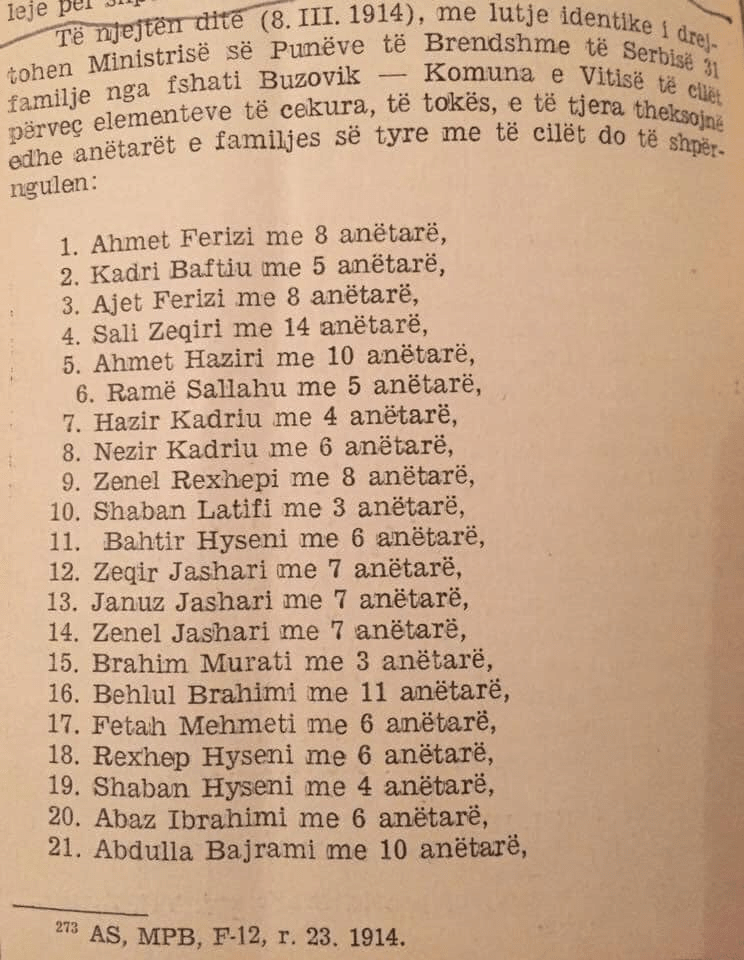
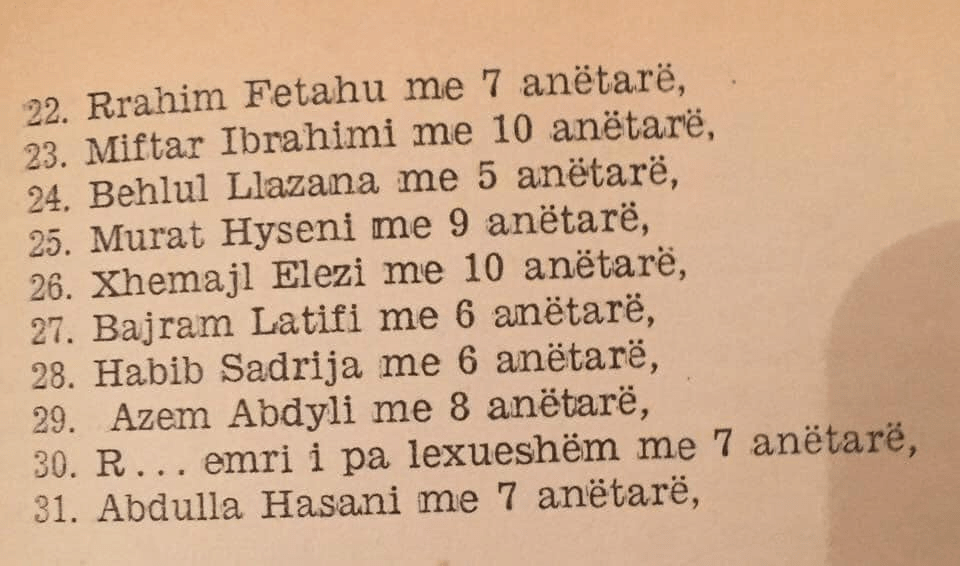
Katundi Buzavik, located approximately six kilometers from Viti in southeastern Kosovo, represents a significant example of a historically Albanian settlement. Prior to 1914, the village consisted of approximately forty Albanian households, though their exact locations were later lost. The settlement, positioned at the edge of surrounding mountains—Buzavik, Kolishta, Lubishta, and Dobelldeh—fits the pattern of dispersed villages, with houses separated by five to ten minutes’ walking distance.
Contrary to claims by Urošević that the village was uninhabited before the arrival of Albanian muhajirs from Serbia, historical documents indicate a longstanding presence. The 1455 cadastral register of the Vilayet of Vëllk records twelve houses in a settlement referred to as Buzovik, inhabited predominantly by Albanians. Neighboring villages included Orthodox Albanian populations in Binçë, as well as Catholic families from the Ballaban, Sopa, Mjaka, and Trakalaq lineages, some of whom were later displaced by Slavic colonists after 1912.
The historical narrative propagated by S. Koiç, suggesting that Princess Olivera, daughter of Knez Lazar, passed through Buzovik en route to marriage with Sultan Bayezid I, reflects fabricated nationalist claims that sought to overwrite local Albanian Orthodox history.
In reality, churches and monasteries in Buzavik were established and maintained by Albanian Orthodox communities, and not by Serbs. By 1914, Buzavik maintained thirty-five Albanian households and four churches, including the Archangel Gabriel Monastery, highlighting the enduring religious and cultural heritage of the Albanian population.
Following the annexation of Kosovo in 1912, and particularly between 1921 and 1927, Serb, Montenegrin, and Russian colonists were settled in the village, gradually becoming a majority by 1937. These demographic shifts, coupled with the appropriation of church lands, illustrate the colonial strategies employed to alter the ethnic composition and historical memory of the region.
Sources
Feri Arifi
- Ottoman cadastral tax registers (defters), especially the Defter‑i Mufassal of the Vilayet of Vëlk (1455), which catalogued villages and households in Eastern Kosovo and surrounding regions, offering baseline administrative data for settlement studies.
- Scholarship on Ottoman provincial history showing Kosovo’s regional integration and administrative organization during the 15th century.
- Studies of Yugoslav colonization policies outlining demographic changes in Kosovo post‑1912, including settlement of Serb and other colonists in former Ottoman territories.
- Demographic historiography emphasizing the complexity of ethnic, religious, and social identities in Kosovo across the medieval and early modern periods.


 Balkan Academia