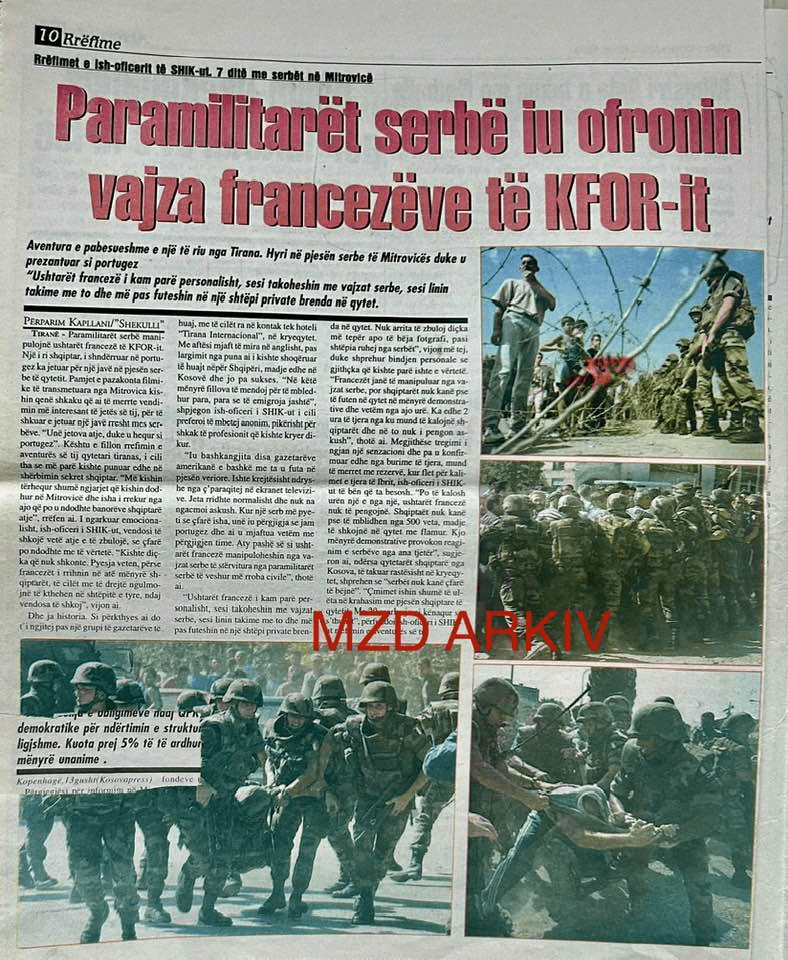

The Uncomfortable Silence: The French–Serbian Scandal in Post-War Mitrovica
In the fragile aftermath of the Kosovo war, the presence of NATO’s KFOR mission was meant to symbolize protection, neutrality, and the rule of law. Yet reports emerging from Mitrovica in the early post-war years reveal a troubling reality that challenges this narrative—one marked by misconduct, manipulation, and moral compromise.
According to investigations published in Albanian media, including Shekulli, Serbian paramilitary networks operating in northern Mitrovica cultivated close and inappropriate relations with French KFOR soldiers. Eyewitness testimonies describe French troops attending private gatherings arranged by Serbian intermediaries, where young women were reportedly offered as part of a broader effort to secure favor and tolerance. These allegations, while deeply disturbing, are consistent with a wider pattern of selective enforcement and passive complicity observed during the period.
More alarming than the alleged personal misconduct is its political consequence. Serbian paramilitaries, often operating in civilian clothing, were reportedly allowed to move freely through areas under French KFOR control—sometimes even armed—while Albanian civilians faced checkpoints, restrictions, and collective suspicion. Peaceful Albanian demonstrations were blocked, while Serbian structures consolidated control in plain sight. Such imbalance raises serious questions about the neutrality of the mission and the standards applied on the ground.
Eyewitness accounts further suggest that Serbian actors deliberately misrepresented Albanians to international forces, portraying them as extremists or criminals. These narratives, once accepted, justified discriminatory practices and reinforced a false equivalence between victims and aggressors. In this environment, truth became collateral damage, and justice an afterthought.
If even a portion of these allegations is accurate, the scandal is not merely about individual misconduct—it is about institutional failure. International peacekeeping missions depend on credibility. When troops appear compromised, manipulated, or selectively blind, they erode trust not only among local populations but also in the very concept of international intervention.
The French authorities and NATO have largely remained silent on these specific accusations. Silence, however, does not neutralize responsibility. Transparency, independent investigation, and acknowledgment are essential—not to reopen wounds, but to prevent their repetition.
Mitrovica stands as a reminder that peacekeeping without accountability risks becoming a façade. For those who lived under intimidation while international forces looked away, the scandal is not history—it is lived experience. And for Europe, it is a warning that values proclaimed abroad must be enforced on the ground, without favoritism and without fear.
Article: The confession of a former SHIK officer: 7 days with the Serbs in Mitrovica
Serbian paramilitaries offered French KFOR soldiers women
Subheadline
An unbelievable adventure of a young man from Tirana, presented as Portuguese. He entered the Serbian part of Mitrovica by pretending to be a journalist.
“I personally saw French soldiers meeting Serbian girls, arranging encounters with them, and then taking them into a private house inside the city.”
Përparim Kapllani / Shekull
TIRANA – Serbian paramilitaries manipulated French KFOR soldiers. A young Albanian, disguised as a Portuguese journalist, managed to enter the Serbian part of the city. The footage he recorded was transmitted from Mitrovica and shows an interesting part of everyday life there, as described by the young man himself.
“I was dressed as a Portuguese, speaking only Portuguese. This is how the adventure of this citizen from Tirana began, who had previously had some experience working in Albanian media,” says the former SHIK officer. “They took me to a hotel. The Serbs treated me well. They thought I was a foreign journalist.”
He explains that during the first days he carefully observed everything.
“At first, I did not want to act. I wanted to understand what was really happening,” says the former SHIK officer, who preferred to remain anonymous for professional reasons.
According to him, Serbian paramilitary groups had close contact with French KFOR soldiers.
“I personally saw how French soldiers met Serbian girls, how they arranged meetings with them, and then took them into private houses inside the city.”
He adds that Serbian paramilitaries were often dressed in civilian clothes and moved freely.
“The French soldiers were manipulated by the Serbs, but the Albanians had no chance to enter the city in a demonstrative way wearing only civilian clothes.”
He explains that there were checkpoints through which Albanians could not pass, while Serbian paramilitaries moved freely.
“There were checkpoints where Albanians were not allowed to pass, while the Serbs passed without any problem,” he says.
The young man says he tried to document everything with photographs, but this was not always possible.
“I could not reveal everything I had seen through photos, because after entering Serbian houses, filming was impossible.”
He further explains that the Serbs had misled the international forces.
“They presented Albanians as extremists and criminals. This lie was accepted by many foreign soldiers.”
According to him, the French soldiers did not prevent Serbian paramilitaries from moving armed inside the city.
“The Albanians could not even organize a peaceful protest with 500 people, while the Serbs could move armed.”
He concludes by saying that the crimes committed were many and serious.
“The crimes were numerous and severe. The suffering of Albanians was incomparable.”
Watermark
MZO ARCHIVE
Photo credits / source (bottom line)
Copenhagen / J. Igrani / Kosovapress


 Balkan Academia