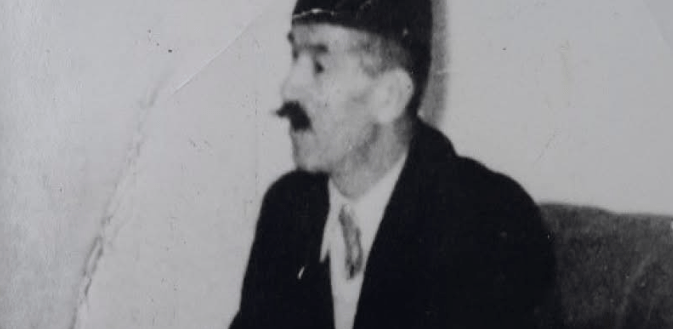

Images from Stav.BA. Author: Elirija Hadžiahmetović
Abstract
This section situates Sulejman ef. Pačariz within the violent socio-political landscape of Sandžak from the Balkan Wars through the early stages of World War II. It traces the systematic persecution of the Bosniak-Muslim population following the withdrawal of Ottoman rule, including mass killings, forced conversions, land dispossession, and unchecked Chetnik violence. Pačariz’s personal radicalization is contextualized through the destruction of his native village, the murder of his father by Chetniks in 1921, and his subsequent conflicts with state authorities. His movements between religious, administrative, and military roles reflect broader Muslim strategies of survival. The text culminates in his return to Sandžak in 1941 and the formation of the Muslim militia as an organized response to existential threats, emphasizing self-defense rather than ideological warfare.
Uleyman ef. Pačariz: “Let us rise up, brothers, in the name of Allah Almighty to defend our villages and cities” (2)
This was the social context when Sulejman Pačariz filed a private lawsuit against Miloš Pantović, an official of the Mileševo municipality. In the courtroom on October 27, 1929, he told Pačariz in a certain case, “Get out, you’re lying,” to which Pačariz allegedly replied, “…insulting Pantović and the court: ‘You are thieves, robbers, you have robbed the entire Muslim population, you do not work according to the law but according to religion.’”
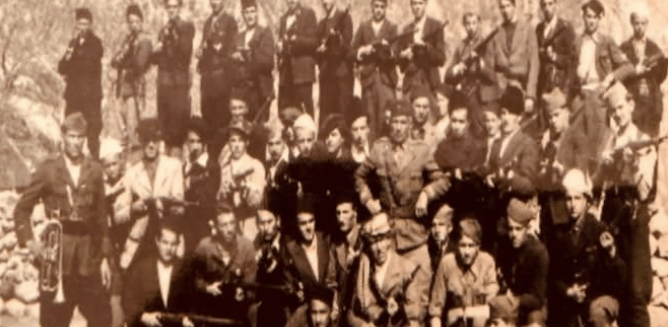
Photo: Part of the operational platoon of the Muslim militia
Here are a few historical facts about the socio-political situation in the territory of Sandžak at the beginning of the 20th century. When Turkey withdrew from Sandžak after the Balkan War of 1912-1914, Berane and the surrounding area were occupied by Montenegrin units who committed unprecedented crimes against the Bosniak-Muslim population. After the horrific massacre of Bosniaks in Plav and Gusinje in 1912-1913 and the forced conversion of the survivors, the Bosniak population began to emigrate to Macedonia and Turkey.
Bioča, native village Sulejman Pačariz, was burned down and then approximately 30 Bosniak families, including Sulejman ef., fled to Bijelo Polje. A part of the population fled to Bosnia and Herzegovina, Albania and Turkey, but the majority remained under Montenegrin rule and King Nikola I. Petrović Njegoš. Mula Ibrahim then went to Peć, where he stayed with his family for two months.
Then he returned to Bijelo Polje, from there he moved to Gostun (between Bijelo Polje and Brodarevo) where he lived until the end of World War I, and finally settled in Brodarevo as an imam, where he was killed by Chetniks on August 21, 1921. The Pačariz then moved on to Prijepolje, namely to the village of Hisardžik, which is passed through on the old road to Sjenica.
As Alija Bejtić wrote in his work “Kasid Ibrahim Biočak”, in Ibrahim’s notebook there were notes handwritten by his son Sulejman about the increasingly strong approach of Montenegrin units, and it is also recorded that the Montenegrins conquered Bijelo Polje (Akova) on September 27, on Monday the 30th, Bioča and Lozna were conquered, and Berane on September 31, 1912.
Two armies were formed in parallel in the Kingdom of SHS, one regular and the other unofficial – the Chetnik detachments of Kosta Pećanac and Puniša Račić, who, with the favor of King Aleksandar Karađorđević and Prime Minister Nikola Pašić, committed crimes against the Bosniak-Muslim and Albanian population in Sandžak.
In August 1921, in the Priboj and Višegrad districts, the Chetniks of Kosta Pećanac, accused of aiding the committee, killed the Priboj hodja Salih Potur and a group of Muslims from that district. They raped women and robbed Muslim houses, so that the Muslim population began to flee to Bosnia, which was also reported in a Sarajevo newspaper Justice.
In that month, Chetniks and armed Serbian peasants and the temporary gendarmerie-Chetniks killed 21 Muslims, which, says historian Željko Karaula, is “a reflection of inherited conflicts from the past and ethnic intolerance”.
The most heinous of the frequent crimes against the Muslims of Sandžak was the genocide against the Bosniaks of Šahovići and Pavino Polje on November 9, 1924, in which, according to various estimates, from several hundred to more than 1,000 Bosniaks, men, women and children, were killed in peacetime conditions.
And this without any reaction from Belgrade, let alone the judicial prosecution of the perpetrators of the genocide. At that time, the Komitas groups of Jusuf Mehonić, Husein Bošković, Feriz Salkić and others were formed, whose primary goal was to protect the Bosniak population, their homes and property from the Chetniks.
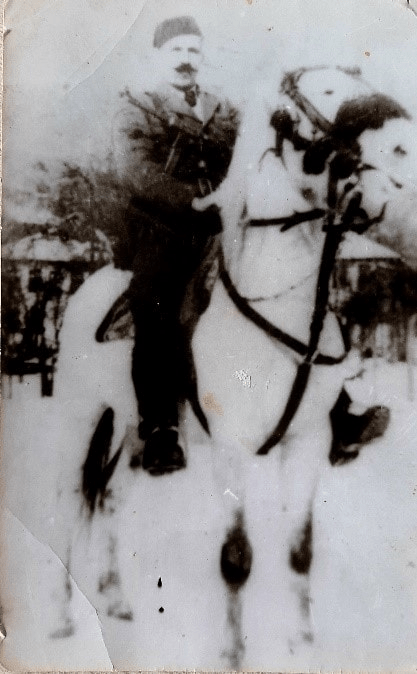
Establishment of the Muslim Militia
According to the testimony of Sulejman’s son Ćazim Pačariz, recorded 1995 (living in Skopje), at the time of the murder of his grandfather Ibrahim ef., father Sulejman was employed in the royal gendarmerie as a military imam.
However, after the murder of his father Mula Ibrahim, he left it and went to the Komite and was with Jusuf Mehonić for a while. After the Albanian gendarmerie killed Mehonić in March 1926, the Komite movement in Sandžak disintegrated, and Effendi Sulejman Pačariz returned to the gendarmerie and served in the village of Stranjani in Prijepolje and Karaula in Sjenica.
However, historian Željko Karaula claims that this information is unreliable, perhaps even incorrect, because the file of the Islamic Community of the Kingdom of Yugoslavia from 1933 does not mention his service as a gendarme.
He also questions whether Pačariz was in Mehonić’s company at all, because if he had previously been in the gendarmerie, as he explained to the gendarmerie leadership, where he had been for five years, from 1921, when his father was killed, until Mehonić’s murder in 1926 and his alleged return to the gendarmerie.
But what is not in question is that on March 15, 1927, he took up the post of imam-registrar in the village of Hisardžik near Prijepolje, and he held that position until 1938, when he was again appointed military imam on the Montenegrin coast in the Bar district.
Karaula also checked this information in the Military Archives in Belgrade, but did not come across any a document that would confirm that Sulejman ef. Pačariz had previously completed a three-month gendarmerie preparatory school, which was mandatory, which he also spoke about at the International Scientific Conference in Novi Pazar and Bijelo Polje in late July and early August 2024.
Let’s go back to Pačariz’s service in the Prijepolje District. The Muslim religious intelligentsia, the beys and agas, were also impoverished in Sandžak by the agrarian reforms that were implemented starting from Austria-Hungary, through the Kingdom of SHS to the Kingdom of Yugoslavia. 1.82 million dulums of the best land, the so-called serf settlements, were taken away from them and allocated to the former serfs. Many of the once rich people were on the verge of existence, including the imams.
This was the social context when Sulejman Pačariz filed a private lawsuit against Miloš Pantović, an official of the Mileševo Municipality. In the courtroom on October 27, 1929, the latter told Pačariz in a certain case, “Get out, you’re lying,” to which Pačariz allegedly replied, “…insulting Pantović and the court: ‘You are thieves, robbers, you have robbed the entire Muslim population, you do not work according to the law but according to religion.’ On September 10, 1930, the court sentenced Pačariz to five days in prison and ordered him to pay a fine to the witnesses who testified in court.
Return from Montenegrin Ostros to Sandžak
Karaula claims that indirect information indicates that Pačariz was often in verbal conflict with both Orthodox Christians and Muslims, which resulted in many private lawsuits. For this reason, the Mufti’s office in Pljevlja transferred him on December 10, 1933, from the position of imam-registrar in Hisardžik to the position of imam-registrar in Ostros, a small town near Bar in the Zeta banovina.
Although he was Unhappy with the decision and requesting that it not be implemented, Pačariz nevertheless moved to Ostros with his family in August 1934. The stress of the change of environment affected his frequent illness the following year, which is why he was granted paid sick leave. From the position of imam-registrar, he advanced to the position of jamat imam in that village inhabited by Albanians. He was also a religious teacher in the local elementary school. His brother Ešref also worked there from 1937.
It was also recorded that some people had complaints that he was not doing his job as a registrar properly. After an investigation conducted by the Mufti’s Office in Pljevlja, he was acquitted of the charge of indiscipline. Some authors state that he was also a military imam in the garrison in Bar and that he waited for the capitulation of the Kingdom of Yugoslavia in that position.
After the outbreak of World War II, Sulejman ef. Pačariz returned to Sandžak. That journey, at least according to the authors Crnovršanin and Sadiković, was over identical to the one from August 21, 1921 (the literature also mentions 1922) when his father Ibrahim ef was killed. Namely, the Montenegrin government had been following his work and movements all the time and was afraid of his reputation and influence among the people, so they decided to liquidate him.
This is a quote from the book “Sandžak – the Enslaved Land”:
“Pačariz set off on a bus from Prijepolje, Ilijaz Čičić, through the Lim canyon in the direction of Prijepolje. According to the old H.A. (according to the statement of Suejman’s son Ćazim, ed.) who happened to be with him on the bus, the Chetniks had set up an ambush from which the hodza skillfully escaped. ‘On the way through the Lim canyon, a group of Chetniks stopped the bus, because they knew that the hodza was in it.
When he saw them armed, he broke the window and jumped out of the bus. He threw himself into the Lim from a 20-meter-high cliff and, diving through the water, hid in a whirlpool and hid there. The Chetniks fired bursts of fire after him, but not a single bullet hit him. Hidden under the vines, to the very shore, the hodja waited until it became quiet and when he saw that the bus had left – he went out to the shore. He took to the forests, gorges and ravines and since he was light on his feet he quickly reached the foot of Mount Jadovnik”.
“Pačarize, black gate, move the army from Kolovrat”
It was a dark night when he arrived in the village of Mrčkovina where he was hosted by the Adilović family and from there he set off for Hisardžik the next day. Immediately after this event Sulejman ef. Pačarize set off to organize the Muslims of the Prijepolje region for defense against the Chetniks. He told the Prijepolje leaders:
“Brothers, I am convinced that the Sandžak is planned to be burned and destroyed, so let us rise up, brothers, in the name of Allah Almighty. to defend our villages and towns”.
German military forces entered Sandžak on May 16 and occupied the entire territory by May 19, 1941. They then handed over Sandžak to the Independent State of Croatia, which openly showed its desire to expand into these territories and remained there until the end of September 1941. The first Ustasha units were stationed in Priboj, Pljevlja, Pijepolje, Sjenica and Novi Pazar.
The first unit of the Muslim militia was formed, it is assumed, in June/July 1941. Since then, Pačariz has been at its head. Its headquarters was in Hisardžik, and it was made up of the local population.
However, Mustafa Memić states that Pačariz only founded a smaller detachment of 40 fighters in September 1941 and he was the backbone of the creation of a numerically stronger Muslim militia for the defense of Muslims in Prijepolje and the surrounding area. First, the people had to be armed and with this intention, Pačariz consulted with the reputable cattle trader Hasan-aga Zvizdić in Sjenica.
The decision was to send people to Kosovo, to Peje and Istog (Burim), to bring weapons. Several people from Peshter went back to Hisardžik with him and they started preparations for the defense. In the defense, he collaborated – in addition to Hasan-aga Zvizdić – with Selim Juković, Isa Sadiković, Ćamil Hasanagić, Ćamil Prašović, Sefer Tarić, Džemail Koničanin, Aćif ef. Hadžiahmetović.
At that time, Sulejman is first mentioned in historical sources as one of the signatories of the Memorandum of the delegation of Muslims from Sandžak of July 7, 1941 to the commander of the main staff of the Turkish army, Marshal Mustafa Fevzi Çakmak. In the Memorandum, he explained the necessity of annexing Sandžak to Bosnia and Herzegovina (the NDH is not mentioned) and outlined the terrible consequences for the Muslim population if the plan to divide Sandžak between Serbia and Montenegro was implemented.
The uprising in Montenegro began on July 14 with an attack on the gendarmerie station in Mojkovac. The insurgents liberated Šahovići and Brodarevo from the Italians, and on July 20, Bijelo Polje. The very next day, the Ustasha commissioner for Sandžak, Murat Bajrović, sent a report to the Ustasha headquarters – in response to the request of the Italian military forces that the Ustasha leave Sandžak by July 15, 1941 – about the clash between the Montenegrin insurgents and Muslims: “…on the way to Bijelo Polje, Sulejman Pačariz, the imam-registrar, was attacked by Montenegrin Chetniks and killed”. Of course, this was not true, but it is assumed that he was wounded.
(In the 3rd part: Petition for the annexation of Sandžak to the NDH, the entry of the Chetniks into the village of Kosatica and the revenge of the Muslim militia, the Partisan attack on Sjenica and Tito’s condemnation of that attack).


 Balkan Academia