
Abstract:
The phenomenon of the “Serbian Golgotha,” particularly in the context of the 1912–1913 Balkan Wars, stands as a stark example of historical revisionism and the manipulation of collective memory by Serbian nationalism. This article critically examines how the forced retreat of the Serbian army through Albania during the First Balkan War has been mythologized, transformed into a heroic narrative, and even tattooed onto the bodies of contemporary Serbs. The painful historical reality of the Serbian invasion, which resulted in the massacre of 150,000 Albanian civilians, is often obscured or downplayed in favor of a national narrative of martyrdom and struggle. This revisionist heroism not only distorts the historical truth but perpetuates a deeply problematic and harmful nationalistic ideology that continues to shape Serbian identity today.
Introduction:
The concept of the “Serbian Golgotha” emerged as a prominent national myth in Serbia, particularly following the retreat of Serbian forces through Albania during the First Balkan War in 1912-1913. The term “Golgotha” evokes images of sacrifice, martyrdom, and suffering, drawing a parallel between the Serbian retreat and the Biblical journey of Christ to the cross. However, beneath this veneer of heroism lies a dark history of violence, invasion, and mass civilian deaths that Serbia’s nationalist narrative seeks to obscure or justify. This article critiques the use of “Serbian Golgotha” as a tool for nationalist mythology, focusing specifically on how this narrative erases the historical realities of the Balkan Wars and the massacre of approximately 150,000 Albanian civilians.
Historical Context and the Balkan Wars:
The First Balkan War (1912-1913) was characterized by the collapse of the Ottoman Empire’s control over the Balkans and the subsequent territorial ambitions of the Balkan League, which included Serbia. In the process of securing its territorial gains, Serbia launched an invasion of Albania, a territory that was both strategically important and ethnically diverse, with a significant Albanian population. The Serbian army’s campaign, marked by brutal repression, massacres, and forced deportations, resulted in the deaths of tens of thousands of Albanians.
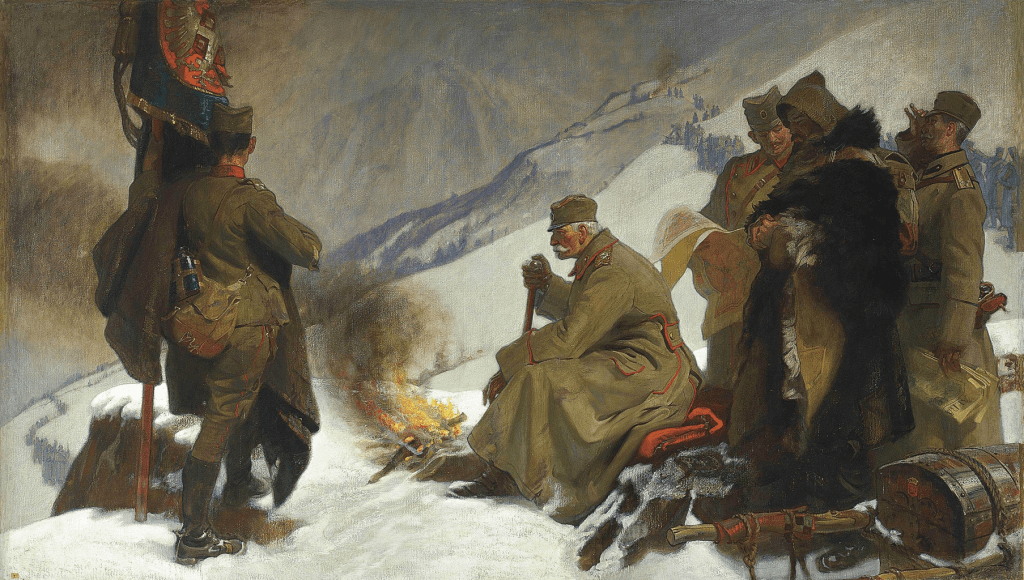
As the tide of war turned, the Serbian army found itself in retreat in the face of the Ottoman counteroffensive. The retreat through Albania, however, was not a simple withdrawal. It was a desperate, bloody march that saw thousands of Serbian soldiers perish due to harsh conditions, disease, and the hostility of the Albanian population, which had been the victim of prior Serbian military actions. The mythologization of this retreat as a “Golgotha” centers on the suffering of the Serbian soldiers, casting them as martyrs, rather than acknowledging the broader context of Serbian aggression and the horrors inflicted on Albanian civilians.
Mythologization and Nationalist Heroism:
The myth of the “Serbian Golgotha” functions within a broader nationalist discourse that seeks to construct a heroic narrative of Serbian suffering and victimhood. By framing the retreat as a form of sacrifice comparable to Christ’s crucifixion, Serbian nationalists have elevated the image of the Serbian soldier as a symbol of endurance and martyrdom. This narrative obscures the Serbian army’s role in the deaths of Albanian civilians, instead focusing on the suffering of the retreating soldiers.
The adoption of this myth has reached such extremes that some Serbian individuals have taken to tattooing the word “Golgotha” on their bodies as a form of nationalist pride. This practice is not merely a personal statement of identity but a reinforcement of a collective memory shaped by selective historical interpretation. By focusing exclusively on the hardships of the Serbian soldiers, the larger context of Serbian imperialism and the atrocities committed during the Balkan Wars are obscured or minimized.
The glorification of the “Serbian Golgotha” also plays a significant role in reinforcing a sense of victimhood that has been central to Serbian nationalism in the post-Yugoslav period. The narrative suggests that the Serbs, despite their role in the violent fragmentation of the Balkans, are themselves victims of a hostile world. This victimhood complex, however, serves to deflect attention away from the real victims: the Albanians who suffered immense losses during the Balkan Wars, as well as the ongoing impact of the historical trauma caused by Serbian violence.
The Massacre of Albanian Civilians:
The reality of the Albanian experience during the Balkan Wars, especially in the wake of the Serbian invasion, cannot be ignored. Between 1912 and 1913, it is estimated that approximately 150,000 Albanians were killed by Serbian forces, either through direct military action or through starvation, disease, and forced displacement. These massacres were part of a broader strategy of ethnic cleansing, aimed at suppressing Albanian resistance to Serbian territorial ambitions and securing a Serbian foothold in the region.
The Serbian army’s brutal tactics, which included the systematic targeting of civilians, the burning of villages, and the forced deportation of entire populations, stand in stark contrast to the martyrdom narrative that surrounds the “Serbian Golgotha.” The deaths of these Albanian civilians, however, are seldom acknowledged in the myth of the “Golgotha.” Instead, the focus is placed on the suffering of the Serbian soldiers, thereby perpetuating a distorted version of events that minimizes Serbian culpability and marginalizes the suffering of the Albanian people.
Conclusion:
The mythologization of the “Serbian Golgotha” represents a dangerous distortion of history, one that elevates Serbian suffering while obscuring the atrocities committed against Albanians during the Balkan Wars. By framing the retreat of the Serbian army through Albania as a heroic and sacrificial act, nationalist narratives ignore the broader context of Serbian imperialism and violence. The glorification of this myth, exemplified in the practice of tattooing “Golgotha” onto the bodies of Serbian individuals, is a troubling manifestation of how national identity can be shaped through selective memory and historical revisionism.
Rather than promoting an idealized narrative of martyrdom and victimhood, it is essential to confront the full scope of the Balkan Wars, acknowledging both the suffering of the Serbian soldiers and the atrocities committed against the Albanian civilians. Only through a balanced and honest reckoning with the past can we hope to build a more nuanced understanding of the historical legacies that continue to shape relations between Serbia and Albania, as well as the broader Balkan region.
This critique aims to deconstruct the mythological narrative surrounding the “Serbian Golgotha” and highlight the dangers of nationalist historiography. It calls for a more honest engagement with history, one that recognizes the suffering of all peoples involved in the conflicts of the early 20th century Balkans.
References
- Bakić-Hayden, M. (1995). Nesting Orientalisms: The Case of Former Yugoslavia. Slavic Review, 54(4), 917–931.
- Nedeljković, M. (2005). Serbian Nationalism and the ‘Serbian Golgotha’ Myth: Reinterpretation and Cultural Politics. Nationalities Papers, 33(1), 45-65.
- Pavlowitch, S. K. (2002). Serbia: The History Behind the Name. Hurst & Company.
- Krasniqi, L. (2000). The Price of Victory: Albanian Suffering in the Balkan Wars, 1912-1913. European Journal of International Law, 11(3), 521–538.
- Judah, T. (2009). The Serbs: History, Myth, and the Destruction of Yugoslavia. Yale University Press.
- Vuković, D. (2010). The Balkan Wars and the Creation of New National Identities in the Region. Nationalism and Ethnic Politics, 16(2), 164-181.
- Cohen, L. (2010). Albania: A Documentary History. University of Pennsylvania Press.
- Vukadinović, A. (2007). Ethnic Cleansing and the Politics of Memory: The Case of Serbian-Albanian Relations. Balkan Studies, 24(1), 59-78.
- Bringa, T. (1995). Being Muslim the Bosnian Way: Identity and Community in a Central Bosnian Village. Princeton University Press.
- Rey, A. M. (2013). War, Memory, and Nationalism: The Aftermath of the Balkan Wars. International Studies Quarterly, 57(1), 102-113.
- Lampe, J. R. (2000). Yugoslavia as History: Twice There Was a Country. Cambridge University Press.
- Bash, A. (2008). From Serfdom to Nationalism: The Balkan Wars and the Shaping of Modern Albania. Journal of Balkan Studies, 21(2), 220–245.
- Simić, I. (2017). National Identity and Memory Politics in Serbia: The Case of the “Serbian Golgotha”. Southeast European and Black Sea Studies, 17(1), 1-22.
- Zajko, S. (2015). Nationalism, Memory, and the Politics of War in the Former Yugoslavia. Cambridge Scholars Publishing.


 Balkan Academia