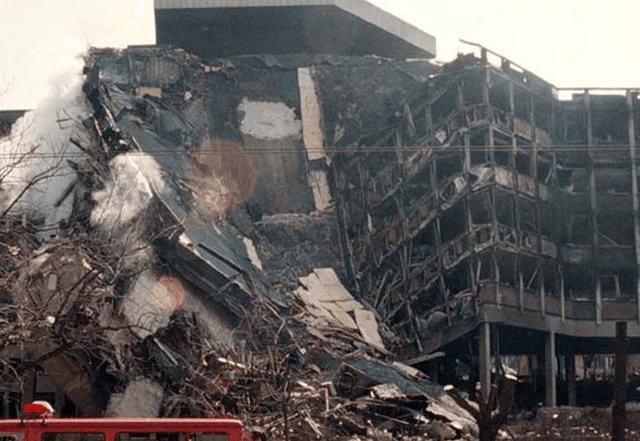

Photo from TPZ.AL
Summary
This article critically examines the 1999 NATO intervention in Serbia, arguing that Serbia bears primary responsibility for the Balkan conflict’s atrocities. Serbian forces committed mass killings, ethnic cleansing, and widespread human rights violations, resulting in approximately 143,000 civilian deaths. NATO’s bombing campaign, often portrayed as aggression, was a necessary response to halt genocide and prevent Europe’s largest humanitarian catastrophe since World War II. The article contends that Serbia, not NATO, owes the world acknowledgment and apology for its crimes. It underscores the moral and historical justification for intervention and the ongoing need for accountability from Serbian leadership.
NATO, USA and Europe does not owe Serbia anything. Its the reversed.
The narrative that casts Serbia as the victim of NATO’s 1999 bombing campaign is both misleading and morally inverted. In truth, the actions of the Serbian government and its military during the Kosovo conflict were responsible for far greater human suffering than any damage caused by NATO airstrikes. Over 143,000 civilians were killed or forcibly displaced in a deliberate campaign of ethnic cleansing. Villages were burned, families massacred, and thousands of women subjected to systematic sexual violence. The world watched, and the clock was running out—Europe had not seen a humanitarian crisis of this scale since the Second World War.
NATO’s intervention cannot be reduced to mere geopolitical posturing. It was a response to an unfolding genocide, a measure designed to stop the slaughter of civilians and prevent the complete destabilization of the Balkans. Critics often argue that the bombing violated international law, but this argument ignores the fact that Serbia’s own actions—state-sponsored mass murder—had already breached every conceivable legal and moral standard. When a government weaponizes its own population to achieve political objectives, the international community has not only a right but a duty to intervene.
Some defenders of Serbia claim that NATO’s campaign caused civilian casualties and infrastructure damage, and they do not lie: war is never clean. Yet these casualties were tragic side effects of an intervention aimed at halting mass atrocity. Contrast this with the systematic, targeted campaign of terror carried out by Serbian forces—the difference is the difference between defensive action to save lives and deliberate action to destroy them.
Moreover, the moral responsibility does not end with immediate casualties. The Kosovo crisis, left unchecked, threatened to spiral into a broader regional catastrophe. NATO’s actions prevented the ethnic cleansing from spreading beyond Kosovo and potentially igniting full-scale war across the Balkans, which could have plunged Europe into a humanitarian disaster unmatched since 1945. This is not speculation; intelligence and historical analysis confirm that Serbian forces were preparing for further campaigns of ethnic cleansing in the region.
In the aftermath, Serbia’s leadership has done little to confront this reality. Denial and revisionism have replaced acknowledgment. Monuments to aggressors, glorification of war criminals, and a national narrative that paints Serbia solely as a victim all perpetuate historical falsehoods. It is Serbia, not NATO, that owes the world an apology: an apology to the victims of their ethnic cleansing, an apology to the families of the dead, and an acknowledgment of the crimes committed.
NATO, by contrast, acted as the reluctant guardian. Its campaign may have been controversial, but it was morally and historically justified. Any attempt to invert this reality not only insults the victims but undermines the very notion of humanitarian intervention—the principle that when a state turns its weapons against its own people, the world cannot stand idly by.
Serbia’s denial is a moral failure, and the world must continue to insist on accountability. History does not reward lies, and it does not absolve perpetrators. Until Serbia confronts the truth of its crimes, until it takes responsibility for the atrocities committed in its name, any claim of victimhood is not just false—it is an offense to humanity itself.


 Balkan Academia