
Researched and published by Dr. Qazim Namani. Translation Petrit Latifi
Abstract
This text critically examines nineteenth-century Serbian historical and geographical scholarship concerning the territorial concept of “Old Serbia,” with particular reference to Kosovo. Drawing on works by early Serbian historians and geographers, including those of Raitch, Solaritch, and Desjardins, it argues that the notion of Kosovo as part of “Old Serbia” lacks historical and linguistic foundation. The analysis highlights that prominent Serbian authors neither defined Kosovo as Serbian territory nor used the term “Old Serbia.” Instead, Kosovo is consistently placed outside Serbian ethnolinguistic boundaries, reinforcing its identification as part of Albanian lands.
Serbian historian Jovan Rajić, in his “Historie des peuples slaves” (History of the Slavic Peoples) published in 1794, writes that Upper Moesia was named Serbia, and its borders were between the Danube and the Sava rivers. This passage was cited from the 1920 newpaper “AGIM”.
Cited from the paper:
“[…] Illyricum of Albania, within which Kosovo was left to Albania; secondly, the one who is considered the first Serb to have defined the borders of Serbia, in his book Histoire des peuples slaves (Vienna, 1794–1795), states that Upper Moesia took the name “Serbia” and had as its borders the Danube and the Sava to the north, Mount Šar and Macedonia to the south, the Drin to the west, and the river Tribica (which appears to be the Morava) to the east.
Although he thus designates the Drin and the Morava as the western and eastern boundaries—suggesting that he intended to include within Serbia even ancient Triballia and Dardania (territories purely Albanian)—he nevertheless never once mentions the term “Old Serbia.” This view is also shared by historians of our own century such as Sax, Farlach, and others.
Likewise, another Serbian geographer, Solaritch, in his Serbian geography published in 1804, states that Serbia is the land extending west of Bulgaria between Mount Šar and the river Timok. Thus, although he was Serbian, he neither mentions nor discusses “Old Serbia.” Where, then, does Dr. Cvijić find “Old Serbia”?
The Serbian historian Raitch (Ivan Raitch, edition of Buda, 1823, Book IX, Chapter V, §9), when discussing the wars of Hunyadi against the Turks, writes as follows: “He (Hunyadi), after remaining a short time in Vidin, descended like lightning into the Plain of Kosovo…” If Kosovo were Old Serbia, such a learned Serbian author, writing in 1823, would certainly have mentioned it.
Regarding the ethnographic boundaries of the Serbian population, Professor Desjardins, relying on linguistic evidence, published in 1853 a map of Serbian-speaking territories. This boundary is clearly marked. To the south, it does not extend beyond Mount Šar; to the southeast, it follows the line separating the Ibar and Toplica from the Morava to the east.
According to this map, which is based on Serbian linguistic and glossological evidence, the cities of Bela Palanka, Pirot, Leskovac, Vranje, Gjilan, Preševo, Kaçanik, Tetovo, Skopje, Kumanovo, and Gostivar, among others, remain outside the borders of Serbia, outside the Serbian linguistic boundaries (that is, outside areas where Serbian is spoken). They remain within Kosovo, which, according to this interpretation, constitutes a part of Albania.
Members of the Serbian political current advocating a Balkan Federation, which had existed within Serbian national discourse since 1860, had a particularly strong interest in spreading Serbian ideological claims over Kosovo.
In that year, the Serbian Learned Society (Société savante), which had published the so-called Macedonian folk songs of Verković (“Srbstvo,” nos. 21 and 25; Miliukoff, p. 77), planted the first roots of Serbianization in Kosovo, which from that time onward began to be viewed with covetous eyes as if it were a Serbian land…[…]”
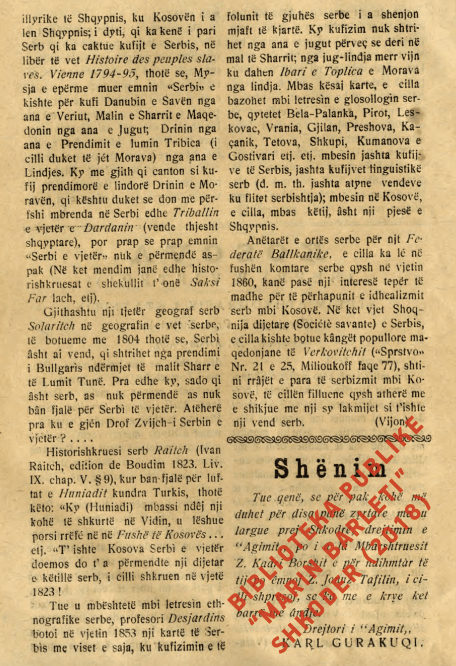
Source
No. 4. Shkodër, August 1920. Year II. AGIMI. A temporary literary-political [publication]. Published at the beginning of each month. Organ of the Society “VLLAZNIJA” Directed by: KARL GURAKUQI.


 Balkan Academia