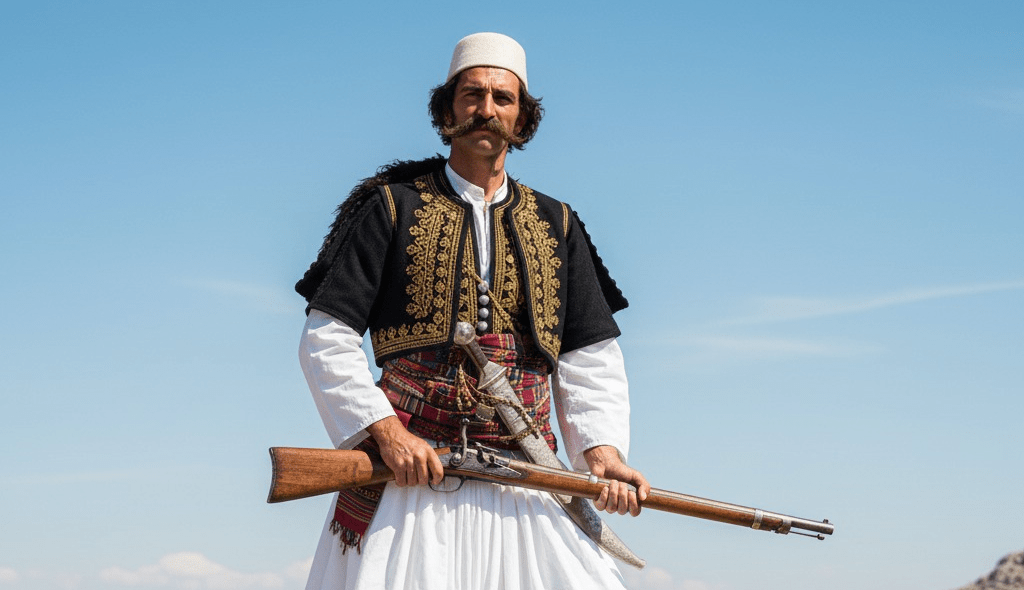

Reassessing Albanian Muslim Resistance and the Fallacy of Religious Loyalty
Abstract
This article challenges a recurring argument in Balkan historiography which claims that Muslim populations in the Ottoman Empire—particularly Albanian Muslims—lacked moral or political legitimacy to revolt against Ottoman rule due to their religious affiliation. This claim, often advanced by Serbian and Greek nationalist writers, implicitly contrasts Muslim Albanians with Orthodox Slavs, portraying the latter as authentic anti-imperial actors. The article argues that this reasoning constitutes a logical fallacy: religious affiliation does not determine political loyalty, nor does conversion imply acceptance of imperial domination. On the contrary, historical evidence demonstrates that Albanians, including Muslims, were among the most frequent and persistent rebels against Ottoman authority.¹
Introduction
In nationalist historiography of the Balkans, resistance to Ottoman rule has often been framed through a confessional lens. Orthodox Christian revolts are commonly depicted as legitimate struggles for liberation, while Muslim resistance—especially Albanian Muslim resistance—is dismissed or rendered contradictory.² A recurring accusation claims that Albanian Muslims could not simultaneously benefit from religious tolerance within the empire and revolt against it. This article argues that such reasoning is analytically flawed, historically inaccurate, and ideologically motivated.
The Logical Fallacy of Religious Determinism
The assumption that religious affiliation determines political loyalty constitutes a false dilemma. It presumes that conversion to Islam necessarily implied ideological alignment with the Ottoman state.³ In reality, religion and political authority were distinct domains. Many Muslim communities across the empire—Arabs, Kurds, Bosniaks, and Albanians—revolted against Ottoman centralization, taxation, conscription, and administrative reforms.⁴ To argue that Albanian Muslims forfeited their right to revolt due to conversion is to conflate belief with obedience, a clear argumentation error.
Albanian Conversion and Political Autonomy
Albanian conversion to Islam was neither uniform nor primarily ideological. It occurred gradually and was shaped by local, economic, and social pressures rather than theological conviction.⁵ Importantly, conversion did not erase Albanian tribal organization, customary law (Kanun), or traditions of local self-rule. Ottoman attempts to impose centralized authority repeatedly clashed with Albanian society—regardless of religious affiliation.⁶ Thus, portraying Albanian Muslims as passive beneficiaries of Ottoman rule ignores the persistence of indigenous political resistance.
Revolt as a Historical Pattern
Rather than being exceptional, Albanian revolts were systemic and continuous. From early resistance following the Ottoman conquest to widespread uprisings in the eighteenth and nineteenth centuries, Albanians—Muslim and Christian alike—rebelled against excessive taxation, land confiscation, conscription, and administrative interference.⁷ In comparative terms, Albanians revolted more frequently than many Orthodox Balkan populations, often forcing the Ottoman state to negotiate autonomy or suspend reforms.⁸
Anti-Albanian Bias in Balkan Historiography
The portrayal of Albanian Muslims as collaborators often reflects nationalist polemics rather than historical analysis. Some Serbian and Greek authors rely on an implicit confessional hierarchy in which Orthodoxy is equated with resistance and Islam with submission.⁹ This framework selectively highlights Christian revolts while marginalizing or omitting Muslim rebellions, producing a distorted narrative that delegitimizes Albanian political agency and resistance.
Conclusion
Muslim Albanians possessed the same political and moral right to resist Ottoman domination as Orthodox Slavs. Claims to the contrary rest on flawed logic and selective historiography. Far from being loyalist subjects, Albanians—regardless of religion—were among the most rebellious populations in the empire. Recognizing this reality challenges confessional determinism and restores historical complexity to Balkan resistance narratives.¹⁰
Footnotes
- Mark Mazower, The Balkans: A Short History (New York: Modern Library, 2000), 52–60.
- Maria Todorova, Imagining the Balkans (Oxford: Oxford University Press, 1997), 175–182.
- Rogers Brubaker, Religion and Nationalism (Cambridge: Cambridge University Press, 2012), 88–91.
- Karen Barkey, Empire of Difference: The Ottomans in Comparative Perspective (Cambridge: Cambridge University Press, 2008), 210–230.
- Nathalie Clayer, Aux origines du nationalisme albanais (Paris: Karthala, 2007), 41–55.
- Noel Malcolm, Kosovo: A Short History (London: Macmillan, 1998), 85–97.
- Stefanaq Pollo and Arben Puto, The History of Albania: From Its Origins to the Present Day (London: Routledge, 1981), 103–140.
- Fikret Adanır, “Tradition and Rural Change in Southeastern Europe,” in The Cambridge History of Turkey, vol. 3 (Cambridge: Cambridge University Press, 2006), 275–278.
- Vjekoslav Perica, Balkan Idols (Oxford: Oxford University Press, 2002), 34–38.
- Oliver Jens Schmitt, Skanderbeg: Der neue Alexander auf dem Balkan (Vienna: Böhlau, 2009), 19–24.
Image and text by Petrit Latifi.


 Balkan Academia